Thursday, August 6, 2015

Geology, Geograhy, and Flora

Erupting Hawaiian Volcano
Anytime we've traveled to a new place, one of the fascinations is not only the new trees and flowers, but also the geography and sometimes even the geology.  An uber example is Hawaii.  With every successive wave of immigration, the types of flowers and trees increased as the new immigrants brought seeds of their favorite plants from the 'old country' whether it was Portugal, China, Japan, New England, or the Philippines.  With the temperate Hawaiian climate, very few failed to flourish.  These new plants crowded out the native vegetation, so today more than 95% of what we consider Hawaiian plants are actually intruders.  The Hawaiian geology - all new real estate created by volcanoes - stole the show even over the vegetation.

Ancient Ocean (black w/trees) and Mantle (mesa)
As we've crossed Canada, we've come to appreciate not only the changing flora, but also the interesting geography, and the geology.  Newfoundland is a land with one of a kind geology:  The Earth's mantle sits next to an ancient ocean bed.  Our hike of the tableland area whetted our appetite for the geology of Canada.  As the Ranger told us, the tableland was heaved up from the interior of the earth together with heavy metals which make it pretty much toxic to plants and even to animals that eat the few they find.  This geologic phenomenon has actually helped prove the tectonic theory of the continents movements.

Another geologic wonder of Newfoundland was the Western Brook Pond.  It's an enclosed fjord.  Retreating glaciers gouge huge holes in the land which fill with water which drains into the sea, and voila, a fjord.
Western Brook Pond
In Newfoundland, the glacier obligingly gouged the hole, but the spongy marsh at the end of the hole filled up with water and cut the fjord off from the sea.  Thus, a landlocked fjord fed completely by snow melt.  (Oh, FYI, any body of water created by a glacier is called a 'pond' in Newfoundland.)  The Western Brook Pond is 220 meters deep (in the middle), and the water is so pure, it doesn't even have electrolytes in it.

We've become fascinated with Pangea.  That's when all the land on earth was smooshed together as one large continent.  The land slowly broke apart and drifted around to form the earth we have today.  Newfoundland actually belongs to a different part of Pangea than the rest of North America, so they have different rocks there.

Drake, being perspective for the sea pillars
The mountains of Eastern Canada are worn down just like the Appalachians. These are ancient mountains which at one point were bigger and higher than the Rockies, but time has eroded them.  The highest peak we've seen is under 3000 feet by a goodly amount.  Sometimes erosion of wind and water creates some great scenery.  Here's an example of 'sea pillars' which we saw in Arches Provincial Park in Newfoundland.  These pillars are surrounded by cobbles, big and small - rocks tumbled and tumbled by the ocean, so they are perfectly smooth and rounded. When the sea is 'up', you can actually hear the cobbles clicking together like castanets as the waves roll in and out.

There are quite a few new to me wild flowers.  When lupine season rolled around, they made me homesick for Texas bluebonnets.  Here's a side by side comparison.  I can see the similarities, but I never, ever saw a blue lupine with red dots.
Texas Bluebonnet
Purple Lupine
 You can find lupines in white, pink, purple and coral, and they are bigger than bluebonnets. Definitely 'kissin' cousins', don't you think?

I've enjoyed taking pictures of the 'formal' flowers, like the peonies which people grow in their yards in the Atlantic Maritimes, and the informal flowers on the side of the road.   It's also interesting to realize that some wildflowers, like lupines, can be cultivated (Susi and Marilyn S, you are going to have your chance!) while others wither and die when gardeners attempt to 'grow' them.  I'm convinced originally, there was one color of lupine, but cultivation and hybridization created the rainbow of colors.  Oh, and the flowers have changed beside the road as we've eaten up the miles.  Now, in Saskatchewan, we are at the peak of the summer, actually probably just over the peak, and the roadside flowers are almost non-existent.   I actually miss them.

Spring green trees
We experienced (by my count) four spring times this year.  One of the best things about spring is the ethereal shade of green when the leaves first come out on the trees.  In a normal one spring year that color only lasts for a few weeks.  Spring green surrounded us for more than a month.  It was so very lovely.

Rhododendrons in Nova Scotia
Two types of flowers surprised me.  I never expected azaleas or rhododendrons in such cold climates.  The rhodies were in such a profusion of colors from peppermint pink to the shades of the sunset.  Super spring time will remain one of my favorite memories of Canada.      

Melted Rock in Sudbury
We accidentally stumbled onto another geologic phenomenon because of a broken clothes dryer.  We had this hideous house in Toronto.  SUPPOSEDLY, you had to 'slam' the dryer door to get it to start.  I mean, really!  Fortunately, we drenched a rug using the weirdo shower, and like good people, we washed it and tried to dry it... Do I actually have to say the slam the dryer door system didn't work? We were just lucky we didn't have a washer full of wet clothes.  So, we changed our itinerary in order to do laundry and landed in the nickel mining capital of the Canada, Sudbury. And the reason it's the nickel capital is it is the site of the second largest meteor collision with the earth - well, the second largest science has found.  Who knows what lurks beneath the mostly undiscovered ocean bottom?  Lots of minerals came to rest in and around Sudbury including a whole bunch of nickel as a result of that collision.  The area is called the 'Sudbury Basin' which is the hole caused by the collision.  In addition to the concave bowl, which is obvious, there's all this melted black rock covering everything.

The elephant in the room in Eastern Canadian geography is the St. Lawrence River.
St. Lawrence River from observation tower
It has influenced the history and economics of the entire region from prehistoric times. We drove the entire length of the river from the Atlantic Ocean to Lake Ontario.  It was as if we had driven the Mississippi River from Minnesota to New Orleans.  Here's the St. Lawrence as it empties into the Atlantic Ocean at the Gaspesie Peninsula.

Now I know why about 20 people a year manage to commit suicide at Niagara Falls each year.  (Why anyone would choose that spot?)  Drake was
Canadian Falls - called 'Horseshoe' 
gobsmacked to discover we could stand practically on top of the actual falls.  He brought his binoculars thinking the experience would be like seeing Mount Rushmore - all at a distance.  To fling yourself into the falls, all you have to do is climb on top of a five foot wall and step off.  We decided that would be too dramatic, so we just took pictures.  Personally, I would have liked to have been the Frenchman who followed the 'sound' in about 1680.  Think about what his face must have looked like when he found them.  The falls, which had not been harnessed with dams at that point, were three times larger!  I can not even imagine what they would have looked like.  When Drake told me, "they turn the falls off at night", I was outraged he would think I would fall for that.  Actually, it turns out to be true because the falls are so dam controlled. They are actually repressed.  We're thinking psychiatric help, but the public would be so shocked.

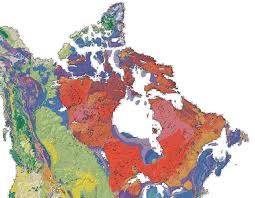
My final observation is about the Canadian Shield.  This is big slab of rock laid down between 200 and 500 million years ago and which covers about one-half of Canada.  It's shown in red in the picture.  This geologic feature has influenced the settlement of Canada.  The soil gets thinner and thinner on the Shield as you go North.  Coupled with the shortened growing season, agriculture was a non-starter.  Settlement of the land on the Shield was almost non-existent.  The area around Lake Ontario is one of the few places where an ancient large ocean laid down enough sediment to become rich soil.  And, lo and behold, that's where people settled.  It's no surprise that 20% of the Canadian population (of only 35 million) live in the rich soil crescent around Lake Ontario.  I finally understood the impact of the Canadian Shield when we rolled off of it - suddenly, and I mean suddenly, the prairies stretched out before us.  No more rocks, just rich black soil covered with grain.  I felt transported as if somehow, I was back in West Texas.  We could see Winnipeg, Manitoba, from 60 miles, excuse me, 100 kilometers away.  As of today, we've driven almost two complete days on this marvelous prairie.  I didn't even realize I was homesick.    


Saturday, August 1, 2015

A Smattering of Art

By this point in the trip we've experienced the best art the Canadians have to offer. We've been to the the Art Gallery of Nova Scotia; The Rooms Museum in St. John's, Newfoundland; the Quebec Fine Arts Museum; The National Gallery in Ottawa; and the Art Gallery of Ontario.  We saw two specialized museums in Toronto:  The Aga Khan Museum of Islamic Art as well as the Gardiner Museum of Ceramics.  Some have presented themselves in magnificent buildings which enhanced the whole experience.

The Aga Khan Museum, Toronto

"The Rooms", St. John's, Newfoundland

National Gallery in Ottawa
The Rooms in St. John's wins hands down for its presentation scheme.  They mixed both art and artifacts in their 'rooms' and floors.  It was a very effective presentation.
A whaling exhibition at 'The Rooms'
The Aga Khan was a recommendation by the neighbors at the terrible house we rented in Toronto.  I won't go into what a disaster the place was, but every experience has something good, and the good thing which came out of that rental was we met the next door neighbors.  Sheila and Eugene were lovely people who turned out to be artists and in Eugene's case, a marvelous musician - a banjo player!  He also plays the accordion. They both have been painters, and they are currently collaborating on mosaics which are large decorative pieces suitable for outdoor display.

They suggested the Aga Khan, and we went.  I know zippo about Islamic art, and this museum was both beautiful and instructive.  This was one of the many unique (to me) items in the museum.  This is a page of the 'Blue Koran' - the Koran written in gold leaf on dyed blue parchment in 1000 CE.  I learned quite a bit about Islamic art patterns here.  We also saw a wonderful exhibition about Near Eastern carpets in 17th century European paintings.  They showed the painting and the carpet portrayed - side by side.


All over Canada, we discovered the "Group of Seven" as well as Emily Carr, and Inuit art.  Those three groups alone made our museum time worthwhile.  First, the Group of Seven is just that:  Seven Canadian artists who were all friends, all painters, and who formed a loose association somewhat like the Impressionists did in the 1880's.  This group's time frame is post-impressionist and right at the beginning of modern art. They painted from the end of World War I forward with some of them painted for more than 40 years.  They focused their art on Canadian landscape painting.

We actually took a train tour into a remote area of Canada outside of Sault Ste. Marie.  In the 1920's Lauren Harris, one of the seven, actually rented a railroad car, had it delivered via train to the Agawa Canyon area and proceeded to paint.  His friends (others of the 'seven') were so enthralled with the paintings he produced, they followed him up and stayed in railroad cars for the next few summers, all painting and hanging out together. Their works are often grouped together in the museums, and each Canadian museum owns some of their paintings.  Here's my favorite Harris painting.  He actually went to the Arctic to paint icebergs, and this is what he saw.


Emily Carr is an artist who should have been part of the 'seven', but wasn't due to her location (Pacific Northwest) as well as her sex and her age.  She was older than the seven, and her paintings prior to meeting them were all about preservation of the art of the First People of the Pacific coast.  She painted the desolation of the native villages which had been ravaged by small pox in the 1860's, subsequently abandoned because sometimes the entire village died, and then looted in the 1880's by Europeans.  It is an old story.  In the early 1900s Carr was trying to call attention to the degradation of the Pacific coast native tribes.  In our opinion, her strongest work is her later work after she came in contact with the 'seven'.  She painted this in 1940.
I also fell in love with Inuit art.  Did you know a higher percentage of Inuits are artists than any other culture in the world?  They generally work in traditional materials - stone, ivory, or bone, but their contemporary works often have a whimsical touch.  


We also discovered two modern iconic Canadian artists:  Alexander Colville who painted post WWII up until 2012 was that rare artist:  famous in his own lifetime.  We were fortunate to see an entire exhibition of his work.  He bucked the trends of his time which were non-representational.  He painted uber realistically, but as with this painting, is about everything except what the picture actually is.  His wife was his model for the entire life of their 60+ year marriage.  She was less than comfortable with the nude paintings especially when displayed, but she was more uncomfortable with another woman being painted in the nude by her husband!


Christopher Pratt paints Newfoundland.  He's their painter emeritus.  At age 80, he's still criss-crossing Newfoundland in a Range Rover scribbling in notebooks about where he is, what he is seeing, and even what he had for lunch!  Then, he paints.  We saw an entire exhibition of his work, but I couldn't photograph it, so I snitched an image from Google. 


We actually saw this one.  It's called "Beyond Cities and Into the Real".  Pretty much outlines his entire painting philosophy as well as his fellow Newfoundlanders.

In Nova Scotia, I found a primitive artist who tickled me.  I like primitive art.  This is the type of art which comes from the souls of artists who are usually not formally trained.  The guy I saw in Nova Scotia is called Joe Norris.  Here's the piece that caught my interest.  It's a 1930's vanity repurposed as a piece of art.

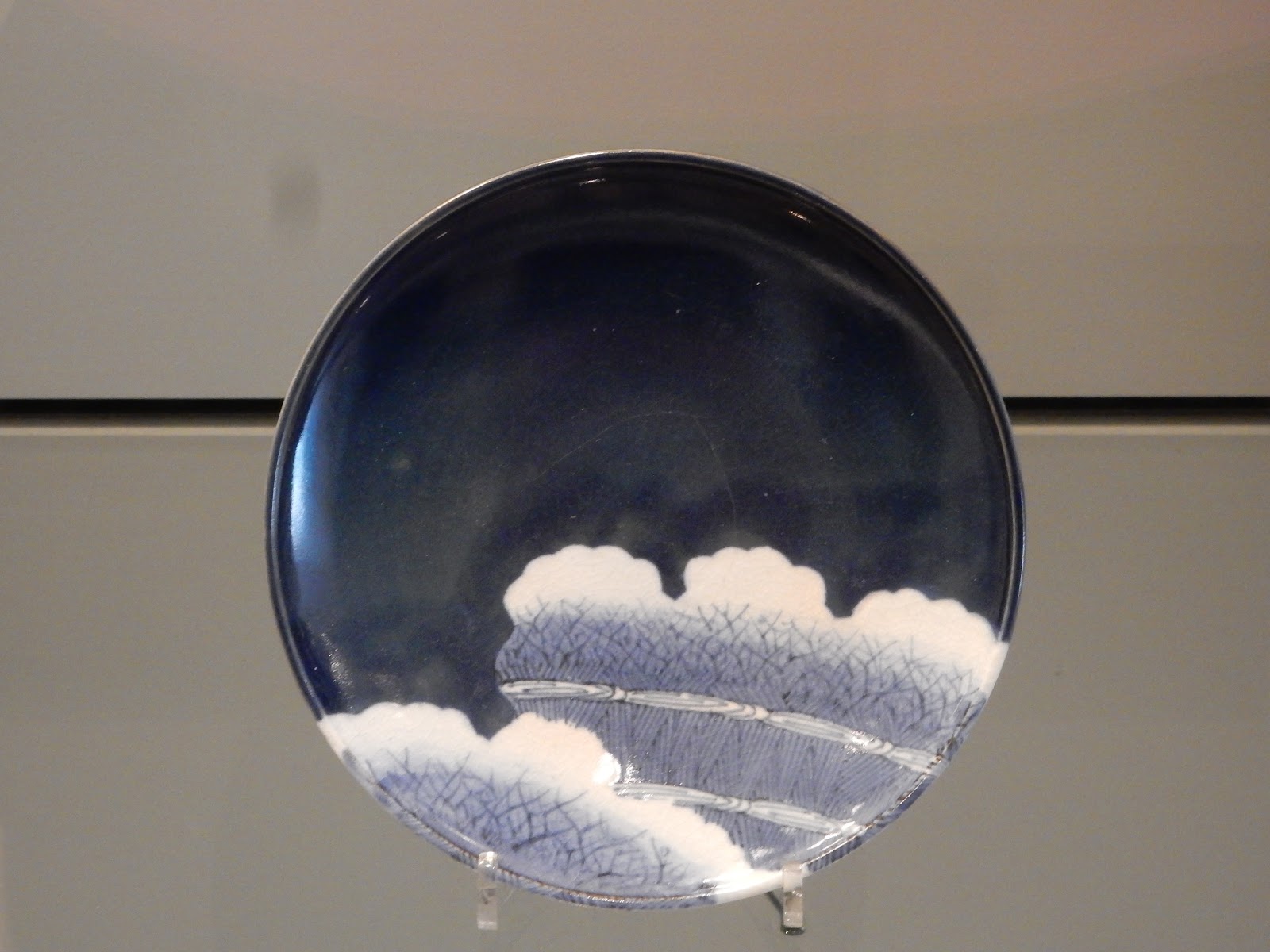
The Gardiner Museum in Toronto was right in my sweet spot - ceramics (AKA pottery).  A Toronto couple went crazy and within a 10 year period put together a world class collection which they then gave to the city along with a museum to house it in and the money to keep it up.  I loved the Japanese section as well as the Contemporary section of this museum.   Here are two of my favorite pieces.
 
This piece is Japanese porcelain circa 1670, and it's called 'Banded Hedge'. 

 My favorite contemporary piece is as much about the "empty space as it is about the ceramics". That's a direct quote from the artist. (Can you see the children?)  This takes amazing wheel control as well as an aesthetic sense, and isn't that art at its best?


The unexpected art of the trip was religious.  Those Roman Catholics in Quebec built some really nice churches.  Some were so special they have been designated 'basilicas' by the Pope.  Here's the altar area of the Notre Dame Basilica of Upper Quebec City


I also have a soft spot for stained glass windows, especially those of the Nativity.  I mean, who doesn't like Christmas?  

Best outdoor art goes, hands down, to Quebec City.  They had the best statues and the best mural I've seen this trip.  Here's a history of Quebec City in a nutshell, well, actually, in a wall.

I especially like Champlain (guy in front and center) - founder of Quebec City, who left behind no picture of himself, so the City just made up a likeness - and that's officially Champlain.  Some of the most influential people in Quebec City were the Ursuline nuns in the upper right window.  They came to Quebec in the 1680's.  The two guys on the balcony are the two Quebecians who were instrumental in crafting the Confederation of Canada in 1867 - joining of all the provinces into one country.  This magnificent piece is painted in the tromp 'de oeil style - meaning it looks 3D on the side of a five story building in Lower Old Quebec.  

The Ursuline Convent/Church in Quebec City had one of my favorite exhibits - embroidery.  Apparently, the 'mother convent' in France sent over to Quebec City in the early 1700's a woman whose family were master embroiderers in Paris.  She became a nun, and drawing on the skills taught her by her family, she ran an embroidery workshop for the Quebec City Convent for over 40 years.  The exhibit was a display of the religious coverings for altars, priests, etc. she masterminded and then supervised the crafting of.  Naturally, they wouldn't let me photo any of it.

Those who really know me realize I could go on and on and on.  And, yes, I have a zillion pictures of the art I've seen across Canada. I decided to go with the smattering approach in the blog, so no one would be bored witless by lots and lots of pictures of pictures, and statues, and sculptures, and ceramics, and decorative arts, and, and, and....  I didn't even mention the 'lesser' museums we saw everywhere including the Sault Ste. Marie Art Museum which is 40 years old and proudly displaying the highlights of what they've bought over the last 40 years.  Now, that was interesting.  My favorite piece from that museum is by an unknown artist


Finally, I'll leave you with a piece of outdoor art, well, it's outdoors at least.  It's the BIG NICKEL in Sudbury, Ontario, the center of the nickel industry of North America, if not the world.  Not sure this is art, but it's sure distinctive, and I wanted to see it!


Sunday, July 26, 2015

The Peculiarities of Canadians

At this point in the Great Canadian Adventure, we have covered quite a bit of ground. So far we've motored from Arizona to New England, and from New England to New Brunswick, and from New Brunswick to Nova Scotia.  We ferried to and from Newfoundland and lolled around the Gaspe peninsula.  I managed not to be seasick on a single ferry or boat (there have been five, so far), and Drake assisted a deer in committing suicide.

We struggled across Quebec doing charades.  Doing the chicken dance will always get you something you recognize to eat.  As we progressed across French Canada, I got bolder and began subjecting the poor French Canadiens to my badly pronounced French.  I discovered I can READ French signs, but no one could understand me when I spoke the actual words.  I might as well have been speaking Spanish.  Funnily enough, my limited Spanish would creep in when I would try to speak French -  "Bluet, por favor."  No wonder they got these puzzled looks on their faces when I opened my mouth. It took five people with lots of consultation to help us order a fast food meal one afternoon.

Now we've found the bulk of the Canadian population in Ontario.  Did you know there are only 35 million Canadians?  That's fewer than the State of California.  Twenty percent of them live on the north shore crescent of Lake Ontario in high rises.  Having covered this much Canadian ground, we've noticed a few things:

1)  All Canadians agree the hardest people to understand when they talk are Newfoundlanders.  I absolutely agree.  Standing in a Newfoundland bathroom washing my hands, I was easedropping on two ladies standing next to me.  I might as well have saved my ears - didn't understand a single word they said, and yes, they were speaking English, at least the Newfoundland version.

2)  The fastest talkers are the people in Toronto - they speak very close to the speed of light.  I find myself repeating what I THINK I've heard.  

3)  All Canadians, whether French or not, like 'poutine'.  These are saltless French fries, covered in salty brown gravy and sprinkled with cheese curds.  NOT yummy looking, and completely devoid of any nutritional value.  No one understands why we don't want to eat them.

4)  French Canadiens are ice phobic.  I was in a restaurant in Levis', major town in Quebec, and I ordered a ginger ale, the 7-up/Sprite substitute of Canada.  The waiter brought the can and a straw.  When I asked for a glass of ice, he explained the restaurant had no ice.  No ice?  In a sit down restaurant?    Then a couple of days later, I was in a motel and went looking for the ice machine.  What I found was the manager who, instead of directly me to the ice machine, handed me what looked like a 6" x 12" piece of bubble wrap - at least they were large bubbles - and this was the ice offered.  Bubble wrap ice.  I mean these places have electricity and everything; they just don't have ice.

5)  My arithmetic skills are absolutely first rate at this point - figuring what the temperature is, how many miles we have to drive, what the gallon price of the gas is, and translating the speed limits.  We've discovered the exchange rate between American Dollars and Canadian Dollars is negated by the Canadian taxes - they run about 20% (or more) on EVERYTHING.

6)  I don't even laugh anymore when offered loonies and toonies ($1 and $2 coins).

7)  The Dollar Store is the Dollarama, and those green and yellow signs are everywhere.

8)  In French Canada you use the Toillete.  In English Canada you use the Washroom.  In the USA, you just go to the bathroom.

9)  It has been a relief to discover Americans do not have tackiness cornered.  If you moved 1000 feet from Niagara Falls, it was a carnival.  All it lacked was the girlie show. Crammed together was:  the wax museum, the mini golf course, amusement rides, the souvenir shops, ice cream stores, fast food joints, and Ripley's Believe it or Not, just to name SOME of the attractions on one block.

10)  I knew Canadians had notorious sweet tooths.  They eat about twice as much ice cream (per person) as Americans.  And, they're not picky - they eat bad ice cream. Just as long as it's sweet; that's all that's required.  What I didn't expect is everything else being loaded with sugar.  We are certain there's a 'Canadian' formula for Heinz ketchup and adult cereals - they are sweeter than all get out.  Everyone offers 'the best plum sauce' as a condiment - think gelatinous sugar syrup.  Most Canadians drink 3 sugars and 2 creams in their coffee.

11) Most real Canadians get their sugar fix at 'Tim's' AKA Tim Horton's.  This chain is not like Dunkin' Donuts and it's not McDonald's, but it's everywhere. There are breakfast food sandwiches, a pastry case, with lots of yummy treats as well as 'Tim Bits' (donut holes in about 10 varieties).  There are hot sandwiches. The coffee is outstanding.  These places are like the local diners of each neighborhood, and every age group eats here - regularly.  I must confess:  We are addicted when on the road. "Yes, yes, there's a Tim's just ahead!"  I'll be coming back to the States with a caffeine jones.

12) Credit card slots at the gas stations are backwards.

13)  Every business has a portable credit card chip reader.  Credit cards in Canada have a pin number associated with them, so the waitress, sales clerk, convenience store clerk, etc. whips out a handheld device when you make a purchase, then you insert your credit card into the machine, punch in your pin number, and Voila!  done.  Well, except for us....we have to 'sign', but your credit card never leaves your hand.

14)  Grocery store rewards cards are only good for 'air miles'.  Really.  You get so many miles per grocery purchase.

Hardly surprising air miles would be so popular - we'll be traveling 5867 kilometers between St John's, Newfoundland and Banff, Alberta.  Let's see....that's the same as crossing Texas from Orange to El Paso 4.5 times.  Piece of cake, ey?    

Friday, July 17, 2015

We Made Our Escape!

I'm pretty sure I just escaped from the Confederacy.  In the case of Canada, the Confederacy is called 'Quebec'.  It's going to be a struggle to express the level of rising frustration both Drake and I have experienced over the past two weeks.  We've spent this time in a place where the people consider themselves simultaneously to be victims and also superior.  Last time I checked, Canada was an English speaking country.  It became one in 1760 when the English militarily kicked the French government out of North America.  They graciously allowed the French Canadiens. who were living in Quebec to stay, to continue speaking French, to continue to be Catholic, and to run their legal affairs as if nothing much had changed.  Big mistake.  Really big mistake. Note to self:  No good deed goes unpunished.

Fast forward 255 years and visit Quebec today.  The residents behave as if they are not part of the rest of the country.  They stubbornly cling to outmoded, outdated ways of thinking in the 21st century, and they are proud of it!  They expect the rest of the country to be bilingual and accommodating to the French language, but this consideration is certainly not reciprocated.  The Quebec provincial government is uber protective of fostering the use of French language and only the French language inside the province and especially in the schools.  English is 'nominally' taught in French schools, but our experience has been almost none of the young people we have encountered here can speak English. The older people who learned English before the Draconian 'French only laws' went into place speak rusty English.  Why is this a problem?

First, it's isolating.  If you are a 22 year old Quebecian who has gone through the school system and NOT learned English, where can you go?  France?  You certainly can't find a job in the rest of Canada - life there is in the English language.  All of Canada, with the exception of Newfoundland/Laborador because of their oil and gas production, is suffering from lack labor productivity.  Labor productivity in Canada is one-half of that in the United States.  Quebec has certainly led the way in swirling red tape and 'rules' not only around the school system, but also around their labor force.  Even without the language barrier, it's very, very difficult for the skilled work force of Quebec to move between the provinces.  While the states in the USA have different certifications and state tests for certain professions, there is very little which keeps most of the United States work force from being mobile.

Surprisingly, after 250 years, there's still a sense here among the people of having been 'conquered'. They still think they are victims.  Their attitude toward the rest of the Canada is: 'You defeated us, but we aren't taking it laying down, and you can't make us become a part of YOU! (English Canada).   If you do, we'll secede from the country.' It's that attitude which reminds me of the Southerners after the Civil War.  After the loss of that war, the white Southern upper class glorified the Confederacy, cemented institutional racism in place, romanticized the entire war along with their roles in it, and set their region back 150 years.

That mentality is exactly what has happened in Quebec since the 1970's.  It's an ingrown society from top to bottom being governed by the French first, French only, French forever being institutionalized by the separatist leaning government.   It seems stagnant here, and I can only assume it's hard for new ideas to percolate - and if they aren't in French, they are instantly unacceptable.  Add to the hidebound attitudes an overbearing Catholic church which is only slightly separated from the state and which controlled the culture and mores.  About 45 years ago, the Catholic Church had this province in an iron death grip, and even after the power Catholicism wielded has faded, there still resentment on both sides.  

There's always a certain level of frustration living our lifestyle - always moving in someplace or moving out.  Always getting lost or having to retrace our steps because we 'missed' the crucial turn.  We are always looking for good gas, supermarkets, post offices, and car washes - to name a few of the mundane.  The exotic is often even more difficult to find.  Add French signage to these problems, and it's easy to see my steaming gasket.  I've only blown up once, and it was over something minor.  My temper tantrum was representative of the problems we've encountered struggling to find places, and running headlong into 17th and even 16th century thinking. I've felt like I've been constantly seething with the frustration and anger of having to put up with it.

Yes, this place is beautiful.  Yes, there's some amazing architecture.  Yes, the food is tasty, but in my opinion, it's not worth the constant irritation.  That said - you can judge the pictures for yourself.

https://goo.gl/photos/J1xnFufyPJ3xLEiU6

https://goo.gl/photos/ozVj1YLnU3AioB8E8


Saturday, July 11, 2015

Gaspesie

For the geographically impaired, (of which I counted myself until we started traveling around), the Gaspesie is a peninsula of Quebec with the Atlantic Ocean on one side, and the St. Lawrence River on the other.  In actuality, it's a trip into rural France.  The only real highway hugs the coastline and goes through a seemingly endless series of small, small towns (usually with populations under 1000, and often under 500).  Each town is dominated by its Catholic church complete with gigantic steeple which towers
over the town and can been seen for miles.  Nobody really speaks English; however, with lots of pointing and charades we managed to eat.  It's amazing how much French I can understand now - well, reading it - can't understand a word beyond Bonjour when these folks talk.  We came up here to see two things:  Forillion National Park and the Sanguenay Fjord.  One was wonderful (the park) and the other a disappointment (the fjord).

As we drove through, one of my favorite things about the towns of the Gaspesie is the fanatical level of neatness, cleanliness, and lovely decoration of all the homes and buildings.  I've also become a devotee of the Halte Municipal.
Those are each town's public restroom facilities, usually little wooden buildings sitting on a lawn overlooking the ocean/St. Lawrence, usually with newly painted picnic tables.  These are not crappy, bug ridden, dirty unkempt pit toilet facilities, but rather just the opposite - always clean, usually with some type of flowers or other decoration sitting on the sink area, clean flush toilets, and always with soap and paper towels.  By the second usage, I was in love.

This is the one we hiked UP
Another big surprise was how mountainous this area is.  It's not the Rocky Mountains, but rather very big hills, maybe 350 meters.  (That's around 1000 feet for you Yankees.)  I struggled up while Drake hiked to the top of one of these tall hills.  The entire center of the peninsula is a series of one big national park (Forllion) and a series of smaller provincial parks.


Yes, I'm still red as a beet from the climb, but I made it         

And here's what we saw; so worth the effort

We also managed to picnic after the big uphill hike, and when we looked up from our table, I was in awe how far up I'd hiked.  If you look closely, you can see the observation tower on top of the cliff - I WAS THERE!  Aren't you impressed?  Well, I was.

If you're a fisherman, this place would be heaven since the numerous rivers with their snaking bends around mountains/hills followed by rippling rapids are loved by salmon and their catchers alike.  In one park, you could 'rent' your numbered spot with a little trail leading to a spot on a river to fish.  There were 65 sites just along the main roadway.

Another myth fell by the wayside in the Gaspesie. We can also no longer believe in the 'moose conspiracy'.  For more than fifteen years, we've been positive there were no moose either in New England or in Canada.  Our experience has always been some planted stranger saying, "Oh, there's a moose just around the bend of the trail", or just up the river, or grazing in the next field, etc.  We were sure there were people at a distance walking on all fours in moose suits as well as those walking around upright stamping moose tracks attached to sticks for the tourists to find.  We are now willing to admit we may have been wrong about the conspiracy.  As we rounded a bend in Forillion Park, a cluster of people were gathered looking at SOMETHING.  (We learned in Yellowstone when you see a cluster, it means some animal has been spotted.)  Quickly pulling to a stop, what did we find but this:  
Yes, it's a moose, and boy oh boy, these are BIG animals - this was was size of a large draft horse.  Now, it's easy to understand all the moose warning signs as well as actual 8 foot high fences along some portions of the Canadian highways.    If you hit one of these guys, it could easily be curtains for both the moose and the people and too often is.  Speaking of which, Drake has become a Bambi killer.  Instead of a moose, a very young deer, hardly older than a fawn because it was only the size of a large dog, jumped out of the brush on the side of the road and directly into the right front bumper of our car.  I was reading a guide book at the time, and all I heard was a BIG THUMP.  By the time Drake got stopped, checked the damage (minimal, thank heaven), and turned around so I COULD TAKE A PICTURE OF THE DEAD DEER, the deer was long gone.  We never did find it, but I'm sure it's dead somewhere back in the heavy brush.  I was so grateful I didn't have to record for posterity, Drake's 'kill'.  There's no way it could have survived.  As Drake put it, "That deer was committing suicide via car since it literally jumped in front of me.  There was no way I could react fast enough to avoid it".  We were extremely lucky.  Nothing mechanical was damaged - just a fog light and the window washer bottle.

The most famous landmark of the Gaspesie is the Perce' Rock.  We had a very enjoyable evening sitting out on our 'patio' in Adirondack chairs drinking a bottle of Pinot Noir recovering from our dead deer day and speculating what size boat could go through the hole.  The question remains unanswered since we didn't see ANY boat try it.

Our final experience in Gaspesie was the Jardin de Doris at Matane.  Yes, that's the Gardens of Doris, although I never found out who Doris was or is.  She does have a fab garden which is even more awesome when you consider the climate.  This place was seriously gorgeous, and they even had a cactus garden - which get's 'taken in' during the winter.  My favorites in this garden were the peonies which were just starting to bloom.  

Leaving Gaspesie, we took ANOTHER ferry from Matane to arrive on the Quebec City side of the St. Lawrence River.  The St. Lawrence is the Canadian equivalent of the Mississippi River, so big and so economically important.  It's time to see the urban portion of New France and the place where the British finally defeated the French to take control of North America.  

If you want to see more of Gaspesie or more of Jardin de Doris, click on the pix!

  
 https://goo.gl/photos/wG9LG1acRXQYVwFe6  (Jardin de Doris)


Tuesday, June 30, 2015

Bring on the Flowers

The Atlantic Maritimes are a flower lover's dream land.  There are several cultivated Botanical Gardens.  The one that won my heart was a small, lovely garden beside St. Mary's Roman Catholic Church in Cow Head, Newfoundland.
The main cultivated area of the garden was the size of a Hurst, Texas front yard, and it was utterly charming. This little gem was so obviously the pride and joy of some lovely ladies with green thumbs.  I especially liked the names of the flowers were hand painted on multi-million year old cobbles.  And, as an added touch, they had a peace and meditation area which just happened to overlook the ocean!

There was the Public Gardens of Halifax - very much a gathering space for the City akin to the Botanical Gardens in Fort Worth complete with a band stand and summer concerts. Then, there was the MUN (Memorial University of Newfoundland) Botanical Garden - a destination almost never found by tourists.  It was a big place, but only a small patch was 'cultivated', and the rest was natural covered in a network of hiking trails - again, so accessible to the public.

Today I was on a Canadian Public Broadcasting radio program - live.  Me, the possessor of the 'Black Thumb', who planted a garden in silk flowers, was interviewed on a Garden Show this morning.  I think I was a novelty.  I was snapping pictures at the MUN as usual, and this woman approached me.  It turns out she was producing this garden show program which was being broadcast at the MUN today.  She ignored Drake totally, and zeroed right in on me asking if I would do an interview and ask a gardening question.  Well... who could resist?  Not me, the complete extrovert!  I was very charming and introduced myself, where I was from, etc.  He brightened right up when I pronounced 'Newfoundland' correctly.  (Here's how I learned:  "I UNDERSTAND NEWFUNLAND" - see, it rhymes with 'understand'.)  Ok, so then I asked him a softball question:  "Why are there no roses here?"  (Answer:  Too wet, too short of a season.)  He told me they get 60" of rain each year in St. John's, and I quipped back,  "Now, I realize why there are no cactus."  It was fun.  I think they should have given me a prize, though.

There's one more Atlantic Martime flower treat before we leave the region - the New Brunswick lupines.  When we get off the ferry on Friday morning, I'm expecting expecting the areas around Moncton to be covered in them similar to how the bluebonnnets blanket the Metroplex in Texas.  I've seen a few, so far, but there are supposed to be fields and fields.  Keep those fingers crossed.

So, I've been snapping flower, flowers, flowers everywhere, and I love this new camera.  You can see the improvement over my last camera.  So, here are the flowers.
I'm showing two links, the same pictures, so hopefully, one will work

https://plus.google.com/photos/115478608971584948192/albums/6166344978335473857?authkey=CMzqkfnDop-5kwE

or

https://goo.gl/photos/RnwqfYfTGiUHWLHv7


Who Doesn't Like Puffins?

I like birds.

I like bird colorations.


I like the challenge of taking pictures of birds with a camera which will fit in my pocket.


I'm even willing to get on a boat* to go look at birds.
*(Willingly boating by the Seasick Queen is the mark of exactly how serious I am about wanting to see birds. )

I don't like being thwarted* in my quest to see birds.
(Thus, I have held a fifteen year grudge against Drake and Sarah who outvoted me on our last visit to the Atlantic Maritimes when the question was whales or puffins?)

I finally got my puffins, and some other unlooked for birding benefits in our last boat outing* in Newfoundland.
(Well, last boat outing except for the upcoming 15 hour ferry ride back to the mainland.  Shudder.)

Click on the below link to see real, live puffins and murres with a few other birds thrown in.

https://goo.gl/photos/mtg1B2zAQAyoujZc6