Saturday, June 6, 2020

New York City in a Time of Protest

            Living in New York City, people expect you to be a complete expert on everything happening in this city.  Well, considering it’s the center of the pandemic, and also, is a very visible part of the massive protests going on for racial equality in policing, people are sending me emails, texts, and phone calls worrying if we are ‘safe’ and asking what’s happening.  Here are my observations as to what is happening in Brooklyn.  To put things in context, I live within a mile of the Barclay Center, a focal point of some of the largest protests in Brooklyn.    

            On top of lock down with people in close living quarters, and the stress of rising unemployment as a result of the pandemic, here come the protests over systemic racial injustice in policing procedures.  Most New Yorkers are torn as to the protests.  There's widespread support.  Drake and I can feel an air of excitement and commitment on the streets.  At the same time, people are fearful about the virus resurging, and I think there will be a resurgence because, while some people are wearing masks during the protests, the six foot social distancing which is to pair with the masks isn't being observed.  The protesters are mostly young (20 - 30), and many of them feel invincible.  Others are the workers who have been exposing themselves daily during this entire pandemic crisis.  And, others feel the cause is too important to stay home and be silent.  Finally, most New Yorkers live a large portion of their lives in public:  the parks, the neighborhood gardens, the bars, and the restaurants.  You know how people are - they will only sacrifice so much for so long.  And, they are just tired of being pent up since their places for going out are all closed.  The protests are giving people a place to be 'out'.  

I am afraid the infection rate among the black and minority populations is going to increase even more as a result of the protests.  They live proportionately in more crowded housing, spend more time on public transit, have lesser health care, and have ‘essential’ jobs which have put them out in public or on factory floors when everyone else was sheltering in place.  As a result, the African-American and Latino communities are suffering a greater infection/death rate.  If you want the numbers, and these are facts, not opinions, check out this website

https://www.npr.org/sections/health-shots/2020/05/30/865413079/what-do-coronavirus-racial-disparities-look-like-state-by-state

Case in point that’s close to home:  Sarah and Jay went to a protest (on the fringes) staying more than six feet away from people.  The protest was in front of a church at the end of their block this past week.  They were carrying the 4’x6’ foot sign they have hanging in front of their apartment which says, END WHITE SILENCE.  They took Cedric in his stroller.  This is an example of what I'm talking about.  I had to laugh when Sarah said, "I've never been to the start of a protest before" since it brought back memories for me.  They did immediately leave as the crowd swelled, so maybe, maybe they limited their virus exposure, BUT they do feel strongly about this issue.  I respect that.  Protest is a decision of the conscience.   

I remember the protests against the Vietnam war at ultra-conservative Oklahoma University in which I participated.   It was at these protests where I first encountered the buzz swirling around an energized group of people focused together for a cause.  I also marched in a Black Power protest when I was 20.  I took Black History in the United States as a semester long 3 hour course.  I was the only white person in the room, so I actually met black people for the first time in my life.  I grew up in a segregated town.  The revelations from the history class as well as my new acquaintances invitation led me to join the Black Power protest – this was a young peoples’ protest against voter suppression, as well as job and housing discrimination.  

I wish I was out protesting today, but with the rate of viral infections in my age group that would be tantamount to suicide.  Having worked with many black colleagues as well as my final teaching job being at the 'black high school' - yes, Fort Worth was like Tulsa, with racial groups segregated by location, I can tell you I've been talking and thinking about the inequality of policing  for more than 20 years.  I heard women (other teachers) talking about how to try and protect their sons from being arrested, beaten and even killed by the police for simply driving a car in the wrong neighborhood .  They talked about teaching strategies to their children when seeing a policeman.  And, it wasn't 'the police are our friends'.  These were educated, middle class people of color - not poor, indigent, drug using low lives.  I heard my students, particularly the boys, talk about their own fears or strut around (as only a 15 year old boy with new muscles can) as to what they would do if confronted by 'cops'.  Too many stories.  Too many pinched faces of worried women for me to discount the reality of systemic police violence against blacks.

Once again, we are confronting the great American problem:  Race.  We surely do love our pecking orders, and for 300 years, the color of your skin has been one of the pecking order yardsticks in this country.  Hard to overcome that.  Some commentators are seeing these protests as the tip of a sea change in the United States.  They could represent a handing off of power to the next generation – the Millennials, whose numbers are greater than the Baby Boomers.  The Millennials have lived through the financial crisis, are living through the global warming crisis, and the corona virus pandemic.  They perceive of the Boomers and the Silent Generation as ineffectual, and unable to even address either global warming or income inequality.  It's possible these protests are quickly morphing into becoming the new generation flexing their will.  The ballot box in November will tell the tale all across America.

In New York City the vast majority of the protests have been peaceful, and are becoming more and more multi-racial.   In the afternoon (around 5:30) you can see young people (anybody under 35 to my 70 year old eyes!) heading to a protest, wearing a mask, carrying a sign, oh, and a water bottle.  The conservative media are framing the protests as if they were justifications for unlawful looting.  That’s so far from the reality.   Prior to dark - overwhelmingly peaceful in NY.  After curfew (basically at dark) which the Mayor established to draw a line between lawful gatherings and unlawful behavior, police have been much less tolerant toward protesters, and they have exhibited zero tolerance for any type of violence.    

The problem in New York is the same as in other police departments around the country.  There's a legally sanctioned lack of accountability and transparency to the public on the part of the police when misconduct is involved.  (In New York the statute that protects habitually delinquent policemen from accountability is called 50-a.  You can google it.)  When everyone starts at a level of distrust, it's very easy for any given situation to get out of hand.  That said, the Bronx, Brooklyn and Manhattan District Attorneys do not plan to prosecute protesters for breaking the curfew.  If you loot or threaten violence, you will be prosecuted.  In total in 10 days of protests in all of New York City where thousands of people have been out on the streets every evening, there have only been 2000 arrests across the five boroughs - the majority of which fall into the non-violent/non-looter category.    The majority of the police as well as the majority of the protesters have been peaceful.  To suggest otherwise is simply not factual.  I live in a neighborhood that is not white.  I don't feel unsafe.

The true dilemma is where to go from here.  How do you translate the passion for true change into reality?  On Monday, New York City starts re-opening.  On June 23rd there's a statewide primary election.  Hopefully, the passion on the streets will continue onto a path to the ballot box.


Sunday, May 31, 2020

Typing Revolution

Most of you know that I write a hefty number of letters each and every week.  These letters have evolved over the years.  In a thumbnail sketch, I write (1) old people; (2) sick people; (3) young people; (4) relatives; and (5) just because letters.  I average six letters a week.  I usually try to write using a different letter font each week just for the fun of it.  This week I chose the Courier font, and it took me back almost 50 years.  

When I got out of college (May, 1971), the first question asked of any woman was, "How fast can you type?"  Didn't matter if you had a degree or not.  Women were secretaries.  Men may have started in the mail room, but women started in the typing pool.  

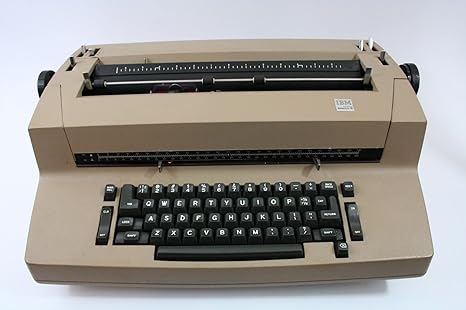
My first real job was at a one man law office, and I got the job because I could type.  The typewriter of choice was the IBM Selectric II.   It cost $620 - equivalency today $3,150 Amazon.com : Selectric II Correcting : Electronics

IBM premiered the first Selectric machine in 1965.  It had 2800 parts, and it took seven years to develop.  It became the best selling typewriter in history capturing 75% of the American typewriter market at its peak.  There were two instantly apparent differences from a regular electric typewriter:  First, there were no keys.  Instead there was the golf ball.  Courier font was the 'default' ball.
IBM SELECTRIC TYPEWRITER Font Ball Head Font Size 12 Courier

Second, if you look closely at the typewriter picture, you can see a little "x" hanging off the end of the space bar - that's the correcting feature.  You could use it to backspace over a typing error and retype.

These were both amazing improvements in the typing world.  Most typewriters using typing keys had a realistic speed of about 50 words per minute while an IBM Selectric could easily be typed at 90 words per minute.  The very first woman I worked with at my tiny law office had been a legal secretary for 40 years, and she could type at a blinding rate of speed on a Selectric.  My all time high was about 70 words per minute on a good day, and I availed myself 100 times more of the correcting feature on the Selectric than the real legal secretary.  Hand in hand with the Selectric typewriter came the small office Xerox machine.  

Prior to both of these machines, in a typical office, everything which needed to be typed was sent to the Typing Pool, and the Typing Pool Supervisor parceled out the work to the typists.  In a law office, everything was typed in triplicate - one original and two carbons.  You loaded one page of stationery, a piece of erasable carbon paper, another piece of stationery, a second piece of erasable carbon paper and a third piece of stationery.  For every typing error, you had to carefully white out your error on the topmost piece of stationery,  erase the error on the other two pieces of stationery, realign the paper and carbon sheets, backspace and type over your error.  Fun times!  You can see why a legal secretary who could type fast and make very few errors was in great demand.  I was not that person.  

With the advent of the IBM Selectric II,  you had one piece of stationery - period.  You could back up and the incorrect letters would magically lift off the page.  Then, you just retyped.  Instead of carbons, you made Xerox copies.  Affordable copy machines were just coming into small offices at the time.  Xeroxing was one of the first of the new electronic words, and it didn't matter what the brand of copy machine your office had - you still Xeroxed.  One of my first 'assignments' beyond typing and answering the phone was to evaluate a half a dozen copy machines  in order for the boss (our one lawyer) to pick one for our office to buy.  

The IBM Selectric II  which premiered in 1973 had an 8000 character memory function making this groundbreaking piece of equipment the first desk top machine with a memory function.  Prior to the IBM Personal Computer which included 'Word', a word processing application which had a cut and paste function, everything was 'typed' on a typewriter.  Keyboarding was a function of key punch operators who used keyboards to type onto paper punch cards - a machine hooked up to a keyboard which literally punched holes into the cards.  These cards with holes were the programs fed into huge room sized computers.

Drake as an early Data Processing Manager in the 1970's, had three groups of people reporting to him:  (1) the people who managed and maintained the hardware - the actual computer in an air conditioned room, sealed to keep dust out, and on a raised floor to let air circulate.  (2)  the programmers who wrote computer programs for office functions and (3) the typing pool and the key punch operator pool.  As he put it,  group (3) was a manager's nightmare.  The typing pool fought with the engineers (his company was a small engineering company) over how long it would take to turn around work, and the key punch operators fought among themselves.  He was thrilled when under a re-organization the third group was whisked out from under him.

This must seem like a 'when I was a kid I had to walk five miles in the snow to school' type memory.  However, I was in my early 20's and starting my working career.  The idea that any manager/engineer/accountant would 'type' anything was unthinkable.  Even into the 1990's, there were specialized people inside companies whose jobs were to manipulate the new desk top electronic machines to produce a finished project proposal with charts, graphs, color, and other embedded bells and whistles.

My dinky little one man law firm was an early adopter of technology.  We had keyboards interfaced with magnetic card readers (initially) which morphed into the 6" floppy disks, which morphed into the 4" floppy disks.  Permanent storage was on a hardware disk about 20" in diameter which had to be manually removed and replaced with another hardware disk to get a 'back up' of our work product.  I don't even remember how much memory these cumbersome disks contained.  

This primitive system cost $50,000 in the late 1970's.  Our lawyer was a figure of ridicule for spending that kind of money.  (That would be about a $250,000 expenditure in today's money.)  It wasn't long before we had the last laugh.  Within a couple of years, lawyers would routinely arrive at our door asking for a 'tour', or a 'presentation', etc. of our equipment.  That quickly became another one of my jobs. 

Document production went from typewriters with stationery and carbon paper (prior to 1973) to IBM Selectric Typewriters routinely paired with Xerox machines, (circa 1975) to desktop computers, (1980s) to handheld computers (2007) That all happened in a timeline of about 35 years.  Furthermore, the rate of change is continuing to accelerate as we move deeper into the Electronic Revolution.  The virus which has upended our lives is pushing the business envelope and due to our smart machines, which allow us to interface on multiple levels, the necessity of the physical work place in 2020 is being questioned in the same way as the necessity of carbon paper in the 1980's.          


Tuesday, May 5, 2020

Crystal Ball Time

Yesterday was the first really nice day.  Correspondingly, there was a visible increase in the number of people on the streets as we walked home from work.  There weren't hordes, and everyone, with the exception of two people, were wearing masks and maintaining a social distance.  There were more children out.  Our 18 month old charge was also 'out' - at the top of the 13 granite steps on his stoop using his large colored chalk pieces.  I think as the late spring finally takes hold, it's going to be harder and harder for people to stay inside.  Oh, and shame on the runners who think they are exempt from wearing a mask as they huff and puff down the sidewalk.

Checking that restlessness is the grim news the limited testing/antibody testing in this city is showing:  There's a 25% infection rate in New York City.   I think this is due to two factors:  The density of the population - lots of people in a small amount of space, and the slowness of the Federal and State governments to grasp the rapidity of the spread of the virus.  Drake thinks with proper handling initially, we would not be in our current state.

I think what we all want to know is what's going to happen in the future.  One set of epidemiologists have three possible scenarios.  None of them is particularly comforting.  Even the rosiest suggests this problem isn't going to be gone quickly. 

What I've been pondering (and Drake too), is what are the take-aways from this pandemic disaster/debacle.  Here's a bullet list of what we've thought about in no particular order:

1)  The gulf between the 'haves' and 'have nots' isn't just something talked about - it's visible.

2)  Maybe teachers will finally get some respect.  Parents are getting an up close and personal experience with teaching and even student management!  It's not so easy, is it?

3)  More people can work 'on-line' than previously thought, and the population could be re-distributed back across the country.  Maybe you can go home again.

4)  Now we know where there's no internet access, and lack of internet is crippling those areas.  Access to technology is critical in a society transitioning into the electronic age.

5)  Is the birth rate going to go up?  Is the divorce rate going to go up?  Will the obesity/diabetic numbers inch up even more?

6)  Close confines breeds domestic violence.

7)  The safety net held together by chewing gum, baling wire and hope is in tatters. 

8)  Is it time for UBI?  (Universal Basic Income).  I didn't even know what this really was until I read an article by Nathan Heller.  The idea goes all the way back to the 17th century, and nobody is really sure if it's a good idea or not!

9)  You can't spend years gutting basic scientific research and development and not expect to have that shortsightedness bite you on the ass.

10)  Nobody knows how many unemployed there really are as a result of the pandemic, and how many there will be as the economy totters toward recovery. 

11)  The closure of the churches may be the final death knell for some of the major denominations which were already in decline.

12)  If you were in doubt before, you know now major corporations are only out to benefit their shareholders.  They could care less about their workers.  They have been firing them, furloughing them, and cutting off benefits at a time when they are needed most - especially workers at the lowest level jobs.   Very few CEO's or other upper management are really making much of a sacrifice - some are cutting their 'base' salary by a small percentage for a couple of months. 

13)  If you compare the things in common of all live in partners (no matter what legal status), we are getting a crash course in how much intersection we have in a Venn Diagram of our relationship.  [you can google this if you are confused as to what exactly is a Venn Diagram.]

14)  Who knew reading could be so much fun?

15)  Have you been reduced to asking for binge worthy TV shows from friends?

16)  Everything can be bought on line; however, delivery is a different story.

17)  The rituals of weddings and funerals and birthdays mean more than we thought they did

18)  I find myself praying for a 'lite' tornado and hurricane season.

19)  I having a rising frustration level over being able to find facts rather than opinions in the media about this crisis.  I long for Walter Cronkite, Peter Jennings, and Tom Brokaw.  At least I knew what they reported had been fact checked before they told me.

20)  I'm going to value exercise more in the future.

I'm sure I could continue on and on and on with observations about how this virus has affected our lives today, and what the outcomes will be in the future.  I welcome any feedback as to something you think I've missed.

Friday, April 17, 2020

Under Siege

Mostly New Yorkers feel like they are under siege.  They are stuck inside their apartments with little opportunity to 'get out'.  It's hard for the rest of the country to understand the residents of the five boroughs (Manhattan, Brooklyn, Queens, Bronx, & Staten Island) feel the most comfortable in the hustle and bustle.  Watching the street carnival as it passes by is a constant source of entertainment and comment.  Now streets filled with small businesses and usually filled with pedestrians look like this.


People use the parks.  They shop at the outdoor markets.   In good weather New Yorkers eat on tiny tables precariously placed on the sidewalks.  (Everyone can see what you're eating and sometimes even comment on it!)  People in New York congregate in any outdoor space - their back garden of a few hundred feet, the rooftops of their buildings, and even on their front steps.  (Sitting on the front steps is something Cedric already enjoys as he comments on the dogs walking by, the gray squirrel scurrying up a tree, or the birds flying by.) 

New York City is actually made up of some of the smallest towns in America.  Some of these unofficial towns are only a couple of blocks long, and a couple of blocks wide.  You actually know by sight everyone in the neighborhood.  Block parties where the street is closed and the neighbors mingle are common in the summer.  You know the crossing guard at the corner.  You know the dry cleaner, the restauranteur, the guy who owns the corner deli, the corner grocery store clerks, the owner of the $.99 store, and the checkers at the supermarket.  You know the people on the floor of your building or those who live above and below you in your brownstone.  [These were originally one family residences which are now three or four family residences.]  You know your bus drivers, and the delivery people who bring you take out food and groceries.

The supply chain for 10 million people is highly visible.  Each street is always filled with trucks of every size - often double parked as every conceivable object is off loaded and hustled into a small store.  Then, we have the national guys:  postal trucks, FedEx trucks and the UPS guys.  Grocery trucks delivering groceries are also buzzing around the neighborhoods.  Fresh Direct may not be a national  grocery chain, but everyone in New York knows their colorful delivery trucks.  There are ambulances, fire trucks (three different sizes), police cars, garbage trucks and street sweepers.  There are the individual car owners - (All cars in New York are mostly either black or white - don't ask me, I don't know why.)  Usually, there is a lot of frustration vented via the car horn when someone isn't paying close enough attention, or a truck has been double parked too long.

Now, the main noise of New York is people leaning out of their windows at 7pm yelling, cheering, and banging pots and pans.  The 'excuse' for this behavior is to visibly thank the front line responders to this crisis.  Everyone is acutely aware how dangerous it is to be medical person, and the support staff in a medical facility are in real jeopardy.  I think the real purpose of the 7pm exhibition is most New Yorkers miss their neighbors, and it's a way to connect.

Streets are silent.  Car and truck traffic is almost non-existent.  Here's Flatbush Avenue, one of the busiest streets in Brooklyn at 8:00 a.m.  That's prime commute time.

There's one car and a handicap transport bus waiting at the traffic light.  Normally, there would be cars/buses/trucks backed up through the intersection as well as 50 people using the crosswalk on any given morning. 

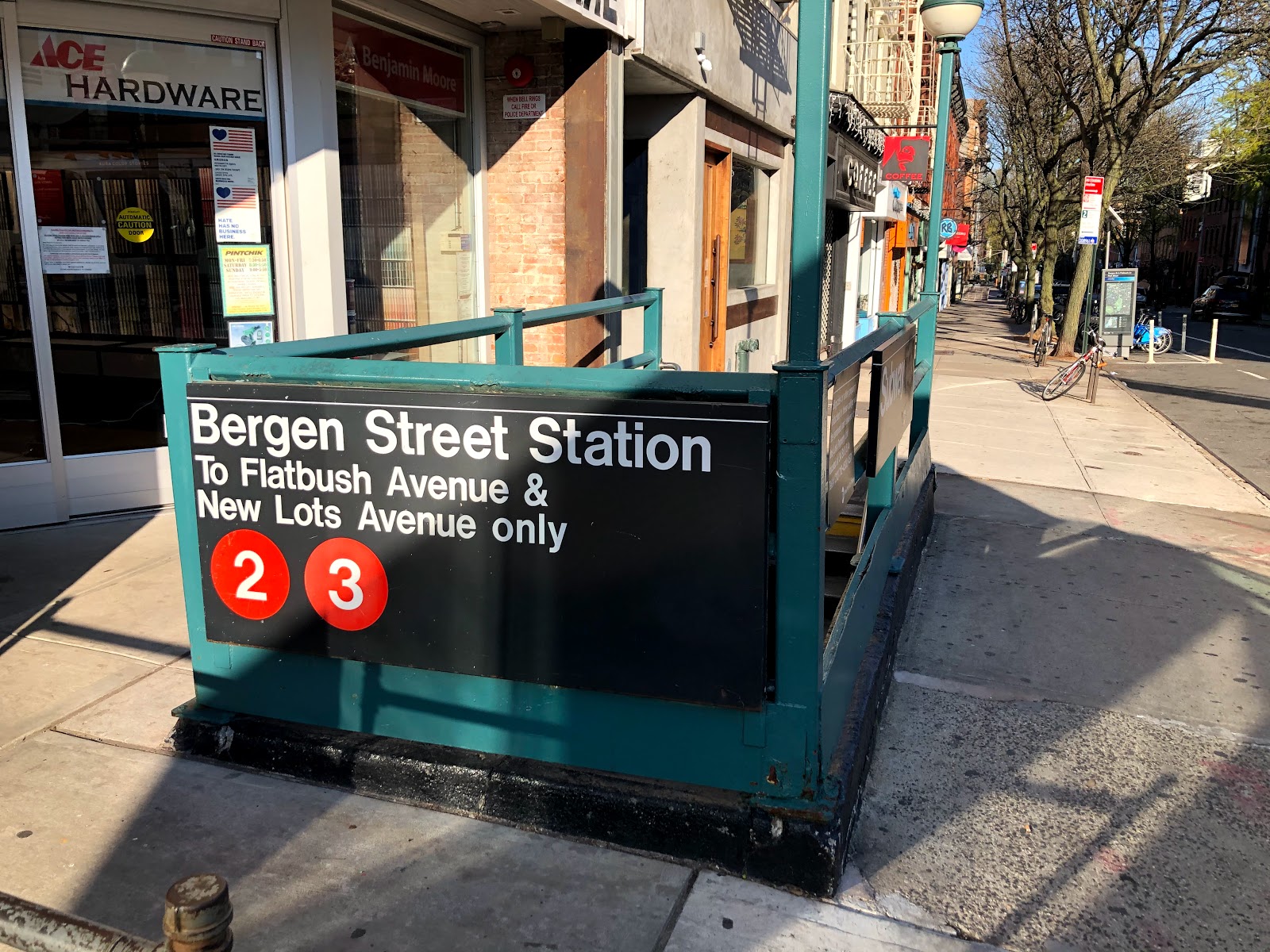
Here's a subway station which would normally have people streaming into it.  It's rare we see even one person coming or going from this subway station.  The bus we normally ride to and from work instead of being standing room only is populated by less than five people, all sitting as far apart as possible gloved and masked.  I'd probably be trying to ride the bus, but it's far too risky.  Our family goal is to stay healthy, so we walk the 2.2 mile roundtrip between our apartments.


This 'Citi-Bike', a bike sharing business with bike racks all over the city, would normally be virtually empty at this time of the day (morning commute) instead of almost full.

Ordinary streets are also deserted.  Here's a street we use to walk to work - it's 90% empty.  (Only the dog walkers are out.  Don't get me started about New York dogs - I'm thinking euthanasia to any dog that uses the street as a toilet.  The dog people insist on taking up ALL the sidewalk.  Drake and I dart into the street to avoid their inconsiderate owners, so we can maintain the 6 foot social distance.  And, today, I saw a St. Bernard mix - oh yeah, such a practical city dog.  Way way too many large dogs suffering in small apartments.  OK - dog rant over.)


Space is such a premium here.  People live in the most minuscule apartments you can imagine.  A generous second bedroom is often 10x8, and it's common to see apartment ads which boast each bedroom having a closet!  We each live in gigantic apartments by NY standards:  1100 square feet.  (By contrast - my Texas house was 2200 square feet, and it was considered on the small side compared to some of the McMansions in Plano.)  Sarah and Jay's first permanent New York apartment - in a new high rise - was 650 square feet.  Their current apartment is actually only three rooms (not counting the one bathroom).  I won't tell you the monthly rentals for these tiny homes. I don't want the top of your head to blow off.

People here have been 'home' in these very small spaces with only a little outdoor time since mid March.  The shelter order has been extended in the city to May 15th.  Now, the few people on the street (like us - essential workers - since we do child care) all wear masks.  I've found it amazing how much compliance there is in the city to these shelter in place measures.  It feels like everyone here is actively doing their part.

There's also a growing sense of 'I don't want it to get the virus' as more and more terrible side effects of having even a relatively mild case are being revealed.  That's certainly our goal.

One small upside has been our opportunity to enjoy the flowers and trees of springtime in New York.  Here's an amazing tree we walk under each day as we head to work.  Sights like this help control our anxiety over so many issues, and reinforce that this too will pass.
 

Sunday, March 22, 2020

What is Exponential and What Does it Have to do With a Kitten Video?

I wrote a fairly mild post about the virus last week.  Brooklyn is a place where the virus is exponentially growing.  If you're not sure what exponential means, think of this phrase:   'That kitten video went viral' - meaning it started with a few people watching, who then sent it to their friends, who sent it to their friends and it just snowballed.)  That's the danger of the coronavirus. 

We keep focusing on the wrong number:  True fact:  Only about 20% of people who get sick will need to be hospitalized.  So if 100 people get the virus, then 20 will need to be hospitalized.  OK - no problem.  However, if we don't know how many people actually have the virus (another true fact), then think about this.  If 10 people in your town/area have been tested and shown to have the virus, the true number of people WITH the virus is much higher.  Harvard Medical School/Mass General Hospital think the number of PEOPLE WHO ACTUALLY HAVE THE VIRUS could be 50 times the number of confirmed cases.  So, instead of 10 people in your town with the virus there could be 500. 

If the virus 'goes viral' over the next few months (like a kitten video), the number of people infected skyrockets by doubling or tripling every day because of social contact, and the true fact that the virus lives for several hours on hard surfaces.  Thus, we have the 'curve' everyone keeps talking about.  SOCIAL DISTANCING HELPS BREAK THE UPWARD CURVE.

If you are still having trouble getting this, think about the penny exercise.  Start with one penny.  Double the number of pennies you save each day. 
Day 1 = 1;
Day 2 = 2;
Day 3 = 4;
Day 4 = 8,
Day 5 = 16
Day 6 = 32
Day 7 = 64
Day 8 = 128
Day 9 = 256
Day 10 = 512 pennies you need to save

Now, let's do it with the virus.  Let's be conservative & say there are 3 times as many cases of people with the virus  in your town:
Day 1 = 10 known cases in your town multiplied x 3 = 30 people who actually have the virus.  (Remember: A big percentage of those 30 will have no symptoms.)  If the number of people with the virus doubles every day this is what happens:

Day 2 = 60 people who actually have the virus
Day 3 = 120
Day 4 = 240
Day 5 = 480
Day 6 =  960
Day 7 = 1920
Day 8 = 3840
Day 9 = 7680
Day 10 = 15,360

If  20% of the Day 10 people with the virus need to go to the hospital, we have 3,072 people who are going to need to be hospitalized in a town that started with 10 known cases less than 2 weeks ago. 
 
Here's another problem:  Hospitals are already 65-95% full.  This leaves even fewer beds for coronavirus patients. What about people who don't have the virus who need a hospital bed? Know somebody who needs an operation?  How about that terrible car crash or accident that happened in every city or town last night?  Know someone with cancer who needs chemo?  Know someone with acute diabetes?  All the normal reasons someone needs a hospital bed or intensive care or a ventilator is going to have their treatment compromised or unavailable.  Some of these people are going to die who under normal circumstances would recover.

Now you know why our family has been practicing social distancing since March 5th.  We don't go anywhere except to walk back and forth between our two apartments.  We give a wide berth to people we pass on the sidewalk.  We Lysol door knobs, switches, toilet handles, etc. in both the apartments right before we 'switch' each day.  Our goal is to help break the curve by coming into contact with as few people as possible.

We wash our hands 20 seconds at a time with soap and water several times a day since we do have food and other supplies delivered to us.  My grocery store that delivers is just around the corner.  When I put away that can of soup (hard surface),  I think,  "Who touched it?"  When Drake uses the laundry in our building, he uses gloves.  We Lysol our door knobs.  I use a stylus to punch the elevator buttons.  I use my shoulder to open the outer doors of our apartment building.  I try to protect our essential workers (like the guy who delivers our groceries) by staying 6 feet away and carrying in our own stuff. 

Now, you're probably thinking, oh those numbers must be false.  Again, think about this:  If you have no symptoms, but you are infected, and you are still out and about, every person you handed something to, and everything you touched has exposed a lot of people to the virus.  Someone an hour later bought the can of soup you picked up, decided against buying, and put back on the grocery shelf.

Social distancing only works if it starts EARLY.

Hand washing is a way of showing concern for yourself and others.

Limit the number of places you go and people you socialize with.

Rise to the occasion.

Wednesday, March 18, 2020

Nothing Travels Faster than Bad News

"Nothing travels faster than the speed of light with the exception of bad news 
which obeys its own special laws."  (Douglas Adams) 

Isn't that just how life has felt for the last few weeks?  If you deal in reality rather than wishful thinking, the bad news would have already been with us for a few months, and it’s going to be bad news for some unforeseen time.  However, you can't change the past no matter how hard you try to turn back time.  Everyone is positive they know who is responsible for the pickle we are in, so I won't infuriate you or allow you to commiserate by stating who I think should be held accountable.

What really matters is how do we go forward?   How should that be?

I've been trying to write this blog for four days.  Each day brings new information.  The 20 somethings who are acting like they are immune or will just get the 'sniffles'?  Well, new data says they are going to be occupying a significant number of our scarce hospital beds, and their cavalier attitude is going to result in exponentially spreading the virus.  Seniors are going to become more isolated, and that isolation will take its emotional and mental toll.  Stresses between family members is magnified.  If we are really trying to be good citizens, we are staying home.  There is certainly going to be more reliance on the internet and the connections between people it can facilitate -both good and bad.  

Will this pandemic crisis work lasting changes in our everyday lives when it subsides?  That always happens with every crisis.  Think about the changes in air travel as a result of 9/11.   Not all changes have to be bad or unpleasant.  Perhaps telecommuting can really take hold and give families more flexibility as to where they live.   

What is the most difficult thing happening to you personally right at this moment?  For me, it's physical - my entire body hurts, and it has nothing to do with the coronavirus.  Yesterday, I was appalled to discover I walked over 10,000 steps.  My feet hurt, my legs ache, and my shoulders are adjusting to carrying a light backpack.  Otherwise, it's nice to be outside when the weather isn't frigid or swelteringly hot. 

As you all know, I'm living in NYC which is trying to flatten the coronavirus curve by taking drastic measures.  I've been quite surprised how calm New Yorkers seem to be.  Most seem to be initially taking 'social distancing' seriously.  Drake and I are walking back and forth between our house and C's house - thus my 8 - 10,000 steps a day.  His parents are working on-line at our house while we are keeping C at his house.  It's a 2 mile round trip.  Until we get a 'shelter in place' edict, this is our plan.

There's already lots of 'delivery' here.  Most people here shop that way for almost everything.  I suspect the delivery services already in place will help us over the crunch.  Buses are almost empty.  I haven't braved the subway or the bus since this started because there's no place to go.  No school, no movies, no bars, no restaurants, no museums, no performances, and worst of all for the NYC economy:  No tourists.  

That's where NYC is going to really feel the pinch.  Tourism is a huge industry here.  All the 19th century factories have been converted to white collar business space or living space.  We don't 'make' anything in New York.  We handle money and credit for the rest of the country, and we show off our entertainment industry, our cultural industry, and our landmarks.  As of today thousands of people have been fired.  These people work in businesses who are doing no business.  So many, in fact, the NYC Unemployment website started crashing yesterday. 

What's so extremely striking is how quiet it is in Brooklyn.  There's little or no commerce happening.  Outside C's apartment there's always an unending stream of cars, school buses, delivery trucks, fire trucks, ambulances, and construction vehicles.  They honk and they play loud music, and there's always just basic traffic noise.   The day after the drastic closures took effect, the lack of traffic is really noticeable.  Drake estimates it's down 80%.   The silence of the city is eerie.  I’ve also noticed the streets seem cleaner.  There’s less litter.

There are a few people like us out on the streets walking.  New Yorkers have never been shy about using their legs, and this crisis is going to get everyone in even better shape.  People seem to be choosing their own foot power whenever possible. We took C for a walk today and the few people out gave us a wide berth

Another good thing is even though the schools are closed for instruction, the cafeterias are remaining open for the normal breakfast/lunch meals.  The elementary school we walk by was open today from 8:30 am to 1:30 pm.  It's a 'grab and go' situation, and the crossing guards are on duty.  Word has been slow to get out to the poorer communities, and I also think as the end of the month approaches more kids will appear for food.  During the few months we were food insecure, the last weekend of the month sure seemed like a good weekend to go visit my parents.  I suspect middle schoolers are going to have to be chased out of school since they are going to miss their peer groups intensely.  New York public schools are going to be starting on-line instruction next week.

I think the necessity of public school students having access to computers/internet at home is going to be something which comes out of this emergency.  It's going to be obvious big heavy textbooks should be a thing of the past, and every public school student needs an inexpensive laptop.  Teacher 'lessons' should be videoed so they can be directly accessed by students from home.  How much easier would homework time be if you could review what the teacher taught that day?   (I advocated for this approximately 20 years  ago, and I always met with a brick wall and a chorus of 'we can't do that'.)  I think the time has come for teachers to rethink their instruction techniques.  I think it's time for lessons to be less about facts and more about collaboration and how to think. 

Another outcome of this pandemic is we are finally going to have to face up to the inadequacies of our health care system.  Granted, if we can't flatten the curve of the number of coronavirus cases, then any healthcare system would be overwhelmed.  That said, we've been robbing peter to pay paul in every hospital.  Corners have been cut.  Expenditures have been cut to the bone and nothing is stockpiled.  If we can't flatten the curve, one health care professional I personally know related to me the number of ventilators at his hospital is inadequate for the probable need.  There will be rationing as well as turning people away who arrive for treatment.  He’s fatalisticly certain he’s going to contract the virus because he can't count on the type of protective gear he needs during treatment and care of patients.  May I cynically suggest it's not going to be the 1% who are denied treatment.  

When this crisis passes, needed changes in the healthcare system will become obvious.   The question is will we be able to assess and make changes.  It's my opinion we will finally have to admit we have a tiered healthcare system which is very unfair, poorly administered, and being driven by insurance companies whose only real concern is the bottom line.  If we want true healthcare which is more equitable and smarter, we should listen to the people on the front lines of  treatment and caregiving rather than to the insurance companies, the bean counters, and the politicians. 

One feature of every crisis is there are some 'winners'.  Who are they?  Streaming services.  Board game manufacturers.  Kindles.  People rediscovering their public libraries.  Delivery services.
  
And there are Losers:   Movie theaters.  Malls.  Big Box stores with weak internet/delivery presences.   It's the in-between people who will be struggling to regain and regroup:  Hair dressers/barbers or anyone else who provides a personal service.  Sit down restaurants.  Bars, of course, will be able to reopen their doors if they have a bartender.  Any business who relies on the walk-in customer, is in danger of bankruptcy.  You can re-open, but it's very hard to come back from bankruptcy.  I don't think the live performance industry whether entertainment or sport has faced a shutdown of this duration across the entire spectrum.  It will be interesting to see how it's handled.   

There’s no way to pretend you’re not affected by this crisis. There’s really no “us” and “them”.  We are all in this together.  Kindness is going to go a long way.  We need to dig deep and find our altruistic natures.  You can shrug this off in a selfish manner with the attitude that this virus won’t affect ME.  Witness the teens and twenties partying together and still heading to Florida for Spring Break.  Perhaps they won’t get sick (but odds are some will, and they will spread the virus across their hometowns).  Their parents and grandparents will fall ill, and some of those people will die.  I wonder if having beers with buddies is justifiable.

In the ways that count, our entire country is fighting an enemy that many of us will never see.  However, we will all know someone we will see it, and we will all know someone who dies.  Isn't that really what World War II was like?  It affected everyone.  Sacrifice was asked.  Our response 75 years ago was to pull together and rise to the occasion.  Now, we are all being asked to rise to the occasion.  I don't want to be thought of as a profiteer, a slacker, or a danger to my friends and neighbors.  What about you?

Tuesday, March 10, 2020

2020 Texas Ranger Guide

I didn't think I would see enough Texas Ranger action to give my Ranger fans a comprehensive guide to the 2020 Rangers.  However, the coronavirus, which is menacing us all, has given me some extra time to watch the final weeks of Spring Training.  (We are being homebodies in NYC thanks to the virus.)  Here is my (and Drake's) analysis of this year's Texas Rangers.

First, there was a completely different feeling in the air and on the field this year.  For the past two years, you could just see the team was nowhere near ready to contend.  One year we started Spring Training with 10 losses!  This year, however, the pitching has been outstanding and the hitting has been lights out.  The Rangers have the highest batting average in the Cactus League, and a winning record in Spring Training.

Some of the hitting changes from last year:  Let's start with Odor.  We were all so exasperated last year.  He lived below the Mendoza line.  He repeatedly struck out or hit the ball directly to the fielders in the shift.  You can't have that kind of batting performance from a crucial hitter in the center of your lineup.  This year I've seen Odor hit the ball repeatedly 'where they're not' as well as remind us he's a great power hitter.

Gallo looks better and better at the plate.   He's solidifying the trend he began last year.  Fewer strikeouts and more walks.  His power looks even more solid.  His big arm is making itself felt in the outfield. 

The big time hitter this spring was  unlooked for:  Isaiah Kiner-Falefeh, freed from trying to become a catcher, arrived at camp looking like he'd put on 15 pounds of muscle in his upper body.  He has hit the cover off the ball including hitting home runs for the first time in his entire career.  (So far, his home run number is only "4", but that's a start for a player who's NEVER hit a home run.)  He looks more than competent at 3rd base, and he's a lock for this team.

Todd Frasier, our acquisition for 3rd base, is a baseball professional.  He's methodically getting ready to play.  He's hitting and his fielding has been impeccable.  As a journeyman, he's our place holder until either Kiner-Falefah or, and here's a newish name, Nick Solak seizes the job.  Solak is a young infielder we acquired in a trade.  He made us all sit up and take notice last year when he was called up in September.  He's been absolutely solid this year.  He's even been working out in the outfield.  [He's more naturally an infielder.]

Willy Calhoun, who hit 269 last year in his first opportunity at extended play in the major leagues, and who was slotted to be the left field starter, was hit in the face a few days ago while batting.  It was totally an accident.  (The pitcher is a close friend of Calhoun, and he was devastated.)  The news was bad, but not as bad as it could have been.  First, he has a broken cheek bone, but his jaw wasn't dislocated.  So, he will be out several weeks, but at least his jaw isn't wired shut.  This opens up a starting position in the outfield.  Center field will be Danny Santana (having a good spring), Gallo will play right field, and according to Drake, Heineman and Garcia will make the team with Garcia starting in left field.  Garcia is a Cuban who is a mature player.  He's hit the cover off the ball this spring, but Heineman has also hit well.

One element which will be a determination as to whether we can be good enough to capture a wild card spot is whether Guzman can hit left handed pitching.  Early returns from Spring are encouraging.  Elvis is playing/hitting with his usual abandon.  Choo looks more relaxed in his role as a team leader and as a professional DH.  Robinson Chirinos is back anchoring the plate.  The other serious injury during Spring Training happened to our young catcher, Trevino.  He fractured a bone, and he's out for some undetermined time.  We'll probably see Mathis make the team as Chirinos' backup.   

Whether we are 'also ran' this year or whether we can capture a wild card is the pitching.  I'm here to report the pitching has been outstanding.  Even in the games where we changed pitchers every single inning, the hallmark of the pitching staff was they were all throwing strikes.  The pitchers have been consistently ahead of the hitters all Spring long.  I haven't seen that kind of performance in the spring by the pitching staff for years.

Lance Lynn and Mike Minor have both looked very solid.  Kluber, an "A" level pitcher we acquired from Cleveland, spent last year recovering from a broken bone, and we have lots of hopes pinned on him.  He's looked good this Spring.  Our other major signee, Jordan Lyles, is an open question.  We also need LeClerc to return to his 2018 form. 

The bullpen is up for grabs.  I've seen a lot of good contenders for those slots this year - again, it's been strikes on top of strikes all spring long across the pitching board. Those facts about the pitching give me more hope for this team than I've had for the past two years.

Better than average pitching paired with our lights out offensive punch could propel this team to a wild card spot.  We need a hot start to get us pointed in the right direction, and to allow a positive team chemistry to form naturally.  Even if the Astros are booed in every away game, I think they are a lock for the American West division winner.  However, this can be the type of season for the Rangers we had in 2008 and 2009 - a really fun team to watch and root for, and if lightening strikes this year, we could have a playoff team.