Monday, September 3, 2018

National Bottle Museum, Ballston Spa, New York

Everyone knows how much I adore visiting unusual places, and it's a fact I've never met a museum in which I couldn't find something to like.  I've been agitating to visit the National Bottle Museum ever since I found it, and I finally wore Drake down.

This place is all about the world of bottles prior to the advent of Michael Owens' bottle making machine which started mechanized production of glass bottles around 1905.  Prior to the invention of this machine, bottles were mouth blown by master craftsmen.

The 'production line' consisted of a master glass blower, his apprentice(s), and the carry boys.

The most efficient way to ' mouth blow glass bottles' - especially ones of size was to 'gather' the glass out of the furnace, (see the blob on the end of the stick in the above picture),  and blow the hot glass into a mold.  The master would blow the hot glass, and it would expand to fit the mold.  Then, it would have to be slowly cooled.  The 'initial puff' took a lot of lung power, and often this was one of the jobs of the apprentice.
  
Now, look at the picture below,  A 'carry boy' - sometimes a child, but always the low man on the glass blowing totem pole -  literally carried the blown glass bottles to the cooling area. See, the black guy holding the bottle?  He's the 'carry boy'.  The blown glass demi-john (type of bottle) is being carried in a 'snap case' which is how he's pulled the glass from the mold.  The blow pipe is being cut off.  Then, he'll carry the bottle to the cooling area.  That's the manual glass blowing by mouth craft in a nutshell.


These two pictures (above) show the process of blowing a glass bottle.   In the glass blowing factory, there would be teams blowing glass into molds for ten to twelve hours a day.   It was a system which was completely turned upside down by the bottle making machine invented in 1905.  An entire group of craftsmen (glassblowers) and their apprentices and helpers were suddenly out of work because of mechanization of their jobs. Glassblowing went from being a blue collar trade to being obsolete in the manufacturing world.  

We had a wonderfully knowledgeable guide (Gary) who is an actual historian, and he has worked at the bottle museum for about twenty years.  He knows EVERYTHING about bottles.  For instance, bottles are categorized by their shapes.  There's a 'whiskey' bottle shape, a 'milk' bottle shape, a 'medicine' bottle' shape.  There are shapes called 'figures', as well as things created by the glassblowers playing around with end of the day glass leftovers.  These are known as 'whimseys'.  I loved the whimsey's.)  Here are some:
The figure in the front is a bank!  
Here's a figure bottle which is actually the original Poland Spring water bottle

One of my favorite displays were the different bottles associated with the fifty states.  The Poland Spring bottle (above) was the "Maine" bottle. 
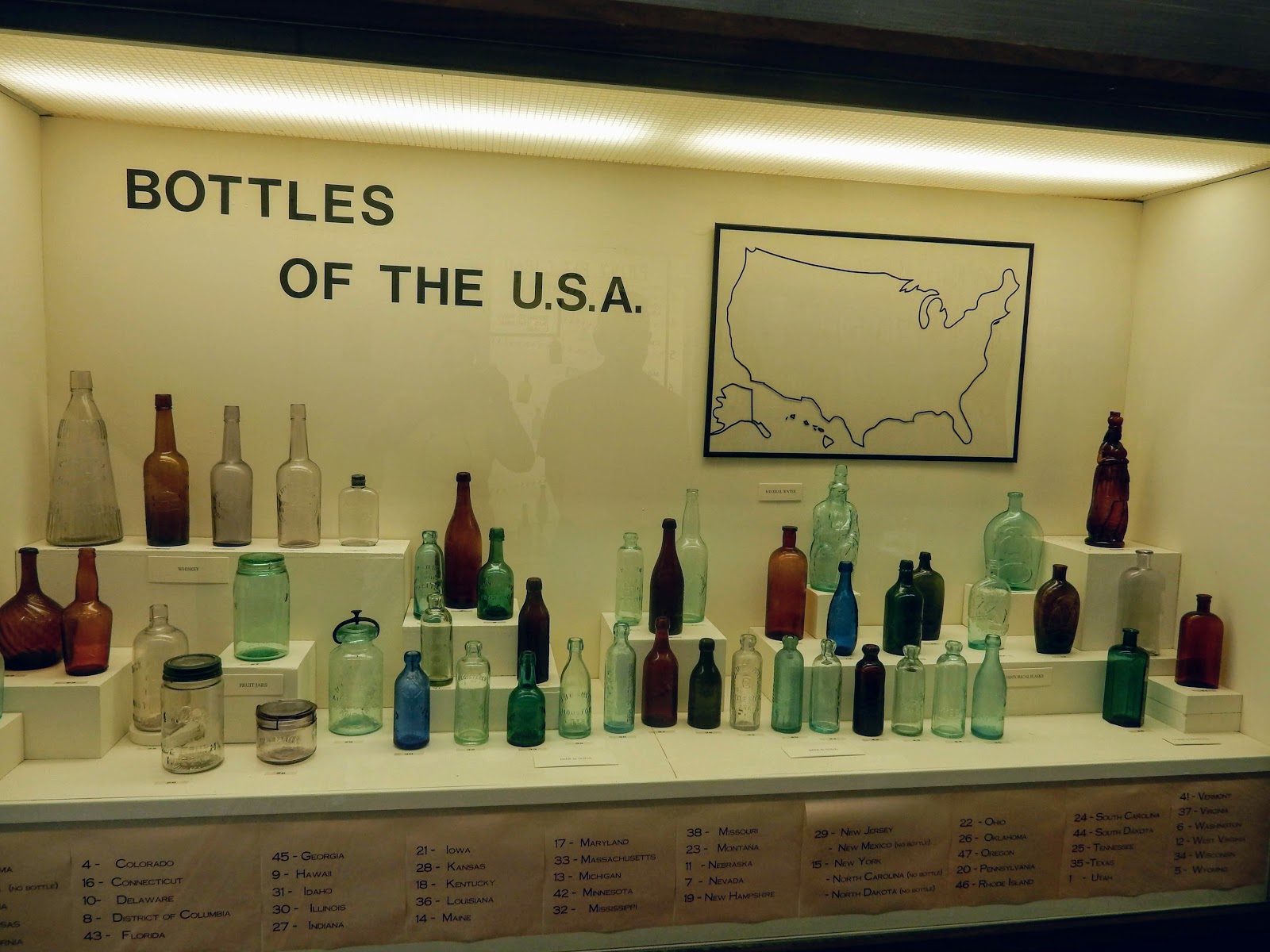
You can guess which state this bottle is associated with:

I thought the variety and colors of medicine bottles were the most interesting.  Here's Drake in front of an actual pharmacy counter circa 1900. 
 
Pharmacists compounded their own medications from their stock of powders and tinctures.  They kept records usually under the clients' names.  Here's a pharmacist's record book:

The museum had a collection of 'poison bottles'.  In a time of low literacy, poison bottles couldn't just be labeled with words.  The solution to preventing accidental poisonings was to create bottles with raised bumps and/or pictures to indicate poison contents.  The second purpose of such 'bumps' was to show by feel in low light, or no light which of your medicine bottles contained poison.

In addition to bottles, the museum had two exhibitions:  The first was a collection of stoneware from potteries created from clay deposits along the Hudson River.  When the clay was exhausted, the pottery factory either moved or went out of business.  Here's a chamber pot manufactured in the 19th century in "West Troy" which is about 25 miles from Saratoga Springs.  
The patriotic theme was handpainted - circa the Civil War
The other exhibition was a paperweight collection donated by an early supporter of the museum.  Here's my favorite paperweight:

Another novelty collection were the glass pieces which contain a small amount of uranium!  Under black light, these pieces glow fluorescent green.

Finally, the museum is continually sorting through donated glass bottles.  A few are noteworthy and added to the collection, but most are duplicates upon duplicates of items the museum already owns.  The museum has devised a clever way to both raise money for the museum as well as send along bottles which they don't wish to add to their collection.  

If you donate $5, you get to pick a prize.  The staff has wrapped give away bottles in tissue paper, and you select (sight unseen) a bottle from the tissue wrapped pile to take home with you.  We donated $10, so I got to pick two bottles from the pile.  I scored two glass medicine bottles blown into molds circa 1875!  How cool is that! 

This museum is well worth a visit.  It unfolded to us thanks to the expert and interesting commentary by Gary.  My pictures start with scenes from Ballston Spa, New York - the location of the museum, as well as the birthplace of Abner Doubleday.  Then, there are more pictures of the contents of the National Bottle Museum.  Click on the link if you are interested.


Monday, August 27, 2018

The Northwestern Berkshires


We made a little trip to the Berkshires - which is western Massachusetts.  The 'Berkshires' are actually just the Appalachian mountains which are located in Massachusetts.  If you are in Vermont, they are called 'The Green Mountains'.  In New Hampshire, they are 'The White Mountains', but they are all one mountain range, the Appalachians.  The Berkshires are famous as a summer vacation spot in the East for culture.  There are numerous theatrical, dance and music festivals. The Berkshires are filled with quaint little towns, each trying to out-quaint the next one five miles down the road.
One of those quaint little towns is 'Williamstown' which is the home of a gem of a traditional museum, "The Clark Art Institute".  It has been completely remodeled and expanded.  I suspect the renovation was done by the same architect who designed the Kimball in Fort Worth.  Check out the first two pictures in the album and see if you don't agree.  If the Clark museum sounds familiar, it's because when it was remodeled, they sent their pictures on an extended tour, and the tour came to DFW.  As we toured this museum a few weeks ago, we kept saying, "We've seen that one."  However, if you like Impressionist art, well, this place has oodles of the best.  You can check out the pix by following the link.

https://photos.app.goo.gl/EncfxtcRN3j3SPg8A

Western Massachusetts was a hotbed of small manufacturing towns in the 19th and early 20th century.  This is the home of the 'widgets' (small stuff that can be put together in the factory where everyone in town works).  International competition, as well as mismanagement of resources, and/or obsolescence put all of these places out of business.  Most of the towns are little dots on the map.  Sometimes they are the sites of fairly famous colleges.  ("Williams" - founded in the 1790's is one of those schools).

An interesting factoid about "The Clark" is Sterling and Francine Clark didn't ever live in Williamstown, the site of the museum.  He wasn't the local industrialist like the Hyde family in Glens Falls who founded a museum to hold their personal art collection.  Oh, this museum was built to hold the Clark art collection, but Williamstown was chosen as the site because Sterling and Francine became alarmed during the Cold War a nuclear bomb attack on NYC (their residence) would destroy their art.  They picked Williamstown, Massachusetts, as the safe place they would build a museum based on a nebulous connection by the grandfather to Williams College!  Sterling Clark is one of those rich guys (heir to the Singer Sewing Machine fortune) who inherited rather than earned his $$.  I'm just glad he left his art collection to the public.

A much more interesting museum is called "The MoCA" -  nope, not about chocolate.  It stands for the Massachusetts Museum of Contemporary Art.  The town of North Adams repurposed a group of eight large derelict factory buildings and transformed them into a contemporary art museum.  This setting for the art is fascinating, and the art is very interesting.  This museum has made this town a tourist destination.  Instead of being a fading 19th century factory town, it is now vibrant and alive with new shops, B & B's and restaurants.  This museum was fun, and they have some wonderful Sol Lewitt pieces.  I just like his use of precision and color.

Ok, so sometimes I get a little crazy
One of the exhibitions that impressed me was called "The Lure of the Dark", and all the paintings exhibited were night scenes.  The gallery was darkened, and there were pools of light around each painting.  Here's an example of what I mean.  The display was novel, and the technique enhanced the paintings.


If you want to see the pix of the contemporary art, click on the link:


Once again, the Berkshires have impressed.  We enjoyed a jam packed day, and I'm hoping we can get back to finish up the Clark and take in the Williams College Museum.  

Sunday, August 26, 2018

Sixteen Miles on the Erie Canal

Everywhere we go, there's always a fascinating history.  I knew Saratoga Springs was a battleground of the Revolutionary War, but I didn't know Washington's victory convinced the French to 'invest' in the Colonial's war against Great Britain.   I knew there was a famous horse race track here, but I didn't know gambling was really the oil that fueled the prosperity of this town.

I knew the Dutch were the original settlers of New York, and as we've toured around, it has become obvious settlement just sort of drifted north and west from New York City and the Atlantic coast.  Gradually, the English settlers outnumbered the Dutch, but some towns retained their Dutch heritage, language, and culture.  I didn't think there would be many surprises beyond what I already knew about the history of the area.

And, then, I learned about the Erie Canal.  Well, that's a NAME we all know from our first American History class, but the significance of it has been lost in history.  First, the logistics:  It's basically a 40 foot deep ditch dug between Buffalo and Albany.  The Erie Canal was a waterway between the Lake Erie and the Hudson River which flowed into the Atlantic Ocean at New York City.  In 1825 roads were few, and what ones there were became easily impassable with the slightest adverse weather.  Rivers were navigable for small distances by shallow draft boats, and there were many portages around water obstacles.     

The Erie Canal construction began in 1817 and was completed by 1825.  The then current and former Presidents of the United States, including Thomas Jefferson, thought the canal was a preposterous idea, and the federal government refused any funds toward its construction.  So, DeWitt Clinton, the Governor of New York, employed massive eminent domain powers as well as seizing Native American lands, and then begged and bullied New York financiers to back $7 million dollars in bonds to construct the canal.  The success of the Erie Canal was almost instantaneous, and its success launched a flurry of other canal projects. 

Construction of the canal was no picnic.  First, it was over 300 miles though dense forest.  The work was halted by the severe winters.  There was the tiny problem of the Niagara Escarpment to overcome.  The lock system finally devised though the escarpment had never been done before.

The construction of the canal required 'on the job training' as there were no civil engineers, nor any engineering school in the United States of the early 19th century.  Many of the techniques to build the canal were devised by Benjamin Wright,
today known as the father of American Civil Engineering, and the founder of the first engineering school in the United States at Renssalear, New York.  The initial canal was 363 miles in length, most of it cut through the dense forests of upstate New York.  It was built, then rebuilt to compete with the railroads, and then rebuilt again before it finally became completely obsolete due to the competition by the railroads and the completion of the St. Lawrence Seaway.  Today, most of the first canal is gone, and the 'towpath' manned by oxen and mules pulling the 'packet boats' is also mostly gone. In the 21st century the Erie Canal is a tourist boat ride of a few miles.

The significance of the Erie Canal can not be underestimated.  It opened up the Midwest for settlement.  Farmers with farms full of worn out soil in New England, particularly Connecticut, New Hampshire and Vermont, were able to pull up stakes, and ride the 'packet boats' of the Erie Canal to new, virgin farm lands.
Farmers in the Midwest suddenly had a market for their goods and produce.  The cost to move goods to the markets in the East decreased 90% when the Erie Canal went into operation.  New York City went from the 4th largest port in the United States to the largest port.   The increased commerce and people passing through fueled the sleepy little towns of Buffalo, and Albany into major cities in the 19th century.  The Erie Canal cemented New York City as the premiere city of country as it became the financial hub of the country. 

Today, the Erie Canal is part of a waterway system which will allow a boat to traverse from Chicago to the Florida Keys and back again.  There are actually 'snow boaters' who follow the good weather in both directions.  This inland system of canals is so extensive that a boater is only on the ocean for 35 miles between Chicago and Keys.  This past week, we took a tourist boat ride on the Canal, and we were following a pleasure yacht well know to the tourist boat Captain as one of those snow boaters.
We are following the yacht - on it's way back to Florida -
through a lock on the Erie Canal
Today, the Erie Canal is a pretty tame and even quaint waterway. 
It feels sleepy and irrelevant in this time of jet airplanes, the world wide web, and space travel.  However, in the 19th century the Erie Canal transformed our economy, and was a spigot that poured native and immigrant settlers into a frontier which has become the food basket of the United States. The commerce the canal generated was the turning point for New York City.  It fired the public imagination and became a symbol of what could be accomplished by a combination of political will, innovation and hard work.

If you want to see more pictures of the actual canal as well as an exhibition of how it was built, as always, just click on the picture links.


Monday, July 30, 2018

Another County Fair

I'm up to my old tricks.  Last week we attended the Saratoga County Fair.  Drake claims I've dragged him to at least twenty of these, but I think the number is closer to ten.  My fascination with county fairs runs deep back into my childhood.  At its root it's all about greed.  My mother believed sugar was the devil incarnate, and she ruthlessly controlled her childrens access to soft drinks, candy, ice cream, and even desserts.  I could count on one hand the times in the calendar year I could satisfy my sweet tooth, and the Tulsa County Fair was one of those times.

Most kids would have looked forward to the midway, but I was a fast learner and realized early on the carnival games just emptied my pocket rather than rewarding me with the big purple bear.  My sweet tooth was also helped along by my irrational fear of all but the mildest of the midway rides.  My speed was always the carousel rather than the rocket cages.  I was even afraid of the swings which rose you progressively into the air as centrifugal force spun you faster and faster.

If I wasn't consuming funnel cakes, cotton candy, or a Dr. Pepper, I was collecting as much free stuff as I could put into my plastic advertising bag.  I loved getting rulers, pens, pencils, band aids, combs, erasers, magnets, clips, and free reading material.  I've never been picky - I'll read anything.

In between sugar fixes, I also inspected every animal pen and cage.  As a city girl, the exotic smells (animal manure, I'm sure) and the lovely animals seen close up seemed to be from a different planet than the one I inhabited.  Hard as it is to believe, as a child I was very shy and timid.  Life for me was mostly solitary observation seeing and noting things I had only read about.  There was nothing about a county fair I didn't love as long as I didn't have to ride anything.

Perhaps that's why it's so easy for me to be eager to 'see another one'.  This time I met some people who made this fair wonderfully unique.  There was Carter, the eight year old who was entered into the sheep showmanship contest for the first time.  We love watching 4H kids working with their animals.  We've watched kids show pigs - that's mostly a free for all.  We've watched kids work young oxen teams.  We've watched five year olds show young cows bigger than they are.  We've watched llama packing - really hilarious - and totally one of a kind in terms of showmanship.  We've watched kids show horses, and we've watched kids show sheep.  We've even watched kids show house cats.

Carter, alternating between being excited and being scared, pointed out his idol to me - a 17 year old boy who, according to Carter, knew absolutely everything about showmanship.  As we worked our way from the 16 - 18 year old class down to Carter's 8 - 10 year old class, he carefully explained to me all the different breeds of sheep we were seeing, why some looked 'rough wooled' while others looked like they'd just seen the sheep barber.  When I asked him why he chose a lamb to raise and show at the Fair, he replied his family farm needed the lawn mowed! 
Carter getting ready for the show ring
I wish I had a happy ending to this story, but, alas, there were two people in Carter's age class - him and a cute little girl with French braids.  He came in second.  Oh, well, there's always next year. 

Moving on, we next encountered a female fly fisherwoman.  I talked to her for about about fly fishing.  When you talk to people who have a passion, it's easy to get a lot of information.  She started fishing about age four, and quickly found out she loved fly fishing.  She's been practicing her craft for more than fifty years. 
For a long time, she fished for trout in fast running streams, but as she aged, she changed her focus to fly fishing on small glacial lakes for small and large mouthed bass.  Her preferred mode of transportation while fishing is not the flat bottomed bass boat with trolling motor of Texas and Louisiana, but rather a one person kayak.  Now, for her it is all about tying interesting flies to catch a fish's interest, then enjoying the utter peace and quiet of the lake as she casts, catches and releases.

I bypass most Fair food these days - unless a really, really good looking corn dog crosses my path.  I also blame New England for putting me off my very favorite Fair treat:  cotton candy.  Well, that's not exactly accurate.  I still eat cotton candy, but only the gourmet variety.  And, you ask, "What is the gourmet variety of cotton candy?"  It's the kind spun from maple sugar.  Once you go maple, you never voluntarily go back to the yucky pink stuff.  The Saratoga Fair didn't let me down. There was a sugar shack, and they were serving up maple cotton candy.  I did rein myself in, though, and only ordered the small size.

Just as I was cleaning the sticky off my hands, I was just in time for a demonstration event.  Now, usually these involve sets of knives slicing and dicing, or waterless cookware, or some cleaning gizmo.  The demonstration at his Fair was so much better.  A woman from the Cornell Extension Service gave a demonstration on how to arrange flowers. 
She had a lot to talk about, and I learned much more than I thought I would when I sat down.  Since there were only me and three other women taking in her talk, it was pretty interactive.  Ok, so I made it interactive. When she started talking about using  greenery from your yard to augment rearranging your grocery story bouquet, I quipped we had to resort to theft in the dessert to find yard greenery.  Everyone started laughing, and when the presenter started asking questions, everyone started answering.  These things are always more fun when the presenter doesn't have to pull teeth to get the interaction going.

Another demonstration which is unique to places with TREES was the timber demo.  This involves sawing, ax throwing, and unique to the Saratoga Fair - log rolling.  In the 19th and 20th century, these skills became logging contests at local gatherings and fairs.  In log rolling, two competitors try to unseat the other from a large log rolling in water.   When it wasn't a competition,
Competition between a father/daughter team
this was the most dangerous part of timber cutting - using a river or large stream to float large cut logs down the mountain to the wagons, and later to the railroad spur to haul the timber to the sawmill.  Men would climb onto the logs to spin them out of log jams and snags as the cut timber floated down the river.  One wrong step and a fall off the floating, spinning log would leave you either crushed, drowned, or mangled.  

A final highlight of the Saratoga County Fair was the eight horse draft/wagon competition.  That's all about driving eight harnessed draft horses pulling a wagon. 
The 'winner' of the driving competition
The predicted rain dampened the entries in this competition, but even though the rain didn't materialize, seeing the two teams drive these horses took one right back to the 19th century when harnessing and controlling teams of these huge horses was a skill in high demand. 

We finished the day at a delicatessen in the town of Ballston Spa,
Main drag of Ballston Spa, New York
the county seat of Saratoga County.  This tiny burg was serviced by four railroads in its heyday.  This is the place where the manufacture of the paper bag with the square bottom was invented.  Who knew?  I tell you in this life there's always something new to see and new to learn.  You just have to be curious.

As always, there are more pictures.  Click the link if you want to see them.

https://photos.app.goo.gl/gW62R2Nt6giPvoG49       


Saturday, July 28, 2018

Slice of American Lives

Mostly, I like life west of the Mississippi.  That preference is because of my Oklahoma childhood.  Northeastern Oklahoma is rolling hills covered with tall trees, so perhaps that explains why I'm so enamored with trees.  It's also an itch the dessert never scratches.  This area is blanketed with second and third growth trees.  All of upstate New York as well as New England has been 'clear cut' multiple times to fuel agriculture, the timber industry, and the paper industry.  And, the trees still keep coming back.

We visited "the Berkshires" this week.  This is Western Massachusetts.  It's filled with rolling hills covered with trees which are part of the Appalachian Range.  One half BILLION years ago when Africa rammed North America, the Appalachians were created.  They've been losing height ever since, and now "The Berkshires" are worn down into a series of  undulating hills.  Embedded are very small towns who have revitalized themselves with the tourist industry.  This is the center of summer cultural tourism (theater, music and dance) with the Tanglewood Festival being the most well-known.  People flock to The Berkshires from New York, Philadelphia and Boston for short summer vacations.  This has been happening since 19th century railroads made 'getting here' easy.

Naturally, wealthy people picked out nice hills and built summer getaways.  These were actually fairly modest family summer homes rather than the ostentatious mansion'cottages' of Newport.  We visited one such Berkshire home this week called "Naumkeag".  The house is named for the American Indians who were displaced and decimated by the 17th century settlement of Massachussets.

This was the summer retreat of the Joseph and Caroline Choate family (old New England name).  It was designed and built by Stanford White (yes, the infamous one) in 1885 at the height of the gilded age.  It was lived in by the family until 1959 when it was turned over to a trust which preserves and maintains it.  Everything in this house is original.  Nothing is 'of the period' which makes it quite unique.  (In all the 'houses' I've toured, this is only the second one with all its original furnishings and bric a brac - the other being in Richmond:  May Mount.)

This time it turns out the house and contents were of secondary interest.  The Choate family were much more fascinating than the dwelling.  Here's Joseph Choate, the owner of the house we toured.  Joseph Hodges Choate cph.3b35057.jpg 
In his era (1860 - 1917), he was incredibly influential and very famous, and as is the case with so many famous people - his fame only lasted his lifetime.  He was a lawyer and partner of THE New York City law firm, and his cases included some of the biggest litigation cases of the late 19th and early 20th century.  This man was perhaps the first 'corporation' lawyer, but to be fair, he also argued on behalf of some surprising non-corporate clients.  He was also a founder of the Metropolitan Art Museum.  He hobnobbed with Presidents, and McKinley (who visited Naumkeag) named him Ambassador to Great Britain where he and his wife charmed and cemented the American/English political bond.  Hilariously, he also brought back to the United States a bevy of English servants.  Boy, I would have liked to have been a fly below those stairs.
His wife was equally interesting.  Caroline Dutcher Sterling Choate had to be extensively pursued before she would agree to the marriage.  She really wanted to be an artist and was set to go to Paris when he finally won her over.  She was famous for her lifelong activism in the cause of education for women - sparked by her own desire to attend Harvard which was closed to her because she was a woman.  
This couple seemed to have had everything - wealth, position, friends, and power.  However, in one of the most important ways, their lives were misery.  They had five children, all of whom lived to adulthood.  However, three of them died very early.  Their eldest son committed suicide at age 20, their second son was mentally ill.  I'm guessing schizophrenia based on the guide's description, and he was institutionalized from the time of his late teens until he died. Their eldest daughter died in her early 30's of colitis after being bedridden by the disease.  Their two remaining children - one son and one daughter lived productive lives, but not to the level of fame of their parents.  Thanks to her mother's progressive views, Mabel, the surviving daughter who never married, inherited Naumkeag which was her primary residence.  She extensively remodeled the gardens over decades, and created the 'trust' which administers and preserves the house today.
 Our other destination was the Norman Rockwell Museum (which is housed in the summer home originally built by one of Joseph Choate's law partners).  Rockwell, long poo-pooed by the fine arts community as 'an illustrator', thus not REALLY a true artist has been reassessed by the art world, and his star is justly rising.  He was famous for his entire adult lifetime as a magazine cover illustrator.  His first cover at age 19 was for "Boy's Life", the American Boy Scouting magazine.  He became famous for his "Saturday Evening Post" magazine covers.  He was assigned twelve to fifteen covers each year for this weekly magazine.  For each cover,  he created a full sized painting.  The painting was then photographed for the cover.

The idea for each painting was conceived by Rockwell.  He often created 'studies' which he executed in either charcoals or oils, then re-evaluated and created the final painting.  Look at the 'photographs, the 'study' and the 'final' for this cover.  This is the same kind of work a 'fine artist' invests in a painting.


Now, see the study.  The cop's uniform and pose is chosen, as is the setting, as well as including the soda jerk behind the drug store counter.

Now, in the final painting, there are other differences in the boy's pose, his possessions on the stick, and the soda jerk has morphed into a counter man in a diner.

This is an example of 'setting up' people he knew in a tableau, then photographing them in various poses and costumes.  He routinely commissioned his Stockbridge, Massachussets neighbors as models for his magazine cover paintings.  The paintings exhibited in the museum were often four by five feet in size and painted in amazing detail.

One large gallery were his 'covers' arranged in chronological order.  I picked out several from each decade to give you a flavor of his work.  This one was my favorite.  It was painted and photographed in 1947.  Here's the cover followed by the painting.  This really show's Rockwell's genius:  It's topical; it's humorous; and it's filled with clever details which hit the mark.  (My favorite person in this painting is the 'grandmother' in the back seat - notice how she's the same going and coming.)


In addition to his own paintings, the summer exhibition was a display of painters who influenced Rockwell.  Two of these painters were Maxwell Parrish and N.C. Wyeth.  I had to laugh when I saw this Parrish painting - it's owned by Crystal Bridges, the Alice Walton museum we toured in Arkansas on our way to New York.

Another piece I really liked was the idea of 'the family tree' - a theme which Rockwell explored in many of his covers.  Here's his take on what an American family tree would look like starting with the buccaneer marrying the Spanish princess, splitting into the "North" and the "South" during the Civil War, splitting again in the "East" and "West" post Civil War, and culminating in the ideal child who is modeled on Peter Rockwell, one of Norman Rockwell's sons.    


Here's another take on that same theme:  This is called "Veterans of Two Wars", a cover for The Red Cross Magazine.

Rockwell definitely saw himself as part of the family tree of artists.  He particularly admired any artist who painted real people doing real tasks.  One of the other exhibitions of the museum were presentations of artists who built their own art on the foundation of others.  First, you saw individual paintings, then a 'family tree' was presented.  Here's the one which culminates in Norman Rockwell.

This was a fun day, OK, my idea of a fun day.  If you want to see more of Naumkeag, or Norman Rockwell covers, here are the links to ALL the pictures.


Monday, July 9, 2018

Calling all Readers

This week I've been learning about memory.  When we recall specific events in our lives, these are called 'explicit memories'.  Sometimes they are BIG like our wedding days, funeral days, birth of children days, or holidays.  Sometimes they are small such as visiting your favorite pizza restaurant with your friends last week.  They are your memories of specific events.  Some of my oldest explicit memories involve books.  Specifically, the impact certain books had on me as I was reading them and beyond.

A few days ago I was watching a mindless reality show on PBS - I'm hung up on 'The Great British Baking Show' - ironic since I hate to spend time in the kitchen - but, they advertised an upcoming program called 'The Great American Read'.  Well, how could I not check that out?  Apparently, 100 books have been chosen by national survey, and there's one 'launch program' you can stream now, with a series beginning in September discussing these books in an up to date way.

The 100 books are all fiction.  An author can only have one book on the list, but some books belong to a 'series'.  They must have been published in English.  I agree with MOST of the choices.  I think "Huckleberry Finn" is missing.  I don't think either the "The DaVinci Code" or "The Twilight Saga" deserves the term great.  Overall, though, it's a pretty good 100.  Here's the list if you want to take a look at it:

https://www.pbs.org/the-great-american-read/home/

Now, here's what's really fun:  You can vote for your favorite book.  The purpose being to choose the 'great American book'.  You can vote for one book a day, so if you feel strongly about one certain book, you can vote for it every day between now and October 18th.  My strategy is to vote for the books which I remember had the most impact on me personally.  Memory is a great trickster, but even so, some books are unforgettable to me.

I've read a lot of the books on the list.  Slightly over one-half, actually.  My first vote went to "To Kill a Mockingbird".  My second vote went to "Lord of the Rings".  My third vote went to "Atlas Shrugged".  Today, I voted for "Lonesome Dove".

This whole idea is right on my sweet spot.  So, if you love to read, check this out and start voting!  I'd also love to hear which books you cast your votes for.  

Tuesday, July 3, 2018

We the People

I read a disturbing opinion piece, which suggested the United States in on the verge of another Civil War.  The piece alternatively angered and terrified me.  Have we really forgotten the bitter lessons learned during the Civil War?  War, especially one which tears a country apart, is horrible even for the best of reasons. 

We were looking at a Civil War monument in one of the towns around here last week, and we calculated the town had 25% of its young men killed during the Civil War.  25%.  And, that doesn't count the ones wounded.  Can you even imagine what that kind of loss does to a community?  In 1865 that meant at the very least 1 in 4 young women wouldn't be able to find husbands.  In a time when women married for economic support, well, what were they supposed to do?  The labor market was decimated.  Old people had no one to care for them in their old age.  Land had no heirs.  Entire towns withered.  And, it was worse in the South for everybody.  The economic system based on the enslavement of people was smashed, sort of.  Even though actual slavery ended, and some historians say it took a war to make that happen; virtual slavery arose which lasted another 100 years.

Second, I find it very frustrating when we collectively decide to forget our own history.  I'm in my late 60's, and in the prime of my great-grandparents' time, they were struggling with an astonishing communication revolution, increasing mechanization of labor, the population shift to cities, an exploding urban manufacturing economy, and the change in the demographics of the population. 

The chaos caused by swift change and societal pressures were so overwhelming; fear ruled us:  We had a corrupt political system drowning in special interest money, racial and cultural fear and distrust, labor/management clashes, and the Anarchists, don't forget those idiots - think 19th and early 20th century terrorists - setting bombs to explode indiscriminately across the country). 

My point is this:  We've survived an economic revolution before.  We've survived a political system going off the rails.  We ALL come from somewhere else unless your ancestry is pure Native American, and even you came from somewhere else - just farther back than the rest of us.  As a country, we are still a unique experiment of a society based on ideas instead of blood lines.  We are:
       
We believe:  You don't have to agree with me, but you must be civil when you don't. 

We know:  Bring us your customs, your food, your values, your religion, and even your language, but our public education system will change your children into Americans. 

We should remember:  We have nothing to fear except fear itself. 

We are ALL Americans because we are 'we the people'.  All of us.  Smart, stupid, no matter what color, or who we worship, or how wrongheaded we appear to someone else. 

Happy Fourth of July.  It's more than a day off work for beer, BBQ, and fireworks.