Friday, June 26, 2015

Ahoy! Iceberg Off the Port Side Bow.

Well, it was pretty darn thrilling.  We headed north to Twillingate, past which Iceberg Alley flows, to see icebergs.  Let me tell you, they do not disappoint.  Also, FYI, even on a calm day, we we were rockin' and a rollin' even in a 65' boat.  Drake was thinking of me when he booked the biggest boat he could find.  We were a bit unlucky in that there were only two icebergs within realistic reach of land for us lubber tourists.  The wind changed the day before we arrived pushing the line of icebergs headed for Twillingate away from it.

Getting to Twillingate was something of an adventure.  Apparently, Twillingate has an
industry second to fishing, and that's the creation of potholes.  Such the mark of a poor region - they really can't afford to fix their roads, and in town was even worse.  Drake had a tense drive from Gros Morne, but even he would agree it was worth it.  The scenery in addition to the icebergs was breathtaking.  Everywhere we've gone in Newfoundland has just been gorgeous.

Iceberg boat day we were a bit unlucky and had crappy weather.  It was 47 degrees when we got onto the boat decked out in long underwear, long sleeve T's, long sleeved fleece, and our hard core rain gear along with hats, ear warmers, and gloves.  We weren't toasty, but neither were we cold.  It was tremendous fortune it didn't rain on us since there was a 50/50  chance.  The wind was also pretty minimal.  The iceberg within reach was a 'growler', a little one - only the size of a 5000 square foot two
story house.  I loved the color - pale blue with striations.  This was so worth it, and I'm on a roll - second boat ride on which I WASN'T seasick.  I admit, this one was touch and go for a few minutes.

Not only was the iceberg a thrill, but the Northern Newfoundland coastline was really beautiful and interesting

Naturally, I sniffed out the only museum worth seeing:  The Armed Brigade Museum was really twofold:  It was memorabilia of the brigade populated mostly by Northern Newfoundlanders during World War I and beyond as well as a collection of important historical artifacts telling the history of the Durrell/Twillingate towns.  To top it off, their centerpiece exhibit was a stuffed polar bear, the very one who walked into town in 2006!  The game wardens couldn't tranquilize it, so they had to put it down.  The polar bear's loss, but the town museum's gain.

When the Twillingate folks aren't showing icebergs, they're fishing, and we even saw a boat 'going out'.  
Plus, there's lobstering.  The pots are strung like necklaces all over the Twillingate area.  Overall, we've wanted to see more of Newfoundland than we have.  Next, we are headed to St. John's, and I get to fulfill a thwarted fifteen year desire:  We are going to see puffins!

If you want to see all the angles of the iceberg plus some more coastal views and Twillingate, then here are more pictures

https://goo.gl/photos/MSNNbUYiSaR1u6GBA


Tuesday, June 23, 2015

Yiss, Bye

"Yiss, bye!" said with a single head toss with upward sweeping eyes pretty much expresses exactly how I feel about Newfoundland.  Let me translate.  "Yes, boy!" is a common slang term used to express both very positive and very negative feelings - depending on your inflection and whether you toss you head in exuberance or mournfully shake your head back and forth.  I learned this from Mike, the water taxi guy along with some other great NL slang.

Western Newfoundland is gorgeous.
I think it would even be gorgeous in the dead of winter.  However, I've been many places with great scenery or fabulous art (Paris comes to mind), and the people who live in those places range from downright rude to barely tolerant, to civil because you're giving them money, to pleasant, to outright friendly and welcoming.  Newfoundland's people fall into the last description.  To be truthful, they remind me of people in West Texas.  As someone I met at the post office yesterday expressed it when I remarked everyone was so friendly, "Well, there are so few of us we love new people."  To be fair, it also helps we are early in the 'season', it's hard to get here, and we are something of a novelty - I can almost, not quite, but almost, see 'cowboys and Indians' cross their eyes when we say we are from Texas. I actually discussed Monument Valley with some old guy, and he was impressed I'd seen it.

The weather here is almost unpredictable.  Literally.  Part of it is being right on the ocean, and part of the inability to find an accurate weather prediction is the natural micro climates which pocket this area.
There are the highest mountains in Newfoundland in Gros Morne National Park (about 2600' feet), and butted up against the mountains are a combination of bogs and marshes which run down to the seashore but only in certain places.  The mountains have the
usual compliment of firs and deciduous trees - similar to New England since these mountains have been logged making way for the trees with leaves that turn colors in the fall to flourish.  (Oh, did I forget to mention the three EAGLES we saw?)   There are also areas of forest interspersed with natural meadows
where the caribou graze. THEN, there are the tablelands which is why this area is a UNESCO World Heritage Site and Canada developed it as a National Park in the 1970's.

The tablelands are actually the Earth's mantle heaved up and left exposed when two of the Earth's continental plates collided upteen years ago - that's an Oklahoma expression meaning, it was a really long time ago and I can't remember the exact number.  When the dust finally settled, you have the Earth's mantle sitting cheek and jowl with an ancient ocean bottom.  Their juxtaposition is credited with helping develop and prove the tectonic theory of the Earth's formation, and geologists come from all over the world to study here since the geology of the Gros Morne area is so unique.  There's also a study station for marine biologists here.

Because the mantle rocks of the Tablelands were so close to the core of the Earth, they are full of
heavy metals and are actually toxic to plants.  The few which manage to grow are poisonous to animals.  If this were there states, there would be warning signs ("DON'T LICK THE ROCKS")  However, this is Canada, so it's assumed you have some sense and understand chromium (to name a one of the inert heavy metals found in the rocks and soil) isn't good to eat.  We learned all this and more from the Ranger led hike we took up into the shoulder of the Tablelands.


This area is dotted with tiny towns which are mostly under 1000 people each.  We are staying at Norris Point, named for Ned Norris, an English trapper who, in 1790, was the first European to live here.  So, the town is named for him, and one of the small coves is called "Neddie's Harbor".  Another town, 'Cow Head' got its name because a French fisherman thought one of the rocks looked like, yes, a cow's head.  The area names are a mixture of French and English.  The tallest mountain was named by the French:  Gros Morne.  It means big sad mountain because it's bald on top.  Men have always been obsessed with their baldness, haven't they?  Cow Head is also a harbor, and the open sea is dramatically different from the protected harbors.  This is a peninsula which separates the Cow Head harbor from the open ocean.

The dominant feature of the geography here are the open and closed fjords.
As the glaciers retreated during the last ice age, they gouged out long, deep channels which the ocean rushed in to fill.  Bonne Bay, the dominant bay of the area where we are staying is an example of one of those fjords.    Norris Point is at the narrow neck where three fjords meet at 'the tickle' so named because it doesn't freeze over in the winter.

More interesting are the enclosed fjords.
 Where there was bog or marsh covered by the glacier, the channel left behind by the glacier was closed to the ocean since the bog rebounded by filling with water just like a sponge when the glacier retreated leaving the deep channel landlocked.  They Newfoundlanders call these landlocked fjords 'ponds'.  We walked in two miles through a marsh/bog area to get to the boat tour of an enclosed fjord.  We boat toured the Western Brook Pond.  They actually helicoptered the boats in pieces, or drug the pieces by sled over the frozen bogs in the winter, built a boathouse, and assembled the tour boats.  Boy, talk about beautiful.  We were worried since it was foggy the day we scheduled the boat ride, but slowly the fog lifted creating fantastic pictures.

A couple of miles away from the marsh and the faux fjord was this lovely seashore dotted with fishing shacks.  Fishing, specifically, lobstering is still the mainstay of the economy, and Bonne Bay is dotted with lobster traps and buoys.

One big surprise here is the food.  Each one of these tiny towns seems to have attracted one or two really talented chefs.  We've had some fabulous meals here.  This meal
was so pretty, and another example of the fifty ways to eat lobster.  This wasn't even my favorite meal here.

To sum Western Newfoundland up, I offer this final picture:  (Please notice, I'm wearing a new necklace from the glass maker from Rocky Harbor.  For a closer look, I posted it on FB.)  And, yes, I'm wearing a long sleeve shirt, a fleece vest and a windbreaker.  I think it was 62 this day.  Just perfect.  And, that's Newfoundland, just perfect.


Sunday, June 21, 2015

Southern Nova Scotia

Nova Scotia is beautiful.  This is the view from the patio at the house we rented of St. Margaret's Bay - actually a subset of that bay - it's Frenchman's Village Bay.
People here are pretty universally 'house proud', so even the human habitation doesn't spoil the loveliness of this corner of the world.  However, it's also hardscrabble in the same way every place without a robust economic base is.  Yes, there is tourism, and yes, there is still lobstering and some fishing, but otherwise...

The woman whose house we rented here was rushing off to a board meeting the day we arrived.  When I inquired idly, "What board?"  She replied, "It's a charitable organization.  This place may not look it, but Nova Scotia is actually a poor province filled with very proud people who conceal their needs."  After that brief conversation, I began to look more closely at what I was seeing as we drove around southern Nova Scotia, and I came to the conclusion she was right.  It has made us more generous in our dealings with people here as they met our tourist agenda.

I have had incredible food here.  It's a given you have to LOVE fish and shellfish in particular.  Well, duh.  I've missed this wonderful fresh fish.  It's just not available in the landlocked world; I don't care how fast you freeze it for shipment.  The Atlantic Maritimes do teach you the fifty ways to eat lobster - well, maybe not FIFTY, but you get my drift.  So far, I've had (1) lobster rolls - OK, several; (2) lobster Caesar salad; (3) lobster wraps - yes, more than one of those; (4) lobster pasta; (5) lazy man's lobster - whole lobster somebody else wrestles out of the shells - did this twice; (6) lobster bisque, (7) lobster mac and cheese, and, my favorite, (8) the lobster cocktail, then, in Newfoundland, I had (9) lobster, scallops and polenta - kind of the Maritime take on the current craze for 'shrimp & grits'.   I have missed the lobster pot pie, the lobster club sandwich, and the lobster eggs benedict; however, I AM still in the Maritimes.

Of course, I've eaten fried clams - they're always fried 'whole' here and bowls of clam chowder. There's even something called "The Chowder Trail" which is accessorized by a blank stamp book.  You're supposed to tote your stamp book around all of Nova Scotia, so you can paste stamps obtained from the various restaurants in to your book  as you eat your chowdery way across Nova Scotia.  (What an complicated, silly idea!  Some tourist promoter's harebrained scheme, no doubt.)

Haddock is the big eating fish here akin to catfish in Texas.  I've had a couple of amazing haddock dishes including a cajun blackened haddock sandwich perfectly prepared.  If you're not jealous now, you should be because these folks know fish preparation just like the New Orleanians do.

Another unlooked for plus is you can get MAPLE stuff here.  Maple hard candies shaped like little maple leaves are some of my favorite sweets.  I found I like them better than the formed maple sugar candies.  There's still no maple cotton candy, but that was probably just a New Hampshire thing.  At least I'm full up on syrup.  I've still got some frozen in my mother-in-law's freezer, so I won't have to carry a jug full of maple syrup along with us on this trip.

There's a lot of very, very good art in Nova Scotia.  (We actually bought a new painting for the AZ house from a gallery down the road from our rented house.)  I found a new to me artist whose work I will be looking for as we cross Canada.  His name is Joe Norris, and he's a primitive.  At least that's what I've seen so far.  This is my favorite piece of several I saw in the Nova Scotia Gallery of Art (the island's premiere art museum).  


I know, I know - everybody is thinking, "Oh, Jan, that piece is so silly.  Are you sure it's ART?"  I'm telling you it has a charming whimsy which is very, very difficult to achieve in this type of art.  

There is, of course, breathtakingly lovely scenery everywhere you look here.  I've snapped endless pictures of it.

And, it's spring again for us.  The rhododendrons are in full roar here, and if you've never seen these bushes, well, let's just say they make azaleas look like poor relations in scanty clothes.

The man-made best sightseeing venue is The Citadel hands down, but the most interesting place I visited in southern Nova Scotia was an example of the early industrial revolution.   This unassuming place is called the Wile Carding Museum, and it's a small red house which looks like a fishing cabin.  At least that was my first impression as I walked up to the place.  I thought I'd see the tired old pictures with too many words and be done with the whole thing in fifteen minutes.

Oh, no.  It wasn't like that at all.  This is an actual early industrial factory which operated from 1860 to 1968.  "Carding" is preparing wool to be spun into thread or made into batting.  What made this place so interesting is the original machines are still in place.  This was seeing the early industrial revolution come to life.  Even more amazing was being able to walk up and see the machines and touch them.  The docent was really well informed, and one reason for her knowledge was the museum curators were able to interview people who actually worked on the machines.

Apparently, Mr. Wile, the owner, was a hard taskmaster expecting his 14 to 16 year old female workers to work 10 to 12 hours a day, six days a week, for the queenly sum of $2 a day.  He installed an indoor privy, not for his worker's comfort, but to cut down on the amount of rest time his employees were able to take. There was no dinner break; they ate standing at the machines they operated.
The carding machinery had no automatic shut-offs or any other safety features at all.  Ironically, one of the worst jobs in the factory was working fat by hand into the wool prior to the carding.  The stinking, rancid, fat was obtained from the tanning factory down the road. The farmer was expected to present washed wool - wool with the lanolin washed out of it - to the factory since the natural wool lanolin was sticky and jammed the machines.  However, with no oil in the wool, it became brittle when run through the machines necessitating the rancid fat being added.

The machines ran the fat saturated wool through a series of rollers each with a smaller and smaller sets of 'teeth.  The finished product was either batting or a inch in diameter rope roll of wool - ready for quilts or for spinning into thread.  At the height of wool production in Nova Scotia, there were about fifty of these 'factories'.  Mr. Wile may have been hard on his employees, but he had a reputation for honesty. Farmers came from far away to let HIS factory card their wool since he returned the farmer's same wool to him after processing.  Some factories pawned off inferior wool back to the farmers, keeping the superior wool to sell themselves.

 It's somewhat of a miracle the building is still standing considering the most of these 'factories' (about the size of your living room/dining room combination) burned to the ground since the processing of wool was so flammable.   The whole process at the Wile Carding Factory was powered by a water wheel at a natural small waterfall area in the river.

So, you can see why I was so excited when I left this place, and the unlooked for lagniappe was the duck family in the upper pond.

As we left Nova Scotia, I dreaded the eight hour ferry crossing to Newfoundland.  I was sure I'd be barfing or fighting not to barf the entire trip.  I feared we would have a  small shabby cabin that smelled like feet with wooden bunks and a communal bathroom down the hall.  Instead, we had a cruise ship type cabin with private bath, and a smooth crossing most of which I slept through.  Just goes to show you, worry is such a waste of time and energy.  Not a single one of my fears came true.  On to Newfoundland. 

As always, if you want to see ALL the pictures:

https://goo.gl/photos/9p95DdQZ6U5hGkrcA  - Wile Carding Factory


And just for good measure - can't remember if I included the Public Gardens in Halifax in the last blog - here is that set

https://goo.gl/photos/DEDmvBRf3evqiguR7 - Public Gardens, Halifax


Monday, June 15, 2015

Halifax


What do you get if you take a New Englander and make them considerate and friendly? You get a Nova Scotian.  This country just floors me.  The level of civility is so refreshing.  Strangers on the street here treat people better than some waitresses I've had in the States.  Nova Scotia is no exception.  I think the province motto is 'Why not smile?'

We were in Nova Scotia roughly fifteen years ago, but we spent the majority of our time in Cape Breton which is the northern portion.  This time we concentrated our time in the south, and in Halifax.  Without a doubt the most impressive edifice during sightseeing was The Citadel.
This place was so massive and at the same time open air.  As an attraction it was extremely well done for sightseeing by utilizing just enough historical re-enactors (mostly college students) to
make the place come alive.  The Citadel is a stone fortress sitting on top of the highest point in Halifax overlooking the harbor which the British picked out in 1750 as one of the prime harbors in North America.  Naturally, they wanted to control this prime real estate in the age of sailing ships, so they promptly set about bamboozling it away from the Mi'k maq.  (We are shocked, just shocked.)  The original 'citadels' were constructed out of logs, and there were two of those before before the stone one was built.  It only took 28 years to finish it beginning in 1827  and finishing in 1855.  The supreme irony is that the Citadel was never attacked.  Legend claims after the fortress was built,  spies would infiltrate the place and return to proclaim they couldn't find a weakness that could be exploited.

Most of the re-enactors were costumed as The Highland Regiment from approximately 1850.  There were pipers as well as soldiers in full dress uniform and others in their 'daily' uniform.  And, yes, the various bagpipers give small impromptu concerts at about 15 minute intervals.  There was one group of WWI clad soldiers in anticipation of a re-enactment event over the weekend.  The kid below (in the kilt) confided to us those uniforms were really, really uncomfortable compared to his.
Most interesting was the Corporal's wife.  According to her, she would have been instantly recognized as a corporal's wife because she had a row of buttons as well as a belt on her dress.  A sergeant's wife would have had not only more buttons but a lace trimmed neckline as well.  A poor private's wife would have neither lace nor a belt and only one or two buttons.   There's a three week training course for these summer jobs to learn the history of the place, a specific job, and about the people as well as how to deal with the public.  Another way the Citadel engages tourists is you can sign up to learn to fire the cannons (and really fire them) or learn to load and shoot an antique rifle - the newfangled weapon of the 1850's.

This was our first sight when we entered the Citadel, and it was LOUD.  In addition to the wonderful scenery from atop the walls, there are a couple of museums inside what used to be the soldiers' barracks.  There were 11 soldiers to a room and the rooms were daisy chained together.

The red coated soldiers are displaying the Highland Regiment's dress uniform while the ones wearing the buff colored top are in the daily uniform.  Their sporins are sporting a stag's head and the motto (He Who Saves the King) which emblem and motto were awarded by the King to the founder of this regiment.  This came about when the regiment founder and the King were hunting together.  Suddenly a full grown and antlered stag charged the King, and the founder jumping in front of the King, beheaded the stag with one slice of his clay-more (heavy sword) before the King could be harmed.  As the re-enactor pointed out - several Scottish regiments have this story as THEIR legend!  

Anyway, no expense has been spared on these uniforms, and it's obvious the students portraying these historical figures are very proud of them as representations of their country.  

The other stand-out sight in Halifax is the Public Garden.  It was really wrecked by an Atlantic hurricane in 2003, and the entire city pitched it to restore it.  They did a wonderful job because it was literally the breath of Spring.  We saw rhododendrons in mass in bloom for the first time since the Butchart Gardens on Vancouver Island in British Columbia.   

If you're interested in more photos, click the links!
I'm almost as colorful as the flowers, but the wind was blowing, blowing, and it was chilly - about 16 degrees.  (Yes, I'm going to be annoying and post Celsius.  Double and add 30 for approximate Fahrenheit.)


Saturday, June 13, 2015

New Brunswick

We've managed to stay in the most suburban town ever, shades of Hurst, Texas, just four times larger.  Moncton, New Brunswick is a quiet, family community of about 150,000 people filled with pleasant, courteous, kind Canadians.  This is the 'bilingual' province. All the signs are in both English and French with a very slight size edge towards the English.  The street signs seem odd at first when they are bilingual:  644 Rue Main St. with both the French and English for the type of road (Rue) and (Street). They also have a Mexican Restaurant I have my eye on for our one night stay after Newfoundland - at least I can get a margarita - I hope.

New Brunswick is all about TIDES.  Their biggest attraction is the Bay of Fundy which claims the highest tides in the world.  Above is Herring Cove inside the park at relatively low tide.  Where Drake is standing, will be covered with about 30 feet of water at high tide.  Typically, at this time a year, the tides rise and fall about 35 feet twice a day when the weather is 'normal'.  Unusual storms coupled with a full moon, and the tides can change up to 50 feet from low to high.  At low tide, you can walk around on the 'ocean floor'. The Fundy National Park isn't very dramatic, but it had a beautiful waterfall, Dickinson Falls.  As important from my POV, the trail to it was EASY.


Much more dramatic, and much more fun, were the Hopewell Rocks with their signature attraction, the flowerpots. This is a private operation, not a National Park, so I got to rock hound to my heart's content. I picked up some nifty ones.  (I'm very virtuous about never picking up anything in a park or historical site, but I will scavenge any rock from the side of the road or wherever it's not prohibited.) Anyway, it's the same 'walk around on the ocean floor' concept, BUT they have large rocks the size of 5 story buildings with trees and plants growing on the tops of the immense rocks, thus the name: the flowerpots.  That's Drake standing next to one of the rocks showing 'perspective' for me.  When the tide comes in, the rocks are covered up 2/3rds of the way with water.  A lot of the 'ocean floor' is gelatinous mud making this a kiddos' paradise. (Oh, that reminds me, I ran into someone who, upon discovering we were from Texas, mentioned he had taught school in Texas for a couple of years, and it amused him we refer to children as kiddos - who knew it was so regional?)   The mud is interspersed with caches of the most wonderful rocks.  I spent a lot of time in the Sanibel crouch while here.

This has been an odd stop for me because we didn't go to a single museum.  There really wasn't anything of interest here except for a quilt exhibit at the library which, of course, I went to.  This has been the third 'spring' now in a row.  The first wildflower out are fields and fields of dandelions which are in such profusion they are blanketing the fields and yards.  People actually 'mow' around them.  One man's weed is another man's flower.  When we return, supposedly, there will be lupines in the same type of profusion as bluebonnets - same family - bigger color scheme.


We now understand the 'mosquito' issue we'd been warned about.  Yesterday, we packed a lunch to take while touring around.  Getting hungry, we found a small town with a 'lookout and picnic park'.  We drove up, unpacked the food, and repacked it immediately.  We were both covered with 30% Deet, so we really weren't getting bitten, but the young flies and mosquitoes were literally swarming us.  Even in Houston and New Orleans we didn't experience the 'swarm factor'.  I think this is going to be the first of many of these occurrences.  We are definitely rethinking 'picnicking'.

Tomorrow, we head for Nova Scotia where we have a house rented on the Atlantic Ocean.  It's taken me a week to write this blog, so the Nova Scotia one will probably be out close to this one.

If you want to see more pictures of flowerpots, and the Fundy Bay, here are the pictures:

https://goo.gl/photos/2so7yCown41TrGNs6  - Hopewell Rocks

https://goo.gl/photos/TaiLtETsreQ7sd6fA  - Fundy National Park


Tuesday, June 2, 2015

A Viewpoint of Maine

Maine is a coin with two sides.  On one side are the people who live here year round.  It's not so much that they 'love' winter as much as they love the isolation of this place.  I believe this is the only place in New England not teeming with people.  These people also love the sea since it's the only source of real income.  Until the last 50 years, the sea provided adequately since fisherman caught not only lobster, but also all varieties of finned fish.  The depletion of the finned fish, in what for centuries was one of the richest fishing grounds in the world, is a cautionary tale.  However, that topic is a whole other discussion in itself.

Little did I know at one of Sarah's graduation parties I would meet someone who grew up in Maine, and he would give me insight into who these people are.  He talked freely about the mindset of 'year rounders'.  First, it's about doing anything and everything to make a living here.  Life is very day to day.  Most people we've either met or observed, especially on Vinalhaven Island, didn't have one job - they had several.  It is a constant challenge to make enough money to get through the year as well as battle winter.  It is so cold here for so long winter is, in fact, a battle for survival even with the modern conveniences of the 21st century.  Never having lived in a cold climate, this startled me.

Then, there are the limbo people who we've seen in every super-tourist town.  (Bar Harbor certainly qualifies because it's the service town to a heavily visited national park.) In Bar Harbor the people who have served us are A-B people.  (In Sun City, we call people who live one-half of the year in AZ and one-half of the year in another fixed place A-B people because each year they travel from A to B and back again.)  Well, in the 'tourist' areas of Maine, people work seasonally. They live in Bar Harbor or Booth Bay or wherever tourists congregate for the season, and then, they live elsewhere (such as Portland or Boston or even back home in Jamaica) for the rest of the year.

Until 1947, Bar Harbor was like Newport; it was the summer playground of the wealthy. They built gigantic opulent homes and came to Bar Harbor for the summer to escape the heat of Boston and New York and socialize.  There was a 'millionaire's row' similar to Newport, Rhode Island.  Down Highway 3 just outside of the sleepy fishing town of Bar Harbor was one magnificent estate after another.  In 1947 a devastating fire  destroyed fully one-half of Bar Harbor and burned most of the homes on millionaire's row as well as 23,000 acres of Acadia National Park.  Most of these mansions were never rebuilt due to postwar changes in culture and lifestyles, as well as the tax laws.   The town of Bar Harbor reinvented itself as a summer destination for ordinary people.  In place of the estates were built a row of motels to house the new middle class summer visitors, and many large homes left were transformed into bed and breakfast establishments for the upper middle class as they all visited the national park, and thus the tourist town of Bar Harbor as it is today was born.

The other side of the Maine coin are the 'summer people'.  There are still some large vacation homes dotted all around Mount Desert Island as well as Vinalhaven.  (Yes, this place is also an island, but a very large one unlike Vinalhaven.)  Bar Harbor is but one town of many on this island.  Southwest Harbor, another Mount Desert town, and Vinalhaven are still obviously filled with homes of wealthy people who come to Maine for the entire summer, or in some cases for a few weekends. The example of these people are the Bushes who 'summer' in Kennebunkport.  Other families, not quite so famous,  with their vacation homes are replicated throughout the coastal areas of Maine. These summer people, or more specifically the HOUSES of summer people allow the year rounders to continue working through the winter maintaining and caretaking those houses.  There's a certain tension caused by the changes to island life these temporary people impose upon the year-rounders.  

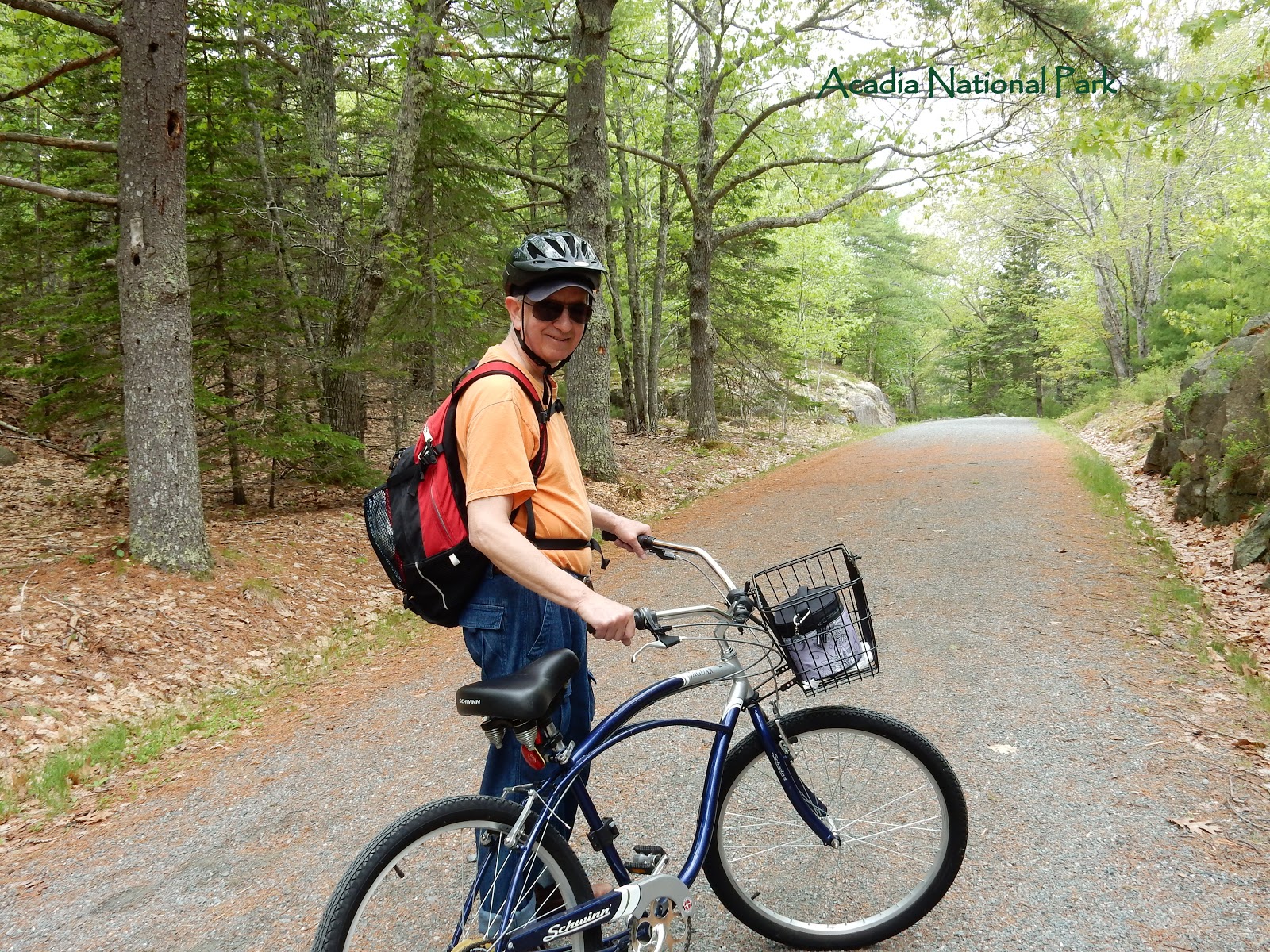
Overall, Maine has been interesting.  Acadia National Park doesn't have the visual drama of the western parks, but we got a bonus:  It's Spring! Everything is in bloom, and all the trees have that beautiful soft vibrant spring green which only lasts for a few weeks.  It's so early here there are some trees still without leaves.  Ominously, the bugs are just starting to come out. This place is full of pools and fens and marshes; it is mosquito and tick heaven.  Their are two great things about this park.  First, the juxaposition of mountain and sea, and second, the carriage roads.  These are gravel roads built by John D. Rockefeller, Jr. around the 'sights'.  They are no bicycle and walking roads on which you can enjoy riding a bicycle or walking without dodging cars.  This makes Acadia unique in that older people and people with disabilities can access this park.
Drake on a Carriage Road


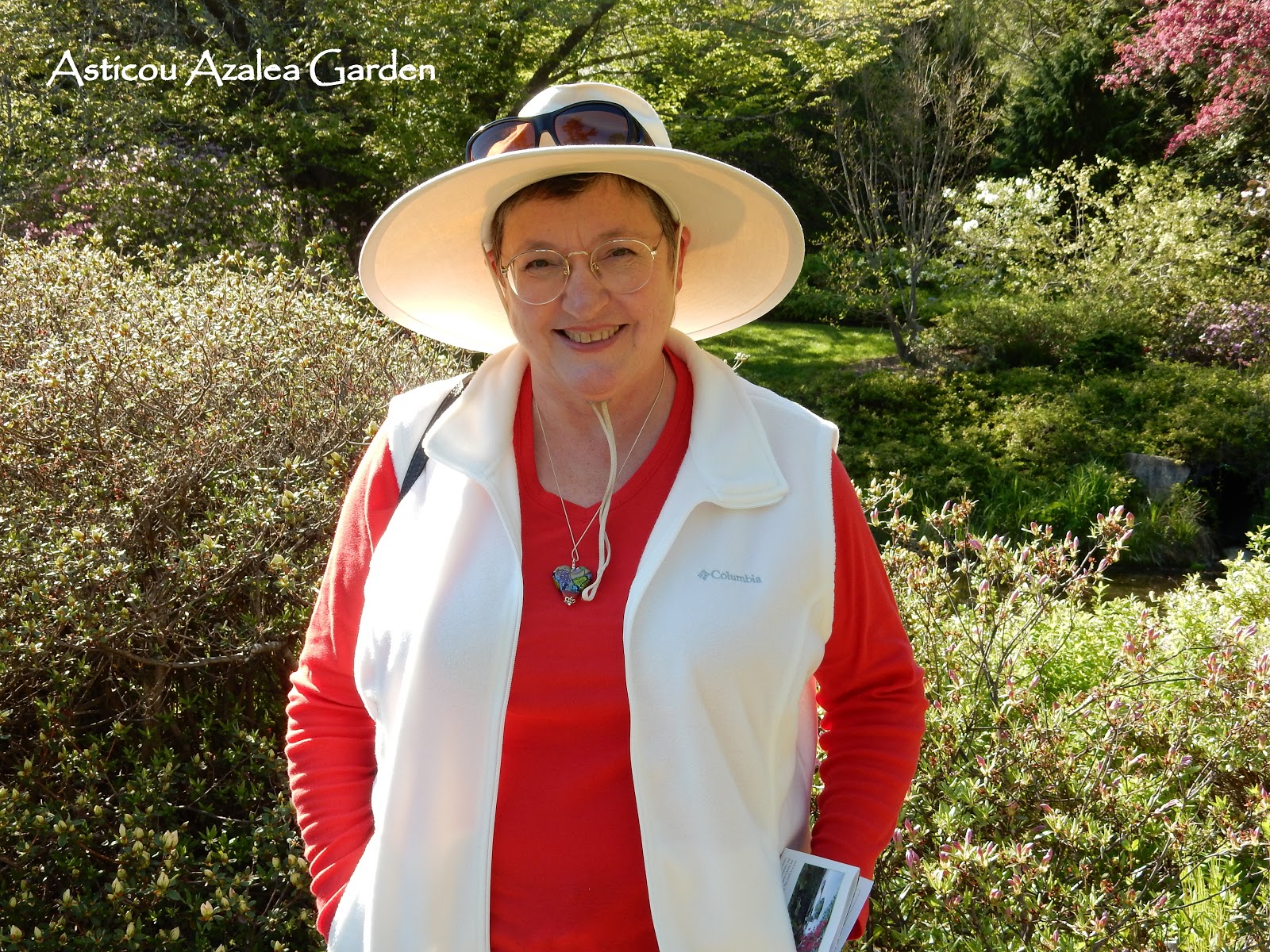
Another surprise here were the azaleas!  I had no idea azaleas could grow here.  The plants here, while looking very similar to Gulf Coast azaleas are totally different plants - mostly Japanese azaleas which can handle the extreme cold of the winter months.

Flowering crabapple tree
Azaleas at Asticou Azalea Garden

Tomorrow, on to Canada.  I've very excited about that prospect since we have done extensive planning on a scale which would have daunted us had we but known how much work there would be.  Oh, and FYI, if you want to reach me, please email since I will not be using my iphone for anything except emergency calls while I'm in Canada.