Friday, July 25, 2014

Did you Ever Want to See Big Sur?

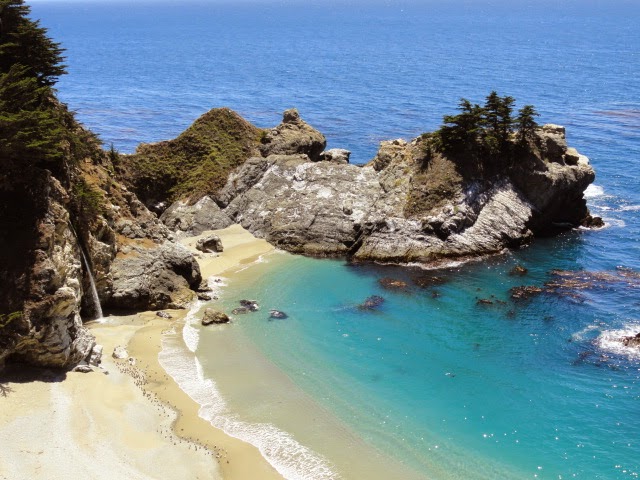
We just finished a jaunt down Highway 1 from Monterrey, California to Morro Bay; it's about 100 miles.  It took us two days to drive and hike this area, and we feel like we just scratched the surface. Undoubtedly, some of the most scenic coastline
McWay Cove and Waterfall
I've seen on the American mainland.  We started with gigantic coastal redwood trees, moved onto protected dunes, hiked inland to a waterfall, did scenic driving and watched whales.  As always, if you want to wade through them - the pictures tell the story.

https://plus.google.com/u/0/photos/115478608971584948192/albums/6040107970317504769?authkey=CKKr6Nrf0ayXcg

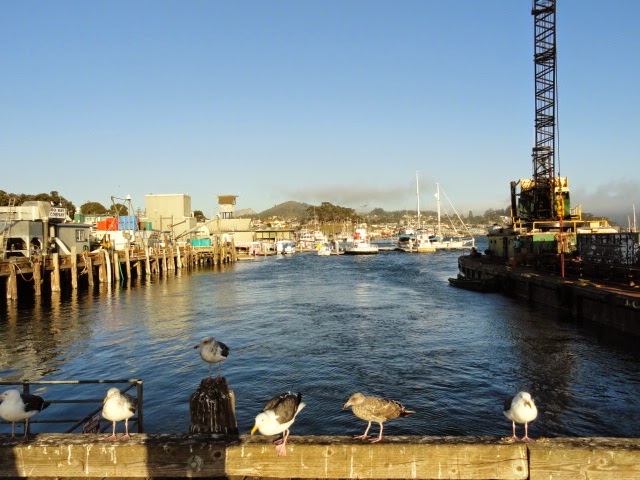
Morro Bay
You can't take pictures of the attitudes you encounter on Highway One.  Monterrey is all about tourism at the tackiest level.   The harbor and wharf were clam chowder in a bread bowl you carry around, cotton candy, ice cream, plastic souvenirs and tons of people in Bermuda shorts.  Pebble Beach is exclusivity and the residents of this community, littered with famous golf courses, will let you have a grudging peek at the high priced scenery they've secured for themselves for by charging you $10 to drive 17 miles along the Pebble Beach coastline.  Carmel is all pretension; it's for the nouveau riche who want and need to throw around their new big money in a loud and boisterous fashion.  You can still catch hints of the hippies who settled in and around Big Sur in the 1960's and '70's.  They built small cabins, stores, and restaurants in wood taken from the forests and they are still perched precariously on the bluffs along the coastline.  Morro Bay is about working the sea for a living.

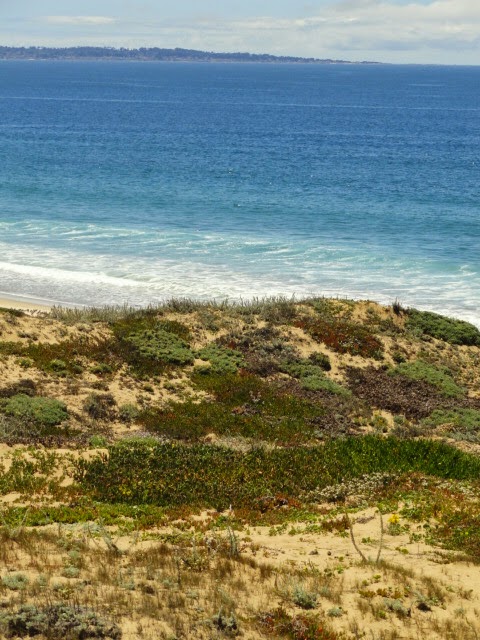
Another feature of this coast are the dunes.  The sand dunes are covered with vegetation that has specifically adapted to the climate and region.  We took a dune hike which was hellishly hard since one-third of it was slogging through deep sand, but worth it to see the plant life up close.
Dunes at Marina State Beach

We stayed in Carmel and had a hotel room with an Pacific Ocean view.  One of the highlights for Drake was the evening we sat out on the balcony with the binoculars.  We saw whales spouting, and jumping completely out of the water just like the Pacific Life commercial logo.  We were very fortunate to have almost clear weather at the coastline for most of the entire trip.

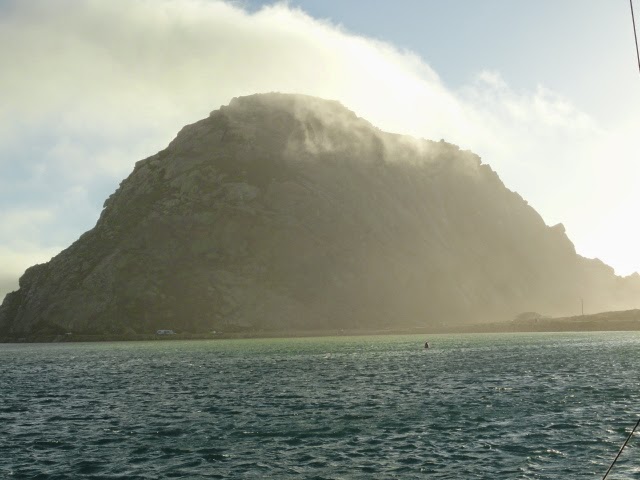
Other than the amazing scenery, my favorite of the trip was the Morro Rock.
Morro Rock
 It's a gigantic rock (539 feet high) sitting in the center of the Morro Bay Harbor.  The rock is actually the remains of a 21 million year old volcano.  There are seven of these ancient volcanoes in a string along the California coast.  The 'Rock' is the most visible remains of the seven.  It was originally an island, but was quarried (and made shorter and smaller) in the early 20th century.  The entire town of Morro Bay and the area surrounding it is a National Bird Sanctuary.  Guns are banned here since any kind of hunting is illegal.  The Rock is no longer an island, no longer a quarry, and it has been completely taken over by birds.  There are huge marsh areas near the town and these as well as the coastal shoreline are habitats for several endangered birds as well as on the migration path of several species.

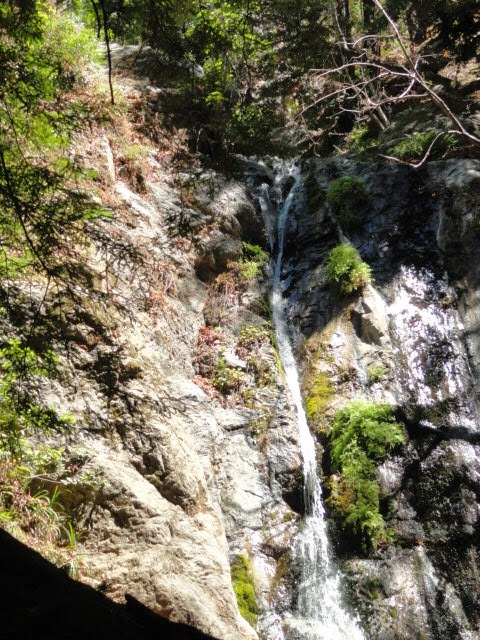
I'd recommend this trip to anyone with one caveat - avoid anything inland - you'll be disappointed.  The Pfeiffer Falls hike was a lot of energy expended for little return.
Waterfall, Pfeiffer State Park
  Also in hindsight, we would have skipped the 17 Mile Drive - better scenery just down the road.  Expect to be ripped off anywhere in Carmel and Big Sur - they know their attraction, and the hotel room prices are jacked up.  They can command those prices since they are sold out during the high season.  We also decided to skip the Hearst Castle in favor of looking for a coastal hike along the Pacific Bluffs outside of Morro Bay.  That fizzled when the fog rolled in.  I did find out there's another 'wine area' in California - around Salinas and Soledad in the inland Central Coast area.  They seem to have a nascent wine tour attraction developing.

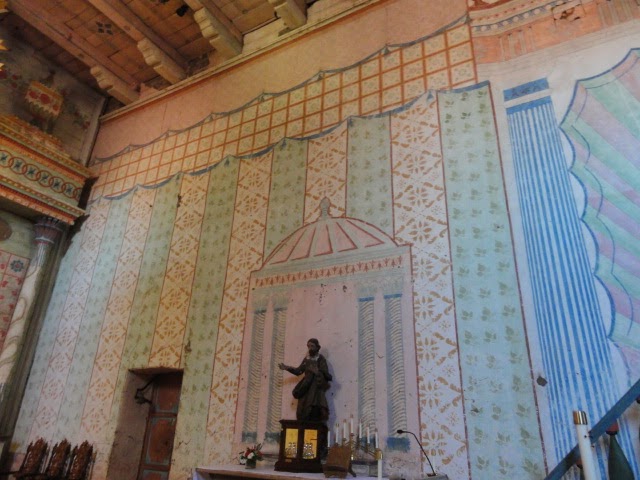
One off the cuff stop turned out to be our history lesson for the trip and very fascinating.  We stopped at Mission San Miguel Archangel.  It is the 16th of the 21 missions the Spanish Jesuits built in California during the 18th and early 19th century.  The sanctuary of the mission we toured has never been repainted, since it was originally painted by the natives under the tutelage of the Jesuits.
Sanctuary, Mission San Miguel Archanger

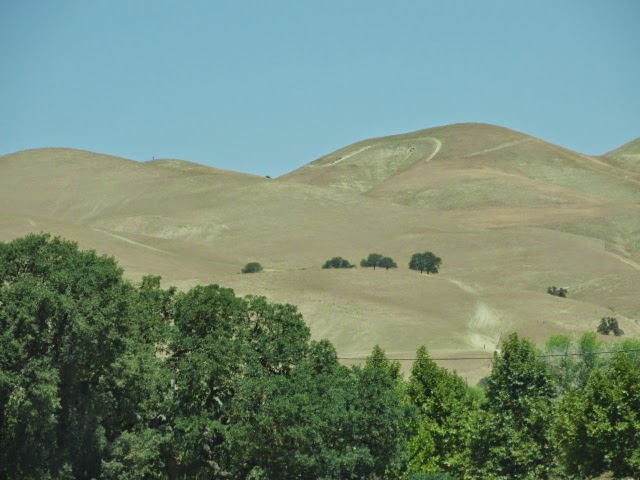
The weather and terrain is all over the place up and down the Central Coast.  Temperature depends on how far you are from the sea, and whether or not there's fog.  Coming back north to Berkeley, we jumped over to Highway 101 ( parallel to Highway 1 on the coast), but about 40 miles inland, the temperatures were summertime hot.
Inland, central coast
 This trip was just a dabble.  There is lots and lots more to do between San Jose and San Luis Obispo.  Perhaps a several month stay during another summer.              

Monday, July 21, 2014

Bleacher Baseball

With regard to baseball, Drake self-describes himself as an anachronism.  On Sunday afternoon, I couldn't have agreed with him more.  We took in an Oakland game (rooting for the Orioles - or 'Ranger's East' as we refer to the O-birds) with Sarah, Amy, her husband Daniel, and a couple of their friends.  Due to economic constraints of the PhD candidates, we decided to go for Bleachers, General Admission tickets.

If you've ever listened or watched the Rangers (or now the Astros) play the Oakland Athletics, there's constant noise.  What had always struck me was the inordinate amount of noise coming from a relatively small group of people.  The A's notoriously draw small crowds to their park.  The Oakland Coliseum, also home to the Oakland Raiders football team, is everything a baseball stadium shouldn't be in this day of designer baseball parks.  It was ironic the Orioles were playing here when we took in a game.

The Orioles baseball park, Camden Yards, was the first in the wave of 'retro ballparks' built since 1992.  These parks have been designed to enhance baseball for the fan.  Wonderful seats, great views, interesting configurations, and architectural features.  The Ballpark at Arlington (the Texas Ranger's park) was consciously modeled on Camden Yards as were several others.  Ballpark construction seems to happen in waves.

In 1965 the Astrodome ushered in the multi-purpose enclosed stadiums turfed in artificial grass.  It was billed as the Eighth Wonder of the World when it opened.   (Sidebar:  Originally, the Astrodome had clear lucite panels in its ceiling and a special Bermuda grass planted on its floor.  The players began to complain they couldn't see fly balls, so the panels were painted white. The grass promptly died.  For most of 1965 the Astros played on dirt painted green.  Chemturf, a new product, was promptly renamed Astroturf and the stadium was carpeted.)  Within ten years there were several domed stadiums which were venues for baseball, football, concerts and commercial shows [think RV, home and garden, etc].

The Oakland County Coliseum was built during this era, just not enclosed since weather was not an issue in the Bay area.  It's the last stadium in the country where professional baseball and professional football share a facility.   The foul territory is gigantic compared with more modern baseball facilities; the pitchers sit out in the open down the sides of the foul lines rather than in a bullpen, and the interior of the stadium is like a rabbit warren.  We actually had to go 'down' a long tunneled ramp to sit in the bleachers.

Ah, the bleachers.  In baseball, the 'bleachers' are the perimeter seating ringing the outfields.  These are historically the cheapest seats in the park, and originally were wooden planks with no backs and no covering.  The sun bleached out the wood, and thus was born the term 'bleachers'.  Bleachers have been shrinking since fans expect a cheap ticket to sit in the far reaches, and no professional sport these days is about a cheap anything.  Bleacher fans have morphed from fans into fanatics as the number of bleacher seats decline, and each team's bleacher occupants take on a group character.  The Cubs 'Bleacher Bums' were the forerunners of this type of fan.

Oakland bleacher fans sit on the right and left sides of center field, and each group has it's own personality.  The fans on the right field side are acknowledged as the rowdiest bunch in the park with the fans on the left field side coming in a close second.  First, I noticed the flags.  Big flags, color guard sized flags being vigorously waved at the start of every inning, and before any batter coming to the plate with men on base.  The right bleachers won the flag game - I guess someone on their front row has band color guard experience since there were about 20 flags and they waved in UNISON as if choreographed.  All flag wavers sit on the front row.  

The other feature of the Oakland bleachers was the musical accompaniment. Our side of the bleachers had three snare drums, two cowbells, and three medieval heralding trumpets, albeit in green plastic.
  
Drummers beat rhythmically throughout the ENTIRE game.  Drummers also sit on the front rows of the bleacher sections.  One of our drummers sported waving curled, shoulder length California golden blond hair, a six pack abdomen, cut off jean shorts and nipple rings.  Flag wavers each own their own flag from pristine green and gold to tattered and faded.  They wave in time to the drum beats while trumpets and cowbells enhance the drum beats.  It's a repetitive concert using three instruments, well, four, actually.  The fourth instrument in the bleachers are voices.  Everyone chants, and anyone can start a chant.  It's often picked up by the rest of the stadium crowd, and the bleacher aficionados don't need no stinkin' MAKE NOISE directions from the scoreboard.

Bleacher fans are also known for heckling particular players on the opposing team.  During the Oriole's game, Manny Muchado came in for particular vilification complete with rhythmic booing, a photographic head shot of him waved around on sticks, and 'Manny Sucks' chants every time he appeared at the plate to bat.  (The A's fans do not forgive:  Muchado got into it with Donalson the A's 3rd baseman on June 9th, and this was their first opportunity to dish it back to him.  He struck out twice during the game, but managed a hit much to the fans disgust in his third at bat.)  There's also singing to various songs throughout the entire game over and above the iconic "Take Me Out to the Ballgame".

Drake attends baseball games to watch every nuance of the game.  Bleacher fanatics leap to their feet at every crack of the bat (literally), and obstructed his view repeatedly.  Over the years, he's grown more and more annoyed with fans who come for the party rather than the game.  The ultimate party boys, three of them, sat in front of us.  They receive the 'ultimate' accolade since Drake detected they had smuggled hard liquor into the stadium in their sunblock tube.  GACK!  My tongue and mouth just puckered into rejection of that liquid.  We spent a happy five minutes speculating how they had cleaned out the sunblock, or if they had, and how they filled it with booze.

I thought the party atmosphere enhanced a game in which I had no real interest in the outcome.  The A's crushed the Orioles, Sonny Gray pitched a terrific game hinting at a no-hitter into the fifth, and the party rocked for the entire game.  I concentrated on keeping score, eating a terrific corndog, and cheering for the former Rangers on both teams.  Drake, well, he was just a curmudgeon, and if you ask him, he's PROUD to be one.              

Friday, July 18, 2014

What Do You Do When the Ilegal is a Child?

I seldom write on political issues because I think everyone is entitled to his/her opinions.  In our politically polarized society, civil discourse is, sadly, a lost art.  The concept of the loyal and honorable opposition no long exists, and if you find yourself on the opposite side of an issue from a friend, at the end of any political discussion that friendship may be a casualty.  All of that said, I'm writing about the crisis of unaccompanied, illegal, alien children coming across the Southwestern borders of the United States.  Everyone in the world has weighed in on this mess, so since I've been thinking about it, I decided to risk offending my readership with my opinions.

First, let's talk about the facts.  The US Naturalization and Immigration Agency along with Homeland Security projects between 60,000 and 90,000 illegal, alien children will arrive at the borders this year. Those numbers more than double the children who arrived at the borders last year.    This year 57,000 of these children have already arrived illegally at the borders, mainly in Texas and Arizona.  The majority of the 57,000 are unaccompanied and from the three poorest and most violent countries in Central America:  El Salvador, Honduras, and Guatemala.

This huge influx of illegal immigrants has backed up the legal system for dealing with people caught trying to immigrate to the US illegally.  This back-up is particularly difficult since these are children languishing in packed detention centers awaiting the legal hearing they are entitled to as provided in a 2008 immigration law.  Basically, the system is overwhelmed.  The citizens of the towns and counties, which will become the instant home of any of these children granted asylum, are up in arms.  They remember much too clearly how their social services, health care systems, and schools systems were overwhelmed during the height of illegal immigration in the 1990's.  And, if that isn't enough, every Tom, Dick and Harry along with the Pope have weighed in with inflammatory, polarized, invective.  I've been reading both sides, and the one thing in common is the objectification of these children.  By objectification, I mean that both sides are writing, talking and acting as if these kids are just the great, unwashed, unwanted, problem whose primary function is to thrust the immigration issue to the forefront of the American public.

Here's what I think they are:  Individual kids whose desperate parents were willing to entrust each of them to some of the sleaziest people on this earth (coyotes), paying these sleazeballs with money they can ill afford in a last ditch effort to let their child escape a no hope, violent situation.  I was immediately struck by the parallel of the European Jews trying to find ways for their children to escape Nazi Germany in the late 1930's.  The endless, and rapid discussion of misguided thinking on the part of the Central American parents attempting to get their children to the USA by any means thinking it assures them a better life is just a blame game and a further way to turn kids into dirty, smelly objects.  On the other hand, the bleeding hearts who would instantly wave a wand and grant asylum to each and every child don't really care what happens to them as long as they don't have to look at them in detention anymore.

What we really have here are frightened kids.  They most likely can't speak English, and many won't be able to read even in Spanish.  The food being given is different and upsetting.  Nothing is familiar and they are very unsure and oh, let's say, 'acting out'.  I'm sure most of them cry quite a bit for their mothers.  They are wearing torn and tattered clothing and shoes.  And some of these kids are sick from the minor to the serious.  They don't know what is going to happen not only from day to day but also from hour to hour.  Imagine your 10 year old facing that.

I know what I think should happen legally to these kids, and I'm sure you have your opinion too.   However, one thing I'm very clear on is out rich, religious (how we describe OURSELVES) country needs to step up and alleviate a situation where kids are scared, sick, and needy.  We can sort out the legality issues later when no one is crying.

If you are a member of a Methodist Church, there are relief efforts you can support both in goods and donations.  If your not a member of a church and want to help, just call a church and they will direct you.  While the Methodists don't have an exclusive on providing help,  UMCOR, the relief arm of the Methodist Church, has a long and honorable history of providing relief during disasters.

If you are one of my readers, and a member of St. Paul UMC, the Mary Martha Classroom is just awaiting your contribution:  All you have to do is walk your new items into their classroom.  They'll do the delivery for you.  If you haven't seen the list, here it is:

Women -
Cotton Underwear sizes 5 and under
Hygiene Products (sanitary napkins, no tampons)
Pants - Women’s small sizes
Tennis Shoes - Women’s sizes 6, 6.5 & 7

Children -
Baby Toiletries (infant to toddler)
Blankets
Cotton Underwear for Children
Disposable diapers & wipes
Nido Baby Formula/Powered Milk
Tennis Shoes Children’s sizes 2-12

Other Items -
Easy open juices
Easy open snacks
Reading Glasses
Rebozos (baby sling/wraps)
Small Backpacks
Small towels
Trash Bags


Watches

Central Texas Conference churches are invited to collect these items and deliver them to Ridglea UMC on July 23 between 3:00pm - 7:00 pm.

                                                  Ridglea UMC
                                                  6036 Locke Avenue

                                                  Fort Worth, TX 76116

Tuesday, July 15, 2014

History of the Computer - the museum

We keep going places, and I keep trying to get caught up in writing about them.  (Actually, I have a little case of writer's block.) The most interesting destination this month (so far) is the Computer History Museum.  It's located south of San Francisco smack dab in the middle of Silicon Valley close to the Google campus.  It was a surprise to me Google headquarters isn't a building, it's several buildings in a campus like setting.  We also passed the Facebook headquarters.  I laughed as we drove by since the Facebook address is:  "One Hacker Way".  Really.

Marker 'posts' 
The Computer History Museum is in a Bauhaus style modern building of curved glass.  It's the only museum I've ever been to where the exhibits are in numbered sections.  The curators did everything except paint a dotted line on the floor for the patrons to walk on.  Naturally, the museum is laid out chronologically.  "Computing" originally meant arithmetic as it related to buying and selling goods as well as building and ocean navigation.  Gradually it came to include scientific application particularly in astronomy.  The abacus was woefully inadequate in handling complex math which required intensive and extensive arithmetic and mathematics.  The following picture shows a promotional product which I thought was hilarious.  Most people don't remember that the electronic calculator is only about 40 years old, and it was the basis of Hewlett Packard.  In 1970 HP offered a $395 hand held electronic calculator based on the Texas Instruments transistor.  It could perform scientific functions. By 1980 anybody could buy a hand held calculator for $10.
  I was fascinated by this museum on lots of levels.  First, it helped me understand that the Electronic Revolution (or whatever it winds up being called in 50 years).  It has had many of the same societal impacts as the Industrial Revolution.  There's been the same rapid pace of change, the seemingly inexhaustible number of new inventions,  new products and applications as a result of research and development.  Electronics has transformed the economic base of  every society around the world with winners and losers inside each economy.  To illustrate - the first computers arose out of the universities and were used for scientific purposes of calculation.  Governmental research and development centered on national defense and missile guidance.  Business and personal usage followed behind both of these.

Early computers were powered by thousands of vacuum tubes linked with miles of wire.  The most famous of these early ones is Eniac, but the Johnniac (same era) was more fun to see.
The Johnniac
It's hard to imagine computers the size of rooms which generated so much heat they had to be placed on elevated floors so air could circulate underneath, and in sealed rooms to eliminate contamination from dust and smoke and whatever.  The 1957 "Desk Set" movie's version of a computer wasn't too far off the mark.  For those of you who have never seen a vacuum tube, this is what they look like up close.  The Eniac and the Johnniac were scientific computers with memories of 1024 words.  (One character = 8 bytes.)
vacuum tubes connected with wires
You fed information you wanted the machine to calculate via punch cards which was the program. Punch cards and punch card operators were an early job casualty of the computer business.

To develop a computer to be used for business, IBM sequestered a group of engineers in a motel for months in order to reduce distractions, so they could conceive of a computer which could be built afford-ably, installed quickly, and be used by businesses for accounting and inventory purposes.  They developed the IBM 1401.

This machine was in its own room since volunteers at the Computer Museum were restoring it to working order.   This is the first machine Drake worked with professionally.  It was operated around the clock by Computer Operators (another job casualty) whose jobs were to feed punch card programs into the machine and keep all the tubes and parts functioning.  Suddenly, corporations had Data Processing Departments with employees who spoke a totally different language and performed magic which was not understood by anyone else in the company.  Drake was one of those people.  Seeing this machine was a waltz down memory lane for Drake.
  The IBM 1401 was introduced by a self-produced movie to the business world.  Unfortunately, there was only one working 1401 at the time.  IBM engineers were afraid to move it to make the movie because they weren't sure it would work if it was relocated.   The IBMer's solved the problem by making the machine in the movie a mock-up with IBM engineers standing behind the giant magnetic tape decks twirling them by hand to simulate the 'computer' running.  This monstrosity weighed 9000 pounds, had 5 miles of wire in it, contained 10,600 transistors, and was the size of a one car garage.  It went on the market in mid 1960 and had an amazing amount of memory: 16,000 bytes.  To give some perspective, I have a 32 gigabyte iphone.  ONE gigabyte is one billion bytes and my iphone has 32 times that much.  See what I mean by rapid change?  The IBM 1401 was a wild success.  It accounted for approximately one-half of all the computers in the world - all 50,000 of them in 1965.  Because Drake could relate personally to this machine, it brought home to me the tremendous impact of computers on our society in only 50 short years.

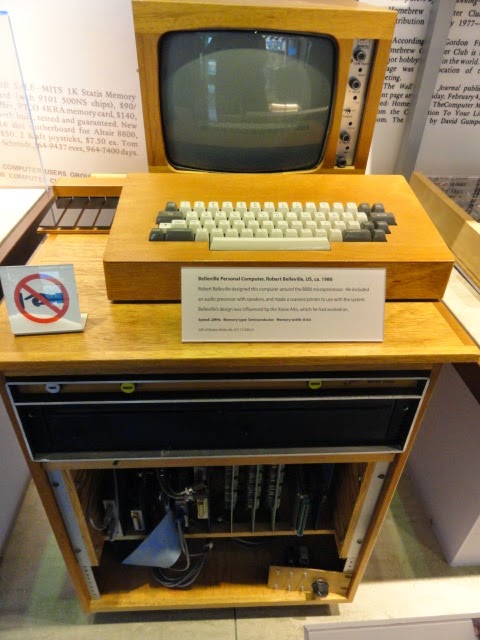
There are twenty 'sign posts' in the Computer History Museum.  We saw everything in detailed minutiae.  One of the highlights were the early desk tops, and I discovered WHY the first personal computers were designed with a keyboard, computer screen that looked like a small TV, on top of a processing 'tower'.  The very first personal computers were individually built at home by a few engineers and scientists.  This one was built by a Xerox engineer, (with wooden cases) for his personal use at home.  His vision of what a home computer should look like is what eventually became the standard for the desk top computer.  

One of the twenty 'stations' in the museum was Gaming.  There was even a 'pong' machine that was interactive - and yes, I'm still horrible at pong.  Those silver knobs were the controls.  The gaming screen consisted of just what you see - a line and two 'pongs'.


 I could go on and on.  We were here for about 3 hours, and I took over 300 pictures (of course).  If you want to see more, click on the link:

https://plus.google.com/u/0/photos/115478608971584948192/albums/6036459133644053793?authkey=CNndgpWltNjEGw


Saturday, June 28, 2014

Asian Art Museum, San Francisco

Front entrance, Asian Art Museum, San Francisco
The Asian Art Museum of San Francisco could be thought of as the museum built by Avery Brundage.  Brundage is best remembered today as a devotee of 'amatuerism' which he promoted as a member of the International Olympic Committee (IOC) from the time of his admittance until his death in 1975. However, when coming through London in 1936 after the controversial Olympic Games hosted by Nazi Germany, he saw his first exhibition of Chinese art, and, according to him, he came away so enamored that "I've been broke ever since".  Over the next thirty years, he collected over 17,000 pieces of Asian art from all over the continent.  He was quick to offer for pieces being sold in distress before and after the second world war in both China and Japan.  He took advantage of the collapse of both the Chinese and Japanese economies to swell his collection.  He engaged a French scholar who was a visiting professor at the University of California as his curator and had a long standing agreement with him no piece was purchased unless they both agreed.  By 1960, he was keeping priceless pieces of Asian Art in shoe boxes under his beds.

The City of San Francisco was ultimately the big winner.  Brundage left his Asian Art collection to the City and it is currently housed (along with a few other pieces) in what is now entitled the Asian Art Museum of San Francisco.  The current building housing the museum was built in 1917 as the library in the Civic Center Plaza.  It was designed after the great earthquake of 1906.  It still retains the 'grand staircase' so prevalent in art nouveau architecture.
The Grand Staircase - made entirely of marble including the carvings on the ceiling

In addition to a world class presentation of Asian Art, we got to see several seminal pieces owned by the San Francisco Museum of Modern Art.  The SFMOMA is currently closed for renovation, and they have loaned out pieces all around the United States as well as to all the other art museums scattered throughout San Francisco.  The exhibit currently at the Asian Art Museum is called "Gorgeous" and consists of 70 diverse works of art.  This exhibit blew me away with the depth and breadth of the art pieces.  There are pictures, of course, of my favorite pieces not only of the Gorgeous exhibition, but of the rest of the museum as well.

Saturday, June 21, 2014

Off to the Wine Country


One of the side trips we've both been anticipating is a jaunt into wine country.  The last time we did this (uh, 25 years ago), we enjoyed Sonoma County more than Napa Valley, so we headed out for four days of exploration around Healdsburg, California.  Drake volunteered to do the research for this trip.  There are more than one hundred wineries you can visit within 15 miles of Healdsburg.  If you rushed in, gulped a 'taste' and moved on, all you'd really have for your trouble is a bad wine hangover.  We set some criteria for our visit:  Affordable wines that have at least SOME distribution.  We started with a Food and Wine article in which they cataloged which wineries they thought were the best in the area.  We also knew going in that we wouldn't be joining any of the wineries 'wine clubs'.  When you have as many addresses as we have in a year, joining a 'wine club' is silly.   We also knew there were going to be some purchases made simply because we loved the wine and not everything we liked was going to be distributed.  Additionally, each wine region has what Drake refers to as 'sweet spots' for certain types of wines.  Don't go looking for sauvignon blanc in pinot noir country.  We did manage to wind up with a broad spectrum of wines with some of bottles falling into a 'special class' which we normally wouldn't be purchasing if we were shopping at Spec's or Safeway.  [That means they cost more than we normally would even think about paying.]  Funny story:  We asked at one winery if they distributed, and they said they did.  We asked,  "Who distributes for you in Texas?", and yep, the answer was "Specs". 


One nice thing about living in Berkeley is you don't have to slog through San Francisco to get to Sonoma.  We were within two hours drive of Healdsburg, so we lingered along the way.  The first little surprise was Petaluma.  It was a nice little town which is home to the Petaluma Creamery.  Shades of Blue Belle and Brennan!
 We stopped both to buy Spring Hill Cheese (a local dairy/cheese maker), and to EAT ICE CREAM!  I must say the peach ice cream  gives Blue Bell Peach a run for its money.  They also have their own cow statue, but Bell Bell edges Petaluma on the cow mascot front.


Healdsburg, California turns out to the the Eureka Springs of wine country.  It's built around a plaza in the center of town.  It was incorporated in 1867 when the 'plaza' was originally the downtown. Now, it's completely given  over to upscale shops, restaurants, inns, tasting rooms, clothing boutiques, book stores, concerts and galleries.  Everyone in town caters to the tourist/wine trade. Ten miles down the road is Windsor - let's just say Windsor is the home of Walmart, Home Depot, Target, and a real grocery store.  Curiously, every nice restaurant in Healdsburg was selling identical menus.  I suppose it had to do with the buzz phrase:  'farm to table' since not only is this a wine valley, but it's a farm valley too.   


   One of the biggest surprises of the visit was the marked contrast between the nascent Oregon wine industry and the mature California industry.  When we were in Oregon, the roads to get to the vineyards were gravel or dirt, and you had to follow tiny blue signs tacked to posts along the roadways.  By contrast, Sonoma county vineyards are all listed on a very nice road map and every road is paved.  The signage is highly visible with arrows!  The Oregon tasting rooms were usually wooden bars you stood at.  In California, there are
gorgeous gardens at every winery, terraces, lawns, outdoor tasting areas, indoor tasting areas, and you can make a reservations for 'food and wine pairings'.

We actually did three of these pairings:  One in Healdsburg at "Partake", which was a restaurant either serving a seven course dinner or a series of 'small plates' and offering wine pairing with each course or plate.  We had a wonderful time here.  We also did a luncheon at the J Vineyards.  We arrived expecting a real lunch with courses and wines.  Instead we got bites and lots and lots of wine.  We had to actually sit in the parking lot for over an hour, so Drake could safely drive!  I didn't enjoy this one much - too little food and too much wine.  I was miserably drunk/hung over for the rest of the evening, slept poorly because of it, and disgruntled at losing an evening.

The third tasting was an appetizer plate plus wine which we both enjoyed.  Drake was really looking forward to this winery because they make Pinot Noir.  As we drove up to the Copain Winery, we couldn't help but notice, there were no vines near the tasting room.  The hills around Berkeley look like this - long grass about two feet in length, all this blond color.  The Copain tasting room was sitting in the middle of these Sonoma  hills which are about 100 feet in elevation.  No wonder fires spread like mad here.  Anyway, it turns out that Copain grows all their grapes in the Alexander Valley up north and over 1000 feet higher in elevation than Sonoma county.  That's why they are making Pinot Noir which according to them needs the slightly cooler weather of higher elevation.  Fortunately, I smartened up and only drank a swallow of a much shallower pour than we got at the J Vineyards.  Copain was our last winery, and on our way back to Berkeley, we stopped at two other attractions  I really wanted to see.


I learned about Luther Burbank in the 4th grade.  What I remember is he fooled around with plants, and he was an agricultural hero.  It turns out my recollection just about sums him up.  Santa Rosa, California was his home and plant laboratory for 40 years.  California celebrates Arbor Day on his birthday.   Luther's goal was to increase the food supply for the world.  Just consider the potato he perfected:  We call it the "Russett", but it's actually the Burbank Russett potato.  It's the most widely eaten potato in the world.  That's just one of his food contributions.  He also loved beautiful flowers, and he worked on garden flowers.  His most famous flower is the Shasta Daisy.  This chart shows his 'big' successes.  His home and the gardens that surround it were his residence for most of the time he lived in Santa Rosa.  Naturally, it's a museum today.

The other famous Santa Rosa resident is Charles Schulz, the cartoonist and creator of "Peanuts", one of the longest running and most widely read comic strips in the world.  He lived and worked in Santa Rosa for more than 30 years, and wrote all his comic strips here.  Upon his death, a museum showcasing his work was built, and that's what we visited.
The museum was beautiful, well thought out, and combined both his written cartoon strips and his animated films.  We even got to see a visiting cartoonist working.  

As always, there are pictures -  Burbank's garden, the Peanuts Museum and the wine country around Sonoma.  


Finally, here's the list of wines we bought on our little junket:


Zinfandels

Balletto Winery – 2010 – Russian River Valley

Mauritson Winery – 2013 – Rockpile Ridge – Dry Creek

Dry Creek Winery – 2012 – “Old Vine” – Dry Creek Valley

Pinot Noir

Copain Winery – 2011 – “Les Voisins” – Anderson Valley

Lazy Creek Winery (Ferrani-Carano) – 2012 Lazy Day – Anderson Valley

Grenache

Quivira Winery – 2010 – Dry Creek Valley

Quivira Winery – 2011 – Dry Creek Valley

Sauvignon Blanc

Stonestreet Winery – 2011 – Terrace Ridge

Quivira Winery – 2012 – “Fig Tree” – Dry Creek Valley
  
Fume Blanc

Ferrari-Carano Winery – 2012 – Dry Creek Valley**

Chardonnay

Rued Winery – 2013 – Russian River Valley

Kendall Jackson Winery – (Jackson Estate) – 2011 – Seco Highlands

Copain Winery – 2012 – “Tous Ensemble” – Anderson Valley

Chenin Blanc

Dry Creek Winery – 2013 - Clarksburg

Rose

Lazy Creek Winery (Ferrani-Carano) – 2012 – Rose’ of Pinot Noir –
                                                                       Anderson Valley

Mauritson Winery – 2013 – “Rockpile” Rose – Rockpile Ridge – Dry Creek


** - We didn't actually buy this one on the trip - found it downstairs at Trader Joe's - knew we were going to visit this winery & bought it ahead of time.


Tuesday, June 10, 2014

Origins of the Moving Picture Industry

Our first California adventure was just a bit odd.  As most people know, California is the center of the motion picture industry not only in the USA, but also for most of the rest of the world.  We experienced the beginnings of the billion dollar industry Saturday night in Niles, California.   As the moving pictures captured more and more interest, the phenomena swept the country in the early 20th century, and first thousands and then millions of ordinary people spent their leisure time going to see what quickly became called 'the movies'.  The demand for product was intense since  initially each 'picture' was usually only a few minutes long could only be shown for a few days in the new movie houses before audiences would begin clamoring for different movies.

Chaplin is the second from the left on the first row.
The first moving picture camera was developed by Edison, and he zealously guarded his camera and patents to the point of sending thugs out to beat up and terrorize filmmakers to kick back a sum for just using cameras they had purchased.  Early films were made in New Jersey, New York and Chicago.  Even the very best cameras only worked with consistent quality in strong sunlight.  To escape Edison's thugs, and the winter weather of New York, New Jersey and Chicago, filmmakers began coming to sunny California.  Niles, California was the new home of Essanay Films out of Chicago.    (Essanay, the film company, which set up to make movies in Niles, was owned by a man named Shor and Broncho Billy Anderson - the first initials of their last names are how they named their film company.) Their first year in California, one of their feature players was a young Englishman straight from vaudeville called Charlie Chaplin.  They paid him $125 a week; a pretty good salary in 1914.  By 1915 he was so popular, he could command $500 a week.   The Tramp, one of his most famous films, was made his first year in Niles.  Five years after this beginning, Chaplin was able to write, direct, and star in his own films, and he made more than $500,000 pre-income tax dollars each year.  He was truly the movies first superstar.

In the background of the above picture is the building which today is the  Niles Silent Movie Theater,. This is a non-profit enterprise which shows two hours of silent films every Saturday night.  For $5.00 a ticket plus $1.00 snacks, you can sit on original hard wooden theater chairs, listen to a live piano
player, and watch cutting edge entertainment circa 1914.  This evening was interesting on several levels.  First, I've only seen a very limited number of silent movies on the 'big screen'.  Second, this was the kick-off to 'Chaplin Week' by this struggling non-profit which is valiantly trying to put their organization, their theater, and their projects into the 'big time' of film restoration and reclamation.  Third, this was film presentation interspersed with commentary by a silent film historian.  As Sarah quipped, it was just like TCM come to life with a Robert Osborne clone.  The film commentator was excellent, and we really enjoyed both him and the piano player who improvised her play as the films were running.  

However, it quickly became obvious the people running the organization are their own worst enemy.  The current project is to raise $30,000 to restore Chaplin's 1915 film, The Champ, made by Essanay Studios in Niles.  There were probably 200 people in attendance Saturday night, and the woman who is obviously the 'wheel' in the non-profit announced they had been given Broncho Billy Anderson's honorary Oscar.   As a fund raiser for the Chaplin film restoration, the 'wheel' carrying her TWO chihuahuas , announced, "During tonight's intermission for a $10 donation, you can have your picture taken with the Oscar.  Sarah and I looked at each other, and we both immediately thought, "Oh boy, I want to do THAT!"

Intermission comes, and we wander all over the place looking for where the pictures are being taken.  No soap.  Can't find anyone taking pictures.  I finally corralled one of the people who long-windedly insisted on giving us the history of the theater and the turn of the century film industry in Niles, prior to the start of the films, and asked,  "Where are you taking the Oscar pictures?"
"Oh, well, let's find Mike and see." (Mike was their photographer - a guy with a camera slung around his neck in a faded t-shirt and cargo shorts.)
"Mike, here's some people that want their picture taken with the Oscar."
"Bob, nobody told me in advance we were going to do this.  Let's just move some of these cameras out
of the way, and then we can get started.  I have to find a place to take the pictures."

Ten minutes later, after rearranging one of the 'rooms' of the museum, they were finally ready to take the pictures.  Turns out that I was the only person willing to ask about the pictures, and when they FINALLY started snapping the pictures, several other people formed a line and paid their $10.  That's Broncho Billy Anderson in the background behind Sarah - who was one of the first cowboy stars of the silent era.  I had no idea he actually was the owner of a film company.  That's a real Oscar.  According to Sarah, it was heavy coming in at about five or six pounds.  I guess if I had just shrugged off the picture, they wouldn't have raised a dime for their restoration from one of their biggest audiences.
It was a fun evening, but I must admit we left right after this picture was taken.  What had been billed as a two hour evening was already pushing three hours at the end of the intermission thanks to the lack of preparation of their opening remarks and their intermission fund raiser.  Plus, even with the pillows we brought, our bottoms were numb from those hard wooden chairs.