Wednesday, July 19, 2023

The Funnest Time in Roanoke

Roanoke, a town of 320,000 is filled with outstanding museums (way above average for its size), great restaurants, and a beautiful setting of rolling hills set in a hardwood forest.  We just kept finding wonderful things to do and places to see right up to the last day.  

Our last day was spent playing pinball because.... Roanoke has a Pinball Museum.  For my youthful readers, 'pinball' was what people played prior to video games.  Thanks to the Covid Pandemic, pinball has made a big comeback.  Apparently, spending a whole bunch of time at home meant, if you were a man, then you needed a 'man cave' equipped with your own pinball machine.  I actually talked to two 30ish nerdy guys who were debating the best of the newest machines.  

Here's what one of the newest of the new pinball machines looks like:  It's called "Weird Al's Natural Museum of Hilarity" and has the most up to date solid state innards and a pixel based monitor.  It also leaves a lot to be desired in terms of reliability.  It broke multiple times in the first three months of its arrival at the Pinball Museum.  I played it.  More about that later.


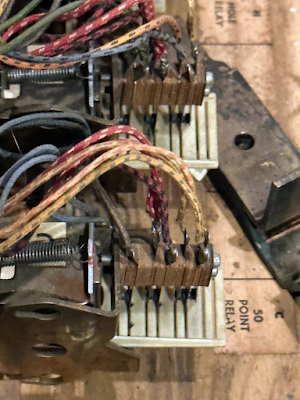
Of much more interest was my talk with "Jason", a mechanical engineer, who volunteers his time repairing these machines.  When I first saw him, he was changing out a transistor based innard for a mother board in a game manufactured prior to 1977.  That was a pivotal year for pinball:   Electronic motherboards appeared and took the place of 'wires' and transistors.  Here's what a transistor innard looks like in an old pinball machine.  Jason was changing out these innards and transforming the game into a motherboard/solid state game.  As the older machines age, parts are just not available.  He will use the same 'top', but the mechanics inside will be completely different.
Wires and Transistors - how every pre-1977 pinball machines looked inside. (above and below left).  The conversion to motherboards - pre1977 to post-1977 pinball machines (below right)


Here's Jason
Whenever I talk to someone who really enjoys either his job or his hobby, there's such enthusiasm.  Jason couldn't wait to show me the 'special' machines.  First up, is 'Humpty 
Dumpty'.  This game was designed in 1947 and it is the first game to employ 'flippers'.  However, they are NOT in the place you would normally expect.  See is you can find them:  
Yes, that's the flippers:  Right above the 10,000 yellow barrels which is about half way up the machine.  It's not until later, that flippers descend closer to the bottom of the machine.  And, it's not until the introduction of the solid state machines that flippers got bigger.  

Drake is an old time pinball player since he played a machine at the pool hall in Altus, Oklahoma during his last two years of high school.  His favorite machine at the museum was a Bally machine called Bows and Arrows.  He said this one has the features he was most accustomed to from that era.  It also has the small flippers and mechanical counters to keep track of your score.


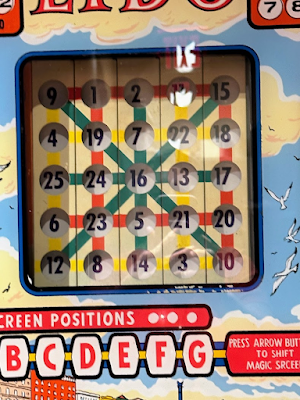
Another strange machine from the 1950's was one called "Lido".  It seemed to blend a gambling element, almost like a slot machine.  You could choose your 'level' to play depending on how many nickels you initially fed into the machine.  I think the photographs will help you get the picture.


I really wanted to play this machine, but it was one 'under repair'.  Jason told me it was almost impossible to have all the 'old' machines up and running all the time.  I decided to skip up to some of the first motherboard machines.  I noticed two things about the more modern machines: (1)  The flippers were about 1/3rd bigger, and (2) the machine would hide the ball, and you had to be prepared for the ball to squirt out in various places.  Initially, I would just stand there as the ball shot out about halfway down the board.  I gradually got better - about a C- worth of better.  Here's the machine I really liked which was one of the first to have an interactive monitor - the 'bride' would have different faces depending on your score with each ball.  At first, I didn't even realize what was happening.  Here's what it looks like - very futuristic, very silver (instead of red, blue, yellow and green).

Remember, I said I'd played the 'newest' game?  It shared more characteristics with the Bride of Pinbot than the Bow and Arrow Game.  Here's a look at the 'board'.  The ball, initially hidden from the player,  would squirt out from multiple places.  You had to be quick, quick, quick with the flippers.


The Pinball Museum is in the center of downtown.  It's in the Market Square which has been selling stuff continuously since 1882, just as the railroad arrived, thanks to that $10,000 bribe. 

The Center in the 21st century is home to a farmer's market, two museums, a few stores (like a candy store!), the local stage for live theater, and a miniature aquarium.  Here's my favorite aquarium shot.


We waved goodbye to Roanoke, and hit the road for Asheville.  It's in the mountains, and if the Canadian smoke ever clears, this place nestled up against the Great Smokey Mountain National Park should be lovely.  I'm already getting the vibe that Asheville is to North Carolina as Austin is to Texas.

Here are more pinball pictures.  I'm playing a Beatles pinball game.


Friday, July 7, 2023

From Big Lick to Roanoke

 When you move to a new town, even for a month, you learn so many things about the place.  Roanoke is a beautiful small city with an accessible downtown.  It's anchored by the beautiful Taubman Museum which I talked about in my last blog.  Curiously, though, I asked several people what they thought was the best attraction in Roanoke.  They ALL gave the same answer:  The Mill Mountain Star.  The "SW Virginia Living" magazine had a picture of the star all lit up in front of a full supermoon which I thought represented how the Roanokians feel about the star and by extension, their little city.

"Roanoke Star" - Symbol of Roanoke, the Star City

Roanoke sits in Roanoke Valley and is surrounded by the Blue Ridge Mountains, a range in the Appalachians.  We drove up Mill Mountain to check out the star and to take a short hike.  (Turned out to be VERY short - no, not my feet or my back.  It was hot, hot, hot and all about trees and only trees - thus, boring after the 10,000th tree.)  Here's what the star looks like during the day:


 The star was built in 1949, a symbol of the post WWII optimism.  There was an amazing amount of materials needed to built this.  Here are the statistics:


 Naturally, there's a lookout observatory platform, at the base of the star, and the Wells Fargo Building dominates the downtown skyline of Roanoke as the Empire State Building did in Manhattan when it was first built.  You can see the Blue Ridge Mountains in the background.


Here we are on the Mountain Star Trail doing our abbreviated hike.  You can tell we haven't been on the 'trail' long because I'm not beet red!  I'm admiring the forest of elm trees which Drake guesses are 40 to 50 feet tall.  And, as you can see, mostly these are saplings!


Roanoke is a railroad town.  The railroad transformed this town in the 19th century just as towns in the 20th and 21st century are being transformed by the infrastructure locations of technology giants.  The railroad was one of the major game changers of the industrial revolution as the computer has been  in the electronic revolution. 

The railroad stopping in your town immediately turned the town into the business hub of the region.  The Norfolk and Western Railroad came to Roanoke in 1882.  The town offered free land for the depot, tax exemptions and $10,000 in cash (can anyone say BRIBE?).  It worked.  Between 1880 and 1890, Roanoke, formerly Big Lick, became the fastest growing town in the South.

The railroad built the tracks and the depot down the center of town (about 700 residents at the time.)  One consequence of the location of the 'tracks' was south of the tracks became the African-American side of town, and north of the tracks was entirely Caucasian.  Jim Crow laws were vigorously enforced.  Below is a 'then' and 'now' picture.


These pictures are from the Roanoke Historical Society Museum called the "O. Winston Link Museum".  So, who is O.Winston Link?  He's a self taught photographer, lifelong Roanoke resident, who decided to document the end of the 'steam era' of the Norfolk Western Railroad in the 1950's.  He usually worked at night, carefully composed his photographs, used his engineering degree to plan his photos, set up photo flash bulbs to light what he wanted lit, and worked with two cameras.  People who worked on the railroad loved him, and train engineers would often slow or stop their engines, so he could get his 'shot'.  He had hundreds of negatives and photos since he processed all his photos himself.  There didn't seem to be a market for his photos until they came to the attention of the Museum of Modern Art in New York City.  The photographic curator knew genius when he saw it, and he promptly bought many of Link's photos.  Today, you can see his best photographs in the museum.  The museum has produced a wonderful 30 minute video about Link and his photographs.


I also really liked the stained glass windows commemorating O. Winston Link.


As a little lagniappe to the story of Roanoke and the railroad, we discovered an exhibition which is a homage to the hat.  Here's a collection of hats owned by the museum.  This exhibition is just charming.  The exhibition was dedicated as a birthday gift for 95 year old Sara Airheart, a longtime volunteer at the museum.  Here's a taste:


As always, if you want to see more pictures (including a lineup of prostitutes circa 1885), just click on the link:


Monday, July 3, 2023

Taubman Museum of Art, Roanoke, Virginia

Taubman Museum of Art, Roanoke, Virginia


 Roanoke, Virginia, has a little over 300,000 people.  In a town this size, 'culture' is usually firmly entrenched in the minor leagues.  (Yes, we are watching baseball every day.)  No matter the size of the town, there's always someone who is financially backing whatever culture can be found.  If you've been to Fort Worth, then you know the Bass family has been crucial for decades in elevating the culture of this dusty western town way above what would normally be expected..

The Bass equivalent in Roanoke is a family named Taubman.  Nicolas Taubman inherited Advance Auto Parts from his father Arthur.  He was CEO of this company until 2005 when he was appointed Ambassador to Romania.  His wife, Eugenia (Jenny) is a naturalized citizen from Bulgaria.  Mr. Taubman was born in Roanoke, and the couple still make their home here.  Their philanthropy is responsible for the new art museum.  Donating $15 million will get your name on the marquee. 

The Taubman Museum of Art (see picture above) was conceived and designed by Randall Stout, an award winning architect.  The museum points to the future with the 75' atrium designed to be lighted at night.  New types of translucent material keep the interior cool during the day.  The rest of the museum represents the hills and valley of the Blue Ridge mountains which surround the Roanoke Valley.  The museum was designed not only to display the art collection but also to offer the community spaces for celebration events such as anniversaries, weddings and birthdays.  There's a theater, a cafe, and meeting rooms.  Even with all that, two things stick out for me:  The building is beautiful, and admission to the museum is FREE.  

The early motivation for a new building for the museum was the coup of landing the collection of Peggy Eakins, the grand niece of Thomas Eakins, the leading American realism painter of the nineteen century who lived in Roanoke.  [Realism refers to the painter's choice of subjects - ordinary places and ordinary people.]  The Roanoke art community lobbied Peggy and won the collection instead of Philadelphia, where Eakins was born and taught at the Philadelphia Art Institute.  He was an early advocate for drawing from 'life' no matter your gender.  He put his $$ where his mouth was because  he was fired for removing the loin cloth of a model in a mixed gender drawing class.  This was the episode that was the final straw of the conservative artists/benefactors who ran the Institute and were happy to be rid of him and his controversial ideas.    

Eakins was also one of the first artists to use photographs as the basis for some of his portraits.  The museum had pictures used by him and the finished portrait he completed hung nearby.


This is William McDowell.

Eakins most famous painting, "Dr. Samuel Gross (Gross Clinic)" was rejected by critics and the public alike.  It depicts Dr. Gross giving a lecture waving a bloody scalpel while talking over the gory patient.  Neither the critics nor the public ever warmed to the monumental talent of this painter during his lifetime.  Everyone else in the art world was dabbling with impressionistic landscapes while Eakins painted ordinary people, often in motion, and sometimes nude.  Upon his death in 1916, the more than 300 paintings that survived him couldn't be given away.  This all changed when the Metropolitan Museum of Art in 1917 opened an exhibition of his work.  Eakins wife, Susan McDowell Eakins, also an artist, who was his student, painted the picture I loved the most of all the Eakins pictures now owned by the Taubman Museum.  It was painted in 1916, the year of his death.  It's a self portrait called "Anguish".  She lived another 22 years, dying in 1938.


The Taubman is not just an homage to Thomas Eakins and his family.  There were many fine paintings, decor, sculptures, and exhibitions.  I think you will find two of the exhibitions to be most interesting:  One is about Louis Tiffany, and the other is about Judith Leiber who created special occasion handbags.  I also enjoyed the repurposing of the Opera costumes which was the exhibition hanging in  the atrium.  

Here are the photos:

Wednesday, June 28, 2023

Dixie Caverns

 When we travel I have a soft spot for certain types of attractions.  I've taken my readers to county fairs from the Pacific Northwest to New England.  I've investigated every kind of off beat museum that crosses my path.  Everyone knows my very favorite big museum is the MET in NYC.  However, I'm also a sucker for caverns.  

Therefore, when I saw the advertisement for the Dixie Caverns, I could hardly wait to go.  Sure enough, it was everything I hoped for.  The discovery story was fascinating.  It's 1920 and a couple of 13 year old boys were out with their dog fooling around.  The dog fell into a hole, and the boys couldn't get her out.  Long story short - they got a couple of adults and some rope  One of the boys was lowered into the hole, rescued the dog, DIXIE, and discovered the cavern.

Over the next few years, the boys explored in the cavern named for their dog.  They crawled into narrow places with their lanterns moving from one discovery to the next.  Here's one of the crawl spaces - so tight, they broke off the rock 'soda straws' hanging down in the crawl space.

Crawl space

Broken soda straws from crawling under them

In 1923 the Dixie Caverns opened to tourists.  One little hitch in the tour - the tourists were lowered individually by rope down the through the same hole Dixie the dog fell into.

The green are leaves - this viewpoint was from the 
bottom of the cavern - approximately 15 feet -
pretty long way to be lowered by rope!

In the 1950's the caverns underwent a major upgrade.  No more rope lowering.  Stairs were poured, floors were laid.  You didn't have to crawl around.  All the dirt and debris dug out during the remodel was packed together in the shape of a wedge of cheese, and over the next 60 years, the dripping water loaded with minerals coated the wedge.

Facing the front point of the "cheese"
floors are on each side.


Drake and I are standing under the "wedding bell".  
(Caverns always name their formations.)

Yes, I'm beet red with my jacket tied around my waist.  Even though the caverns are a constant 55 degrees, I'm so hot my glasses are fogging up.  Drake has on three layers of clothes.  According to our guide, getting 'dripped' on - especially on your head - is a guarantee of good luck.  I'm going to be very lucky....  I wonder how long it will last?

If caverns are your thing, there are more photos with lots of named stalactites and .    
stalagmites.  If the cave wasn't enough fun, there was a huge 'collectibles' antique mall attached to the gift shop with dozens of booths selling everything from record albums, to vintage everything else.  (I bought some handmade crocheted pot holders and a set of salt and pepper shakers made out of pressed glass with flower etchings and silver tops.)
Am I a tourist or what?

I'd look at the pictures individually, so you can see the captions.  


Saturday, June 24, 2023

Where the West REALLY Began

 Fort Worth, Texas, is known as the place "Where the West Begins".  Not so fast....  There have been many places in the United States where the West has begun.  Perhaps you think of St. Joseph, Missouri, the jumping off point for covered wagon travel.  Or, it could be the western end point of the Erie Canal.  This week we visited a place which is where the West truly began:  Fincastle, Virginia, founded in 1770.  If you arrived in the American Colonies in the 18th century at Philadelphia, the largest city in Colonial America, you quickly determined the free land of Pennsylvania was already claimed.  A significant number of immigrants, first the Scotch-Irish and then German immigrants moved down the Great Valley Road on their way to the Shenandoah Valley and points west.  Many stopped at Fincastle, the County Seat of Botetourt County, Virginia, to resupply to continue travel into the unknown western wilderness of Kentucky, Ohio, Iowa and Illinois.  


Botetourt County included all the land shown, but all new potential settlers saw was uninhabited wilderness where they could claim as much land as they could take back from the gigantic forest which covered it.  Of course, there were multiple tribes of Native Americans living in this supposedly uninhabited area including the Creek, Cherokee, and the Shawnee to name a few.  The clash of the European and the Native American cultures began in earnest as more Whites arrived in the British Colony.  Prominent Virginians, including George Washington, Patrick Henry and Thomas Jefferson, arrived in Fincastle or sent their agents, to 'claim' large tracts of land.

Fincastle was built in the 1770, and incorporated in 1772.  It was a town of merchants and lawyers.  As the county seat, it boasted of a magnificent courthouse which would later be rebuilt in the Jeffersonian style.  If you could afford it, you could supply yourself to move deeper into Botetourt County.  The county was named for one of the few Colonial Governors who actually arrived in the New World to govern.  It was much more common to hire a 'Lieutenant Governor' who would actually make the arduous sea voyage and govern the colony.  

Today, the entire town of Fincastle, Virginia is an architectural wonder of buildings constructed in the 18th and 19th centuries on the spot where they still remain. I spent quite awhile studying a map of the enormous county to get a feel for what Colonial Virginia at the edge of the wilderness looked like to the immigrants.  (Dotted lines are 'roads'- mainly trails through the massive forests.)

Modern Fincastle is a small town about 16 miles from Roanoke.  Since we arrived in Roanoke, it's been raining.  The day we visited Fincastle, like idiots we walked around locating the historic buildings in the drizzling rain. (The brochure pretty much melted by the end of the day!) We began our visit at the Fincastle Historical Society Museum.  This is a small museum housed in a 19th century home.  The museum collection is of ordinary objects mostly donated by local residents.  My favorite object was dug up by a local resident as she was gardening.  Boy, was she surprised to find this slate sun dial dating from the 1790's.

I also liked the traveling kitchen from the 18th century.  Those are pewter plates, an iron mortar and pestle, an axe head, cooking utensils, and a lantern.  It would be carried on the back of either a handcart or a wagon as an immigrant (sometimes accompanied by family) moved into the wilderness.


Fincastle was devastated not just by one fire, but two, one in 1820 and the other in 1870. The courthouse as well as most of the 18th century houses on central Main St. were destroyed.  The museum has two of the items left from the original 1770 courthouse:  a large bell and the original witness chair.


(Sorry about the poor picture, but it was behind glass & it picked up the glare in the room.)  I could have done without the 'model' in the witness chair in an inappropriate dress.  It would never have been red, and unlikely to have been trimmed in lace.  Also, the testimony of women in any kind of trial would have been severely limited in the 18th century. 
 
Nevertheless, having a 24' x20' courthouse with accompanying sheds to each side in 1770 would have been an impressive structure.   All of the early structures in Fincastle would have been made of hand hewn logs, covered by clapboards - a luxury.  Fire was a constant hazard.  Most of the centrally located buildings, including the courthouse, were consumed by the two fires (1820 and 1870).  Fortunately, the country records were kept inside an iron safe inside the courthouse and the safe along with the records survived the fires.  Fincastle was such a lucrative location, with unlimited building supplies (logs), the structures were re-built, and the town continued to prosper.

While I found the colonial artifacts the most interesting, the museum also displayed additional artifacts from later periods.  The furniture was also beautiful.  Here's a restored 18th century spinet which was found in terrible shape in an old barn.  The craftsmen at Williamsburg restored it.  The price was the right to show it at Williamsburg for a number of years.  Then, it was returned to Fincastle.


The biggest attraction at Fincastle are the buildings.  There are numerous buildings from the 18th and 19th centuries.  The 18th century houses were built out of hand hewn logs, then if able to be afforded covered by clapboard.  We found one house (on the National Historic Register) which has been restored to the exterior logs. This is the Crowder house, circa 1791.


  Another building constructed in 1872 and restored to the original logs was a 'destination hotel' for coastal visitors escaping the summer heat and more importantly the mosquitoes which caused Yellow Fever.  The monthly rate in the 1880's was $25 a month.  That's Drake in the blue rain jacket.
As we were walking around, Drake reading the melting brochure, and me taking pictures, one of the owners of an 18th century house came outside and invited us into a portion of his house.  I was especially interested in the stonework around the fireplace, outer wall, and the hand hewn logs running along the ceiling.  All the stones are hand placed.  There is no mortar between the stones.


Due to the lousy weather, we stopped in at the Pie Shoppe and had wonderful homemade pies.  True to the Southern tradition, we had just sat down when we were quizzed by two separate employees (and I quizzed them right back) about where we were from, why were we in Fincastle, etc.  Discovering how truly wet we were, and full of pie and coffee, we called it a day after seeing only about one-fourth of the homes/buildings.  However, as usual, I took plenty of pictures.  Look at them individually, one after the other, to see the captions.


Tuesday, June 20, 2023

Seagrove, North Carolina

I got ALL whipped up when I toured the miniscule Greenville, NC art museum.  Did they have fabulously unexpected pictures or sculptures?  No.  Did they have world recognized artists?  No.  So, you ask, why did I get my panties in such a twist?  The tour guide clued me into SEAGROVE, NC., arguably the hand made pottery capital of the United States.  I immediately got Drake on board to visit this podunk town, population 200, with one stoplight.  I even made arrangements to stay overnight at the Duck Smith B & B, a turn of the century home, which is exactly the same as when it was built with the exception of the addition of four bathrooms.  [Surprisingly, the interior walls of this house - and I mean EVERY interior wall - was two inch wide dark varnished board and that included the ceilings!]  Fortunately, these were the high ceilings you find in these types of houses to help with summer cooling.  I forgot to take pix of the house because I was so pottery crazy.  This was a great place to stay - comfortable and with a killer breakfast.  

However, I came to see pottery, and I conquered.  First, we toured the North Carolina Pottery Museum which was an interesting history lesson about pottery in this Piedmont Region of North Carolina.  To make pottery you need clay, and central North Carolina is filled with all types of clay deposits.  The pottery tradition started with the Native American tribes which inhabited this area.  They made coiled rope pots and fired them.  Every piece needed a five step process to complete, and every piece was functional.


The Europeans arrived in the mid 1700s, and some of the first arrivals came with pottery making skills which included using a pottery wheel.  They were thrilled to discover potter's quality clay for the taking.  Unfortunately, the early glazes included using LEAD.  The lead poisoned both potters and their families.  The below pictured plate is from 1780 and the cake pan is from 1830 - they both use lead based glazes.  The plate form and decoration is still being made today by contemporary potters.


As soon as lead was determined to  be poisonous, potters quit using this type of glaze.  However, the clay needed for the non-lead glazes was much harder to get.  It needed to be dug out instead of being collected by the shovelful on the surface of the land.  The new type of clay when fired was called 'stoneware' replacing the earlier clay called 'earthenware'.  Potters scouted out caved in sides of creeks and riverbanks (water is in abundance in NC) as the easiest way to find the necessary clay.  Clay digging expeditions were organized.  In addition to the right kind of clay, potters began using salt fired glazes.  If there was no convenient salt lick, then this ingredient needed to be purchased.  Salt was dumped into ports in a hot kiln containing the stoneware vessels.  This caused a gray dimpled glaze which looked like the surface of an orange.  The pot below was fired in 1850.


North Carolina pottery of the 19th century was completely functional.  Pottery was used for all types of plates and bowls, but also for canteens, foot warmers and grave markers.


Pottery making was the second source of 'cash' for a family farm after tobacco.  Thus, family run potteries have a long history in North Carolina.  One of first large family potteries run as a business separate and distinct from a tobacco farm was the Jugtown Pottery which is still in business today.  Here's an example of Jugtown pottery in the distinctive orange glaze. 


In the 20th & 21st centuries, pottery had a dual character.  The majority of pieces were still 'functional' and classed as a craft rather than an 'art'.  From the 1970's forward, more and more potters were creating studio pottery following the Japanese style - production of mostly functional pieces which prized uniformity of pieces together with the 'master potter' creating one of a kind studio pieces.  It hasn't taken long for these unique studio pieces to be classified as art by the art world and displayed in top museums. 

I've been collecting pottery since 1970.  My pieces are both studio pieces and functional pieces, and my favorite pieces are BOTH.  We went crazy in Seagrove.  I could have easily spent another entire day there and spent twice as much.  Fortunately for me, there are three large galleries in town which display and sell 90% of the 100+ potters working in the area.  I came away with a beautiful platter 18" long which is sea green and shaped like a tropical leaf; a blue jug with cascading glaze useful for gravy or salad dressing or juice for two; two magnificent coffee cups, so lightweight you can't believe they are pottery; a large round lidded display piece in forest green; two small display bowls; and a piece of lace pressed pottery about 3" across.  Oh, man, I had a good time.


If you are ever in the area, I recommend a stopover.  The big galleries are all clustered in town.  If you need more pictures and explanations, here they are: