Wednesday, August 26, 2015

The Best Canadian Pictures

I realized my last post was all 'words', and I know certain readers (you know who you are) never read a word I write and head only for the pictures.  So, thinking of you, I went back through the pictures I've taken this trip and picked out the best.  I probably added too many "words", but you can just ignore them.

Our initial trip fervor was to get to Connecticut and watch our daughter graduate with advanced degrees from Yale.  (Yes, I'm bragging.)  Here's perhaps not the best picture, but certainly my favorite picture.
Drake and Sarah at Yale Graduation - Oh, and I made the hat!
The hat thing is a Yale Forestry School tradition.  Her Environmental Master's Degree is from this school
I was so happy that day.  One of the best pictures taken of me in years was in the Forestry School graduation tent.
I decided if Sarah could have a hat, I could
take the leftover materials and make a
corsage.  I wish I'd had enough to make one for Kit,
Jay's mom.  We were all so very happy that day.
I expected moving on to Boston after graduation would be a let down, but it wasn't in the least.  Here's my favorite Boston picture
Fenway Park was a 'bucket list' attraction for Drake.
We had a great time; the ball park was everything everyone
always says about it.  The Rangers won 2 out of 3 - guess which one we saw?  
I had mixed feelings about Maine.  We initially expected to summer there, but I couldn't find anyone who would rent me a house when I tried for one in February.  In a way that's how the trip to Canada came about.  There are two pictures from Maine. The first is from Vinalhaven, Maine.  That's an island in the middle of the Atlantic Ocean. You have to want to live there badly since it's a 1 hour 20 minute ferry ride from shore.  I'd be stark raving crazy in a week.  To visit however is wonderful.
Vinalhaven is all about lobstering or 'hauling' as they call it.  If you ate
a lobster this summer, most likely it came from here.
Bar Harbor is the bookend to Banff, completely a tourist town.  We spent time in Acadia National Park which was lovely.  I'd like to see it in the fall.  Here's Acadia.
The balanced rock is an 'erratic' - a random rock
different geologically than the area where it was
deposited as a glacier receded.
New Brunswick, our first Canadian province, and the most bilingual, was also the least photographic.  The most interesting 'attraction' we saw there was the Hopewell Rocks. These are towers of stone which are located in the path of the Bay of Fundy Tides which rise and fall about 35 feet on a normal day.  Low tide:  Walk around the base of the Hopewell Rocks.  High tide:  Kayak around the top of the Hopewell Rocks.  These are called 'flowerpots' since they have vegetation growing on their tops.
These are about the size of a four story building.
Nova Scotia was wonderful vacation with a teen aged Sarah 15 years ago.  We were eager to return to the part we didn't see then.
Bonus!  This is the first place we saw rhododendrons in bloom.
Breathtakingly beautiful.  We actually saw four, yes four 'springtimes'.  What a treat!
The real attraction in Nova Scotia was in Halifax:  The Citadel, a British Fort built in the 19th century, was so impregnable, it was never attacked.
This is one half of The Citadel which sits on the highest hill in Nova Scotia overlooking the water access
to the city of Halifax.  I'm on top of on of the three foot thick walls looking down on the courtyard.
I would be remiss if I didn't include a picture of the Wile Carding Mill, a peek into the
early Industrial Revolution.  As a person with an American History degree, this was thrilling!
Most of these mills burned down, often killing workers.
 All these mills, and there were about 50 in the hey day, is a tinder box.
We caught the ferry to Newfoundland at Sydney, Nova Scotia.  I was really dreading the 10 hour crossing.  There was a lot of hand wringing on my part and ginger chomping since I was completely positive I was going to be sea sick for the entire crossing.  Of course, all worrying is so useless.  The sea was like glass; I slept the night away  People who worked the boat told me it was the smoothest crossing they could remember this year.  Newfoundland was fabulous and would have been worth even a rough crossing.
Here's the Western Brook Pond.  It's an enclosed fjord.
This is one  of the ten boat trips we've taken on this journey.
Gros Morne is a UNESCO National Heritage Site because of it's unique geology.
This is Bonne Bay, formed by glaciers, and in the background is the brown tablelands rock from the earth's mantle right beside the remains of an ancient ocean.  This juxtaposition helped prove the tectonic plate theory.  
When in parks we are always on the look-out for animals.  This sighting was one for the books.  Park workers told us the small herd of caribou in the park have learned the cars stop for them, and treat the highway as the easy way to move from meadow to meadow.
He walked right beside the car!

We hated leaving Gros Morne, but we actually changed our itinerary to loop up to Twillingate on the north shore of central Newfoundland to see icebergs.
Now, this was a boat outing!  It was also the roughest sea by far.  I had to wedge myself on deck to take this picture in 40 degree temps with threatening rain.  Glad I brought my long underwear.
The other fascinating thing about Twillingate was the local museum.  Here's the centerpiece of their little historical museum
This polar bear arrived in town via ice floes about ten years ago.  He ambled around town for hours.  The bear finally had to be put down.  Now, he lives on in the town's museum.

If I had to name the most unexpected attractions we encountered in Canada, it would be the churches, notably, the Catholic churches.  Here's the St. John's Basilica in St. John's, Newfoundland.
I chose the long shot to give you the grandeur of this church.
The one boat ride I've been thinking about since February was the Puffin Boat.  Well, the puffins didn't disappoint.  How could they?
Aren't puffins great?  The adolescents spend 3 years at sea before they return to land to mate.  That's your puffin fact for the day.
A feature of St. John's was brightly painted houses.  In fact, most of Newfoundland is filled with houses painted every color in your imagination.  Surprisingly, in other cities and provinces this is a recent phenomenon, but it's really caught on.
Typical street in St. John's.  This kind of whimsy makes this city very livable, and I can imagine how cheering it would be in a winter I can't even imagine.
Coming back from Newfoundland, we entered what I thought of as rural France.  Actually, it was the Gaspe Peninsula in Quebec, our fourth and the most difficult province of the trip.  French, French, French everywhere.
You are looking at where the St. Lawrence River flows into the Atlantic Ocean
Because of the preponderance of French, Quebec was frustration at every turn. However, it was lovely. I loved the Halte Municipals - public washrooms.  (After Canada, I don't think I'll ever think of public conveniences as anything except 'washrooms'.)
Every town on the Gaspe peninsula had an immaculate public washroom.  The USA could take a hint.
I can't leave the Gaspe Peninsula without sharing my picture of our first moose.
I guess these animals are real after all.  We've seen two so far standing in water and eating water plants.
Finally, the major tourist attraction of the Gaspesie (Gaspe Peninsula) is the Perce Rock

We were sitting on a patio drinking a bottle of Pinot Noir when I shot this photo.

We took ANOTHER ferry in Matane, Quebec to cross the St. Lawrence.  Matane was an industrial town, but I ferreted out the Jardin de Doris
Say hello to lupines.  Another flower that was unexpected.  
I knew there would be flowers in Canada, but I wasn't prepared for the devotion to their flower beds and gardens especially the French Canadiens.  Some yards in extremely modest homes were breathtaking.  I also loved these flowers

We actually stayed in Levis across the St. Lawrence River from Old Quebec City.  There were excellent pictures to take of the city from the ferry.  Old Quebec City place filled with architectural wonders as well as a magnificent mural
Here is the history of Quebec City in picture form.
What was the most fun thing about Quebec City?  The funicular, of course.
This device, in service since 1879, is the connector between Upper and Lower Quebec City
The Notre Dame Church in Upper Old Quebec was breathtaking


I could put up a zillion pictures from Quebec, but I'll leave you with one more.  Here's the most photographed hotel in the world
What a monstrosity!  I took this picture from the ferry.
Quebec to Ottawa was a short hop.  Ottawa is the capital city of all of Canada.  Here's what Drake wanted to do most of all
The Changing of the Guard  happens at 10 am every morning, rain or shine, since 1954.  I really like  I captured their feet in the air.  They are actually doing parade marching as part of the ceremony.
We really liked the museum scene here since most of the National Museums (think Junior Smithsonian) reside in Ottawa.  Here's part of the most striking exhibit at The Civilization Museum
He's going on the road with his dog, his frog, his raven, his whale, his wolf, his child and his wife.
 The funniest thing about Ottawa?  It was the gargoyles scattered all over the Parliament Buildings.  Here's my favorite
I guess he's praying for honest legislators and just laws.
Our favorite city was Toronto.  We are considering spending next summer in upstate New York because we didn't get enough of this place.
This picture may look a little funky - but we were on the other side of an arm of Lake Ontario on our bikes
when we spotted the Toronto skyline.
We are definitely fans of the Canadian Seven.  They were a group of seven painters who decided to paint Canadian landscapes beginning right after WWI.  My favorite painter in that group is Lawren Harris, and here's my favorite picture from the exhibit
Lawren Harris, 'Grounded Icebergs'  After seeing the real McCoy, how could I not like this picture?
Harris decided to rent a railroad car about 1920 and have the Transcontinental Canadian Pacific haul the car to Agawa Canyon, a scenic spot, an hour and a half outside of Saulk Sainte Marie, Canada, and he painted in isolation for the summer.  We took a relaxing train ride to the spot.
Agawa Canyon - weather didn't cooperate, but this was one beautiful place.
We went to Sudbury, Ontario to do laundry, and we found
The 'Big Nickel' - couldn't resist including this - it was so over the top.  That nickel is 30 feet in diameter
Drake dreaded the drive around the north side of Lake Superior.  It turned out to be an outstanding scenic drive which we both enjoyed immensely.  One section if famous for its amethyst mines - guess who got a new necklace?
Here's a Lake Superior roadside attraction:  the second largest waterfall in Canada.
The largest waterfall in Canada was so enormous 'waterfall' is too small a name for it.  Niagara exceeded both our expectations.  I'll never forget the sound of the falls.
Maid of the Mist at Horseshoe Falls.  That's American Falls in the distance.
Winnipeg, Manitoba is the type of place you have to ask yourself, "Why would anyone want to live here?"  It's a lively city, but even in the summer, the wind was blowing constantly.  Can't imagine winter and the wind chill here.
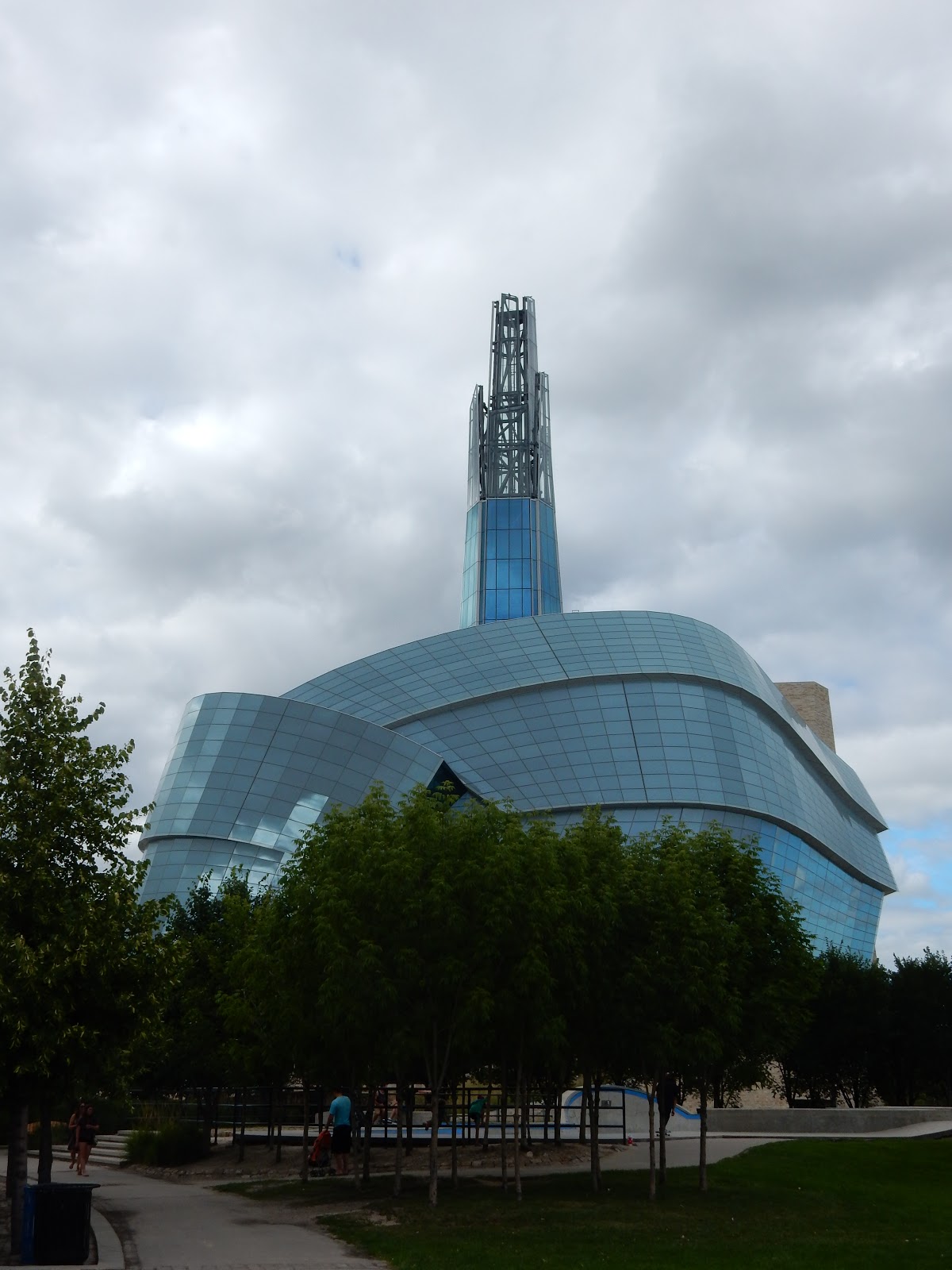
This is the National Museum of Human Rights.  It's the first national museum in Canada to be
 opened in 40 years.  It was beautiful with that terrific observation tower on top.
Winnipeg is also known for Folklarama - a celebration of all the ethnicities the railroad dropped off here at the turn of the century.  You go to pavilions, eat ethnic food and watch entertainment.  Lots of fun.  We timed our visit for this event.
All the hosts, performers, cook and servers are volunteers.  There are about 30 pavilions you can visit
in the two week festival period 
So, we are driving, I'm embroidering, and had my head down.  I looked up and we had popped out onto the prairies.  Actually, as soon as you drive down off the Canadian Shield (a big rock shelf that covers almost one-third of Canada) the prairies begin - abruptly.
We came down off the Canadian Shield, and I swore I had landed in West Texas.  I felt just like a reverse Dorothy in the Wizard of Oz.
This prairies were comforting.  Familiar, yet a little unfamiliar.  The drive was not boring.  The amount of agriculture we zipped past was like a combination of West Texas cattle county and the flat rich black soil of the Midwest. Here's a crop growing I'd never seen
Say hello to canola.  I took lots of pictures out of the car windows - have to when you're driving 11,000 miles in a trip.  
As we headed further west, the landscape changed again
These rolling hills held a surprise - the badlands.
We headed for the dinosaurs in Brooks, Alberta.  What I didn't expect was the super-sized form of Palo Duro Canyon.  These are the Canadian badlands.  They don't rise above the land, the sink down into it just like Palo Duro does in West Texas.
This place was a photographic dream.  I could put up 20 pix.  This as a fun place to hike.  It is also paleontologist heaven because of the major dinosaur bone finds.
And the dinosaurs they dig up in Dinosaur Provincial Park wind up in an internationally famous dinosaur museum called the Royal Tyrrell Museum.
The mineral content turned this complete skeleton black, thus the nickname.  The entire museum was really
impressive, but this guy is the jewel of their collection.  If you have any little kiddos, I have a complete dinosaur photo album designed just for kids.  Email me, and I'll send it to you. 
After Brooks, we headed for Jasper, Alberta, and the home of Jasper National Park.  We maximized our time there with our 10th boat outing on Maligne Lake
You can't beat these glacier lakes fed by snow melt.  These peaks are about 8 - 10 thousand feet.
Definitely in the Canadian Rockies now.
The boat ride was out to 'Spirit Island' which is just this tiny spit of land.  Hey, it gives a reason and destination for a boat ride.
And here is 'Spirit Island' in all its glory - actually, this reminds me of St. Mary's Island in
Glacier National Park.  You should have seen the people with tripods and foot long lens, some even getting wet to take this picture.
The bonus of this boat trip was this mother moose and her two calves.  Of course, there were people creeping too close.  We were on the boat, and our boat commentator was getting quite worried as people kept edging up and actually got BETWEEN the mother in the water and the calves on shore.  How stupid can people be?  Pretty stupid.


Then we headed down another famous scenic drive, Icefield Parkway, which was pretty much compromised by smoke which has drifted in from the wildfires in Washington state and Idaho.
Here's a glacier - thus, the name Icefield Parkway
The other major attraction of the Parkway is Lake Louise; however, we were at the peak of tourist time and we couldn't even find a parking spot to be able to get even a glimpst, so we settled for Peyto Lake recommended by a Canada Ranger we ran into in Newfoundland!
This is Peyto Lake; you can see the smoke in the picture (to the right), and we contended with growing smoke from wildfires in Washington and Idaho from this point forward
We landed in Banff, the bookend to Bar Harbor both being uber tourist towns.  To be fair, Banff (like Bar Harbor) has done a good job at being a town whose sole purpose is to live off the tourist trade.  Banff especially has devised an entire system of bike and hiking trails that leave from town to a number of their 'attractions'.  Good thing for us - we lost the car for 3 days having the car towed to the next town over and repaired.  Here's one of those 'bike to' attractions.
Riding our bikes here was a much fun as the attractions.
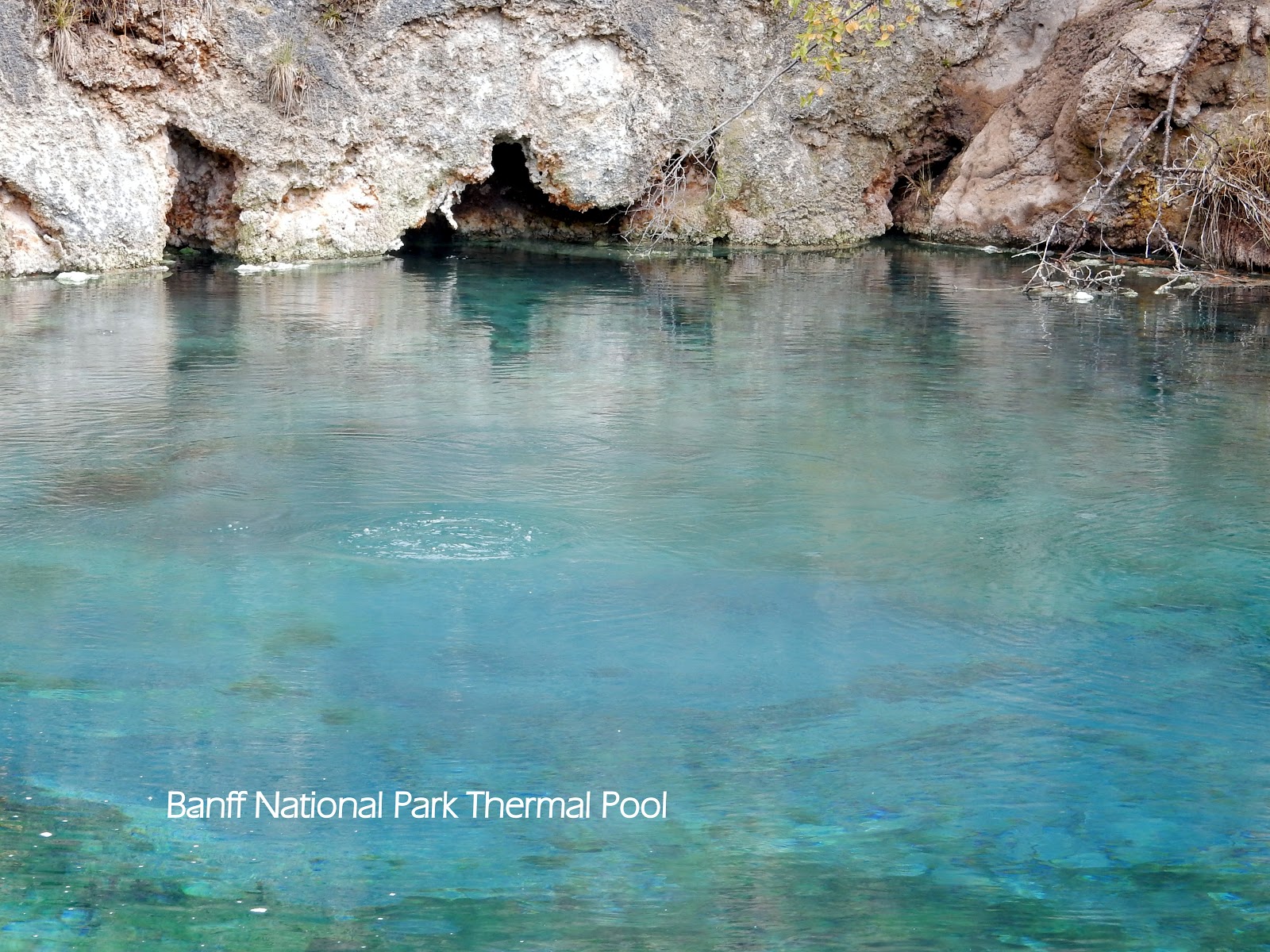
Surprisingly, there was even some thermal activity near Banff.
Now, the thermal pools are closed to people because of an endangered snail.  It would have been a stinky soak; the pools are sulfurous
The real beauty of Banff is not the attractions so much as the locale.
On our last day in Canada, the smoke from wildfires abated, and here's the reason people have been coming to Banff since the transcontinental railroad arrived in 1880's.
Canada was one wonderful site after another with several UNESCO Heritage Sites as well as one of the world's great natural wonders.  This trip was a joy and at the same time exhausting.  Drake and I both are glad we did this, but we both agreed our normal travel style of settling into one spot for two or three months works better for us.  I leave you with my favorite Canada picture
Even my photographer friends have to admire this one.
If I had to pick one place for a Canadian vacation, it would be Newfoundland.  It's hard to get to, has terrible roads, and is vast.  That said, they have the best scenery and the most delightful people.    


Saturday, August 15, 2015

Frustrations on the Road

If it's a long way to Tipperary, then it's light years to Banff.  According to Drake, and his oil change records, we've driven 7000 miles between Sydney, Nova Scotia (where we got on the Newfoundland ferry) to Banff, Alberta.  It's 3646 as the crow flies miles from St. John's Newfoundland to Banff, Alberta.  If we continued on across Canada, it would be another crow fly 600 miles to Victoria, Vancouver Island.  (It's also 1172 MORE miles from Banff to Fraser, CO - our two month 'fall' destination.)  The Canadian portion of this massive trip is over in just a few more days.  We've driven from Arizona to Texas to Connecticut to Massachusetts to Maine to New Brunswick, to Nova Scotia, to Newfoundland, to Quebec, to Ontario, to Manitoba, to Saskatchewan, to Alberta.  We still will be driving from Alberta to Montana to Wyoming to Colorado and back to Arizona.  The most important thing I've learned:  It's more difficult than you imagine to be away from your own country for any extended period of time.

The suspicion there might be difficulties first struck us when the bored Canadian Border Patrol fine toothed searched our car and trailer because of our 'TEXAS' license plates.  They wanted to make absolutely sure we were telling the truth when we claimed we were not bringing guns into Canada.  Everyone knows that all Texans are gun totin' crazies, right?

We continually ran into this phenomenon:  A total stranger walks up to the car, even once knocking on the side window, and says, "You're a long way from home, eh?"  After the umpteenth time of this happening, Drake now answers, "Really?  I'm trying to get to Houston.  I must have taken a wrong turn at Fort Worth."  Sometimes, the Canadian even gets the joke.  Subconsciously, Canadians think Texas is still full of cowboys and Indians.  When we say something to the effect that three of the top ten US cities are in Texas, and they are always amazed.

One thing we were already concerned about before we left the States was signing up for Medicare,  (Yes, hard to believe, but we are 65!)  Turns out, we were right to be vigilant.  We started as early as possible, and with a combination of internet information, telephone calls, a virtual post office box, our persistent daughter, and FedEx, we were able to get 'er done.  We actually received our medical cards from our 'advantage plan' at our post office box today.  (FYI:  If you are thinking of traveling away from your home for more than 30 days, I would get an internet post office boxes.  We've had ours for years, and it's saved our bacon more than once.)

Continuing to be 'connected' when traveling out of the country is a complete hassle.  First, if you think your current 'cell' bill is high, try buying an 'international plan' from your carrier.  They are hideously expensive, and after you've checked your email, scrolled once through your Facebook account, and checked an 'attractions' page online where you're currently visiting, you've just used your allotted data for the month.

We did take a tip from our traveling daughter, and as soon as we crossed the Canadian Border, we bought a Canadian plan and 'loaded' it with money.  This means we have had a Canadian telephone number which has come in handy ever since.  All went well until we realized making ANY phone call costs at least $.50 per minute, and more to the states. That tends to rack up the dollars.  It dawned on us, we needed to 'load' more money into the account.  Then the problems started.  They wouldn't let us add dollars to our account because our credit card billing address was 'different' from the phone's New Brunswick address.  Well, duh.  Even after numerous phone calls, and some mysterious form being filled out, it's still not resolved - but we did get the important thing: another gigabyte of data added to our account.  We've got about $12 left with which to make phone calls.

Do not under any circumstance have a car wreck in a foreign country.  As I've previously mentioned, Drake was involved in a deer suicide with our car.  We were very fortunate. While the deer didn't fare well, there were no injuries to humans, and no mechanical damage to the car.  HOWEVER, it's impossible to reach your US claims agent because first, there's 'phone tag' - expensive for us, as well as time difference problems, AND our assigned agent doesn't read her email.  Recipe for frustration. Drake has drunk a lot of scotch over this.

We have also had our alternator fail suddenly on us.  It was a blessing we were in the Banff Trailer Court campground when this happened.  We had to call a tow truck (who ripped us off, of course), but the Ford dealership in the next town went out of their way to get us back up and running.  More black thoughts and dire predictions by Drake over this mishap, but it turns out Banff is very bikeable.  I shudder to think how difficult the car repair could have been since we've been many places out in the middle of nowhere with no cell service at all.

When you don't speak the language, and can't make yourself understood no matter how carefully you studied the pronunciation of the language, expect to perfect your charade performances.  One of my goals was to learn how to pronounce French.  OK, I thought I was doing great.  I practiced and practiced as we drove in the first part of the trip in anticipation, that even though I couldn't SPEAK French, I would be able to read off menu items in Quebec or order a beer.  The first Quebec day at Tim Horton's I asked for a blueberry muffin,  and no one understood me when I said 'bluet'.  Maybe, it was adding 'por favor' that was the problem.  Initially, I kept getting common French and Spanish numbers and phrases confused.  Anywho, I tried and tried.  Finally, I was reduced to pointing, charades, and kind people to get what I wanted to eat.  This becomes very, very old and very very frustrating after about three days.  Yes, I guess this makes me an ugly American, but I just wanted people who spoke English after awhile.

When in a bi-lingual country, expect the grocery store run to take twice as long.  No, I do not want air miles on my grocery store reward card which I don't have because I'm only going to use your grocery store ONCE.  Brain has had to be re-trained to instantly recognize French and turn the box or can over.  Everything to eat  which is packaged at the grocery store is printed in English on one side and French on the other.  I think bored and sadistic grocery store stockers turn the French side out in Western Canada and the English side out in Eastern Canada as they go about their jobs.

If you've ever thought you wanted to time travel, think again.  So far, we've been in six time zones.  Sometimes, they've even snuck up on us.  Once, we crossed a time zone, and because of our car's analog clock, we didn't realize for several hours it was now an hour earlier, or was that an hour later?  And, then, there's Newfoundland which has its own wacky time.  It's a half hour off Atlantic time.  I never knew what time we were leaving or arriving on the ferry trips to and from Newfoundland.

We have also been playing the game called we give the clerks bills and they give us back coins.  Canada does not have dollar bills; they only have dollar coins.  They even have two dollar coins.  ('Loonies' and 'Toonies')  Plus, there's the normal assortment of quarters, nickels, and dimes. There are no pennies.  (We haven't missed those little copper disks in the slightest.)  Drake hates carrying coins, so we have constantly been forgetful about taking our coins inside an establishment.  Here's what happens.  The clerk says, "That will be $11. 45."  Drake gets this pained expression on his face which means, 'Damn it, I forgot to get the coins from the car, AGAIN."  Speaking of bills, the Canadians bills are plastic.  Yes, they are rectangles of plastic in different colors. (Queen Elizabeth II is on the sea green $20.)  They are slick and difficult to handle.  I'll be happy to be back in the land of paper money.  Even Canadians don't like the plastic money.  Getting cash is going to cost you a 'fee'.  It doesn't matter what anybody at any banking institution told you in the States.

Truthfully, this trip has been a great learning curve for a real out of country trip.  While Canadians abhor being thought of as Northern Americans, the reality is we share far more similarities than differences.  The experiences I've enjoyed here have far outweighed the difficulties of being a foreigner.  The size of this country is awe inspiring.  The sparse population was one of many surprises.  There are only 35 million Canadians as compared to 350 million Americans.  We've been made to feel overwhelmingly welcomed here especially in places not normally thought of as tourist destinations.  If you want to come to Canada, get in touch, Drake and I have paved the way for you.


Thursday, August 6, 2015

Geology, Geograhy, and Flora

Erupting Hawaiian Volcano
Anytime we've traveled to a new place, one of the fascinations is not only the new trees and flowers, but also the geography and sometimes even the geology.  An uber example is Hawaii.  With every successive wave of immigration, the types of flowers and trees increased as the new immigrants brought seeds of their favorite plants from the 'old country' whether it was Portugal, China, Japan, New England, or the Philippines.  With the temperate Hawaiian climate, very few failed to flourish.  These new plants crowded out the native vegetation, so today more than 95% of what we consider Hawaiian plants are actually intruders.  The Hawaiian geology - all new real estate created by volcanoes - stole the show even over the vegetation.
Ancient Ocean (black w/trees) and Mantle (mesa)
As we've crossed Canada, we've come to appreciate not only the changing flora, but also the interesting geography, and the geology.  Newfoundland is a land with one of a kind geology:  The Earth's mantle sits next to an ancient ocean bed.  Our hike of the tableland area whetted our appetite for the geology of Canada.  As the Ranger told us, the tableland was heaved up from the interior of the earth together with heavy metals which make it pretty much toxic to plants and even to animals that eat the few they find.  This geologic phenomenon has actually helped prove the tectonic theory of the continents movements.

Another geologic wonder of Newfoundland was the Western Brook Pond.  It's an enclosed fjord.  Retreating glaciers gouge huge holes in the land which fill with water which drains into the sea, and voila, a fjord.
Western Brook Pond
In Newfoundland, the glacier obligingly gouged the hole, but the spongy marsh at the end of the hole filled up with water and cut the fjord off from the sea.  Thus, a landlocked fjord fed completely by snow melt.  (Oh, FYI, any body of water created by a glacier is called a 'pond' in Newfoundland.)  The Western Brook Pond is 220 meters deep (in the middle), and the water is so pure, it doesn't even have electrolytes in it.

We've become fascinated with Pangea.  That's when all the land on earth was smooshed together as one large continent.  The land slowly broke apart and drifted around to form the earth we have today.  Newfoundland actually belongs to a different part of Pangea than the rest of North America, so they have different rocks there.

Drake, being perspective for the sea pillars
The mountains of Eastern Canada are worn down just like the Appalachians. These are ancient mountains which at one point were bigger and higher than the Rockies, but time has eroded them.  The highest peak we've seen is under 3000 feet by a goodly amount.  Sometimes erosion of wind and water creates some great scenery.  Here's an example of 'sea pillars' which we saw in Arches Provincial Park in Newfoundland.  These pillars are surrounded by cobbles, big and small - rocks tumbled and tumbled by the ocean, so they are perfectly smooth and rounded. When the sea is 'up', you can actually hear the cobbles clicking together like castanets as the waves roll in and out.

There are quite a few new to me wild flowers.  When lupine season rolled around, they made me homesick for Texas bluebonnets.  Here's a side by side comparison.  I can see the similarities, but I never, ever saw a blue lupine with red dots.
Texas Bluebonnet
Purple Lupine
 You can find lupines in white, pink, purple and coral, and they are bigger than bluebonnets. Definitely 'kissin' cousins', don't you think?

I've enjoyed taking pictures of the 'formal' flowers, like the peonies which people grow in their yards in the Atlantic Maritimes, and the informal flowers on the side of the road.   It's also interesting to realize that some wildflowers, like lupines, can be cultivated (Susi and Marilyn S, you are going to have your chance!) while others wither and die when gardeners attempt to 'grow' them.  I'm convinced originally, there was one color of lupine, but cultivation and hybridization created the rainbow of colors.  Oh, and the flowers have changed beside the road as we've eaten up the miles.  Now, in Saskatchewan, we are at the peak of the summer, actually probably just over the peak, and the roadside flowers are almost non-existent.   I actually miss them.

Spring green trees
We experienced (by my count) four spring times this year.  One of the best things about spring is the ethereal shade of green when the leaves first come out on the trees.  In a normal one spring year that color only lasts for a few weeks.  Spring green surrounded us for more than a month.  It was so very lovely.

Rhododendrons in Nova Scotia
Two types of flowers surprised me.  I never expected azaleas or rhododendrons in such cold climates.  The rhodies were in such a profusion of colors from peppermint pink to the shades of the sunset.  Super spring time will remain one of my favorite memories of Canada.      

Melted Rock in Sudbury
We accidentally stumbled onto another geologic phenomenon because of a broken clothes dryer.  We had this hideous house in Toronto.  SUPPOSEDLY, you had to 'slam' the dryer door to get it to start.  I mean, really!  Fortunately, we drenched a rug using the weirdo shower, and like good people, we washed it and tried to dry it... Do I actually have to say the slam the dryer door system didn't work? We were just lucky we didn't have a washer full of wet clothes.  So, we changed our itinerary in order to do laundry and landed in the nickel mining capital of the Canada, Sudbury. And the reason it's the nickel capital is it is the site of the second largest meteor collision with the earth - well, the second largest science has found.  Who knows what lurks beneath the mostly undiscovered ocean bottom?  Lots of minerals came to rest in and around Sudbury including a whole bunch of nickel as a result of that collision.  The area is called the 'Sudbury Basin' which is the hole caused by the collision.  In addition to the concave bowl, which is obvious, there's all this melted black rock covering everything.

The elephant in the room in Eastern Canadian geography is the St. Lawrence River.
St. Lawrence River from observation tower
It has influenced the history and economics of the entire region from prehistoric times. We drove the entire length of the river from the Atlantic Ocean to Lake Ontario.  It was as if we had driven the Mississippi River from Minnesota to New Orleans.  Here's the St. Lawrence as it empties into the Atlantic Ocean at the Gaspesie Peninsula.

Now I know why about 20 people a year manage to commit suicide at Niagara Falls each year.  (Why anyone would choose that spot?)  Drake was
Canadian Falls - called 'Horseshoe' 
gobsmacked to discover we could stand practically on top of the actual falls.  He brought his binoculars thinking the experience would be like seeing Mount Rushmore - all at a distance.  To fling yourself into the falls, all you have to do is climb on top of a five foot wall and step off.  We decided that would be too dramatic, so we just took pictures.  Personally, I would have liked to have been the Frenchman who followed the 'sound' in about 1680.  Think about what his face must have looked like when he found them.  The falls, which had not been harnessed with dams at that point, were three times larger!  I can not even imagine what they would have looked like.  When Drake told me, "they turn the falls off at night", I was outraged he would think I would fall for that.  Actually, it turns out to be true because the falls are so dam controlled. They are actually repressed.  We're thinking psychiatric help, but the public would be so shocked.

My final observation is about the Canadian Shield.  This is big slab of rock laid down between 200 and 500 million years ago and which covers about one-half of Canada.  It's shown in red in the picture.  This geologic feature has influenced the settlement of Canada.  The soil gets thinner and thinner on the Shield as you go North.  Coupled with the shortened growing season, agriculture was a non-starter.  Settlement of the land on the Shield was almost non-existent.  The area around Lake Ontario is one of the few places where an ancient large ocean laid down enough sediment to become rich soil.  And, lo and behold, that's where people settled.  It's no surprise that 20% of the Canadian population (of only 35 million) live in the rich soil crescent around Lake Ontario.  I finally understood the impact of the Canadian Shield when we rolled off of it - suddenly, and I mean suddenly, the prairies stretched out before us.  No more rocks, just rich black soil covered with grain.  I felt transported as if somehow, I was back in West Texas.  We could see Winnipeg, Manitoba, from 60 miles, excuse me, 100 kilometers away.  As of today, we've driven almost two complete days on this marvelous prairie.  I didn't even realize I was homesick.    


Saturday, August 1, 2015

A Smattering of Art

By this point in the trip we've experienced the best art the Canadians have to offer. We've been to the the Art Gallery of Nova Scotia; The Rooms Museum in St. John's, Newfoundland; the Quebec Fine Arts Museum; The National Gallery in Ottawa; and the Art Gallery of Ontario.  We saw two specialized museums in Toronto:  The Aga Khan Museum of Islamic Art as well as the Gardiner Museum of Ceramics.  Some have presented themselves in magnificent buildings which enhanced the whole experience.

The Aga Khan Museum, Toronto

"The Rooms", St. John's, Newfoundland

National Gallery in Ottawa
The Rooms in St. John's wins hands down for its presentation scheme.  They mixed both art and artifacts in their 'rooms' and floors.  It was a very effective presentation.
A whaling exhibition at 'The Rooms'
The Aga Khan was a recommendation by the neighbors at the terrible house we rented in Toronto.  I won't go into what a disaster the place was, but every experience has something good, and the good thing which came out of that rental was we met the next door neighbors.  Sheila and Eugene were lovely people who turned out to be artists and in Eugene's case, a marvelous musician - a banjo player!  He also plays the accordion. They both have been painters, and they are currently collaborating on mosaics which are large decorative pieces suitable for outdoor display.

They suggested the Aga Khan, and we went.  I know zippo about Islamic art, and this museum was both beautiful and instructive.  This was one of the many unique (to me) items in the museum.  This is a page of the 'Blue Koran' - the Koran written in gold leaf on dyed blue parchment in 1000 CE.  I learned quite a bit about Islamic art patterns here.  We also saw a wonderful exhibition about Near Eastern carpets in 17th century European paintings.  They showed the painting and the carpet portrayed - side by side.


All over Canada, we discovered the "Group of Seven" as well as Emily Carr, and Inuit art.  Those three groups alone made our museum time worthwhile.  First, the Group of Seven is just that:  Seven Canadian artists who were all friends, all painters, and who formed a loose association somewhat like the Impressionists did in the 1880's.  This group's time frame is post-impressionist and right at the beginning of modern art. They painted from the end of World War I forward with some of them painted for more than 40 years.  They focused their art on Canadian landscape painting.

We actually took a train tour into a remote area of Canada outside of Sault Ste. Marie.  In the 1920's Lauren Harris, one of the seven, actually rented a railroad car, had it delivered via train to the Agawa Canyon area and proceeded to paint.  His friends (others of the 'seven') were so enthralled with the paintings he produced, they followed him up and stayed in railroad cars for the next few summers, all painting and hanging out together. Their works are often grouped together in the museums, and each Canadian museum owns some of their paintings.  Here's my favorite Harris painting.  He actually went to the Arctic to paint icebergs, and this is what he saw.


Emily Carr is an artist who should have been part of the 'seven', but wasn't due to her location (Pacific Northwest) as well as her sex and her age.  She was older than the seven, and her paintings prior to meeting them were all about preservation of the art of the First People of the Pacific coast.  She painted the desolation of the native villages which had been ravaged by small pox in the 1860's, subsequently abandoned because sometimes the entire village died, and then looted in the 1880's by Europeans.  It is an old story.  In the early 1900s Carr was trying to call attention to the degradation of the Pacific coast native tribes.  In our opinion, her strongest work is her later work after she came in contact with the 'seven'.  She painted this in 1940.
I also fell in love with Inuit art.  Did you know a higher percentage of Inuits are artists than any other culture in the world?  They generally work in traditional materials - stone, ivory, or bone, but their contemporary works often have a whimsical touch.  


We also discovered two modern iconic Canadian artists:  Alexander Colville who painted post WWII up until 2012 was that rare artist:  famous in his own lifetime.  We were fortunate to see an entire exhibition of his work.  He bucked the trends of his time which were non-representational.  He painted uber realistically, but as with this painting, is about everything except what the picture actually is.  His wife was his model for the entire life of their 60+ year marriage.  She was less than comfortable with the nude paintings especially when displayed, but she was more uncomfortable with another woman being painted in the nude by her husband!


Christopher Pratt paints Newfoundland.  He's their painter emeritus.  At age 80, he's still criss-crossing Newfoundland in a Range Rover scribbling in notebooks about where he is, what he is seeing, and even what he had for lunch!  Then, he paints.  We saw an entire exhibition of his work, but I couldn't photograph it, so I snitched an image from Google. 


We actually saw this one.  It's called "Beyond Cities and Into the Real".  Pretty much outlines his entire painting philosophy as well as his fellow Newfoundlanders.

In Nova Scotia, I found a primitive artist who tickled me.  I like primitive art.  This is the type of art which comes from the souls of artists who are usually not formally trained.  The guy I saw in Nova Scotia is called Joe Norris.  Here's the piece that caught my interest.  It's a 1930's vanity repurposed as a piece of art.

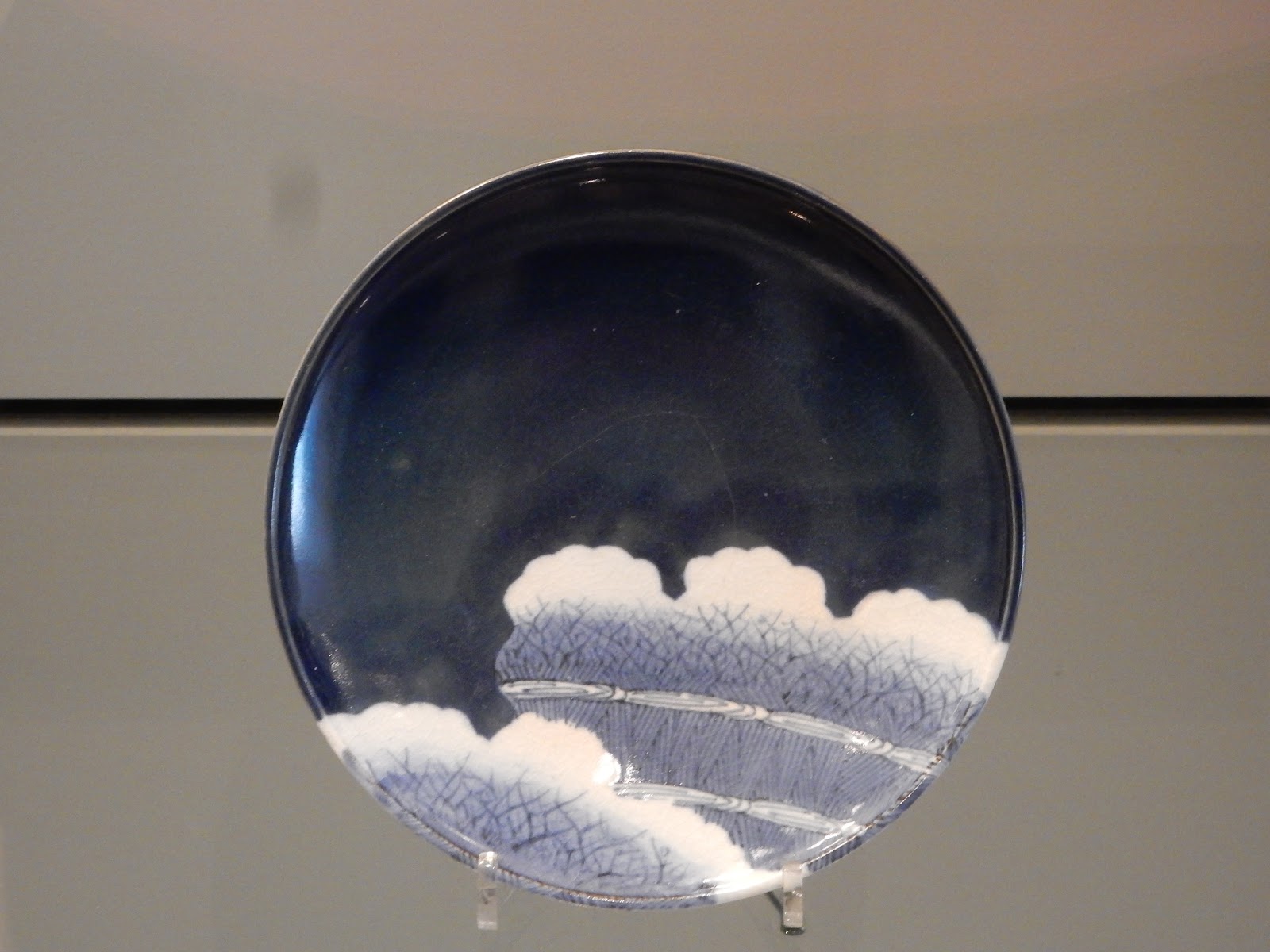
The Gardiner Museum in Toronto was right in my sweet spot - ceramics (AKA pottery).  A Toronto couple went crazy and within a 10 year period put together a world class collection which they then gave to the city along with a museum to house it in and the money to keep it up.  I loved the Japanese section as well as the Contemporary section of this museum.   Here are two of my favorite pieces.
 
This piece is Japanese porcelain circa 1670, and it's called 'Banded Hedge'. 

 My favorite contemporary piece is as much about the "empty space as it is about the ceramics". That's a direct quote from the artist. (Can you see the children?)  This takes amazing wheel control as well as an aesthetic sense, and isn't that art at its best?


The unexpected art of the trip was religious.  Those Roman Catholics in Quebec built some really nice churches.  Some were so special they have been designated 'basilicas' by the Pope.  Here's the altar area of the Notre Dame Basilica of Upper Quebec City


I also have a soft spot for stained glass windows, especially those of the Nativity.  I mean, who doesn't like Christmas?  

Best outdoor art goes, hands down, to Quebec City.  They had the best statues and the best mural I've seen this trip.  Here's a history of Quebec City in a nutshell, well, actually, in a wall.

I especially like Champlain (guy in front and center) - founder of Quebec City, who left behind no picture of himself, so the City just made up a likeness - and that's officially Champlain.  Some of the most influential people in Quebec City were the Ursuline nuns in the upper right window.  They came to Quebec in the 1680's.  The two guys on the balcony are the two Quebecians who were instrumental in crafting the Confederation of Canada in 1867 - joining of all the provinces into one country.  This magnificent piece is painted in the tromp 'de oeil style - meaning it looks 3D on the side of a five story building in Lower Old Quebec.  

The Ursuline Convent/Church in Quebec City had one of my favorite exhibits - embroidery.  Apparently, the 'mother convent' in France sent over to Quebec City in the early 1700's a woman whose family were master embroiderers in Paris.  She became a nun, and drawing on the skills taught her by her family, she ran an embroidery workshop for the Quebec City Convent for over 40 years.  The exhibit was a display of the religious coverings for altars, priests, etc. she masterminded and then supervised the crafting of.  Naturally, they wouldn't let me photo any of it.

Those who really know me realize I could go on and on and on.  And, yes, I have a zillion pictures of the art I've seen across Canada. I decided to go with the smattering approach in the blog, so no one would be bored witless by lots and lots of pictures of pictures, and statues, and sculptures, and ceramics, and decorative arts, and, and, and....  I didn't even mention the 'lesser' museums we saw everywhere including the Sault Ste. Marie Art Museum which is 40 years old and proudly displaying the highlights of what they've bought over the last 40 years.  Now, that was interesting.  My favorite piece from that museum is by an unknown artist


Finally, I'll leave you with a piece of outdoor art, well, it's outdoors at least.  It's the BIG NICKEL in Sudbury, Ontario, the center of the nickel industry of North America, if not the world.  Not sure this is art, but it's sure distinctive, and I wanted to see it!


Sunday, July 26, 2015

The Peculiarities of Canadians

At this point in the Great Canadian Adventure, we have covered quite a bit of ground. So far we've motored from Arizona to New England, and from New England to New Brunswick, and from New Brunswick to Nova Scotia.  We ferried to and from Newfoundland and lolled around the Gaspe peninsula.  I managed not to be seasick on a single ferry or boat (there have been five, so far), and Drake assisted a deer in committing suicide.

We struggled across Quebec doing charades.  Doing the chicken dance will always get you something you recognize to eat.  As we progressed across French Canada, I got bolder and began subjecting the poor French Canadiens to my badly pronounced French.  I discovered I can READ French signs, but no one could understand me when I spoke the actual words.  I might as well have been speaking Spanish.  Funnily enough, my limited Spanish would creep in when I would try to speak French -  "Bluet, por favor."  No wonder they got these puzzled looks on their faces when I opened my mouth. It took five people with lots of consultation to help us order a fast food meal one afternoon.

Now we've found the bulk of the Canadian population in Ontario.  Did you know there are only 35 million Canadians?  That's fewer than the State of California.  Twenty percent of them live on the north shore crescent of Lake Ontario in high rises.  Having covered this much Canadian ground, we've noticed a few things:

1)  All Canadians agree the hardest people to understand when they talk are Newfoundlanders.  I absolutely agree.  Standing in a Newfoundland bathroom washing my hands, I was easedropping on two ladies standing next to me.  I might as well have saved my ears - didn't understand a single word they said, and yes, they were speaking English, at least the Newfoundland version.

2)  The fastest talkers are the people in Toronto - they speak very close to the speed of light.  I find myself repeating what I THINK I've heard.  

3)  All Canadians, whether French or not, like 'poutine'.  These are saltless French fries, covered in salty brown gravy and sprinkled with cheese curds.  NOT yummy looking, and completely devoid of any nutritional value.  No one understands why we don't want to eat them.

4)  French Canadiens are ice phobic.  I was in a restaurant in Levis', major town in Quebec, and I ordered a ginger ale, the 7-up/Sprite substitute of Canada.  The waiter brought the can and a straw.  When I asked for a glass of ice, he explained the restaurant had no ice.  No ice?  In a sit down restaurant?    Then a couple of days later, I was in a motel and went looking for the ice machine.  What I found was the manager who, instead of directly me to the ice machine, handed me what looked like a 6" x 12" piece of bubble wrap - at least they were large bubbles - and this was the ice offered.  Bubble wrap ice.  I mean these places have electricity and everything; they just don't have ice.

5)  My arithmetic skills are absolutely first rate at this point - figuring what the temperature is, how many miles we have to drive, what the gallon price of the gas is, and translating the speed limits.  We've discovered the exchange rate between American Dollars and Canadian Dollars is negated by the Canadian taxes - they run about 20% (or more) on EVERYTHING.

6)  I don't even laugh anymore when offered loonies and toonies ($1 and $2 coins).

7)  The Dollar Store is the Dollarama, and those green and yellow signs are everywhere.

8)  In French Canada you use the Toillete.  In English Canada you use the Washroom.  In the USA, you just go to the bathroom.

9)  It has been a relief to discover Americans do not have tackiness cornered.  If you moved 1000 feet from Niagara Falls, it was a carnival.  All it lacked was the girlie show. Crammed together was:  the wax museum, the mini golf course, amusement rides, the souvenir shops, ice cream stores, fast food joints, and Ripley's Believe it or Not, just to name SOME of the attractions on one block.

10)  I knew Canadians had notorious sweet tooths.  They eat about twice as much ice cream (per person) as Americans.  And, they're not picky - they eat bad ice cream. Just as long as it's sweet; that's all that's required.  What I didn't expect is everything else being loaded with sugar.  We are certain there's a 'Canadian' formula for Heinz ketchup and adult cereals - they are sweeter than all get out.  Everyone offers 'the best plum sauce' as a condiment - think gelatinous sugar syrup.  Most Canadians drink 3 sugars and 2 creams in their coffee.

11) Most real Canadians get their sugar fix at 'Tim's' AKA Tim Horton's.  This chain is not like Dunkin' Donuts and it's not McDonald's, but it's everywhere. There are breakfast food sandwiches, a pastry case, with lots of yummy treats as well as 'Tim Bits' (donut holes in about 10 varieties).  There are hot sandwiches. The coffee is outstanding.  These places are like the local diners of each neighborhood, and every age group eats here - regularly.  I must confess:  We are addicted when on the road. "Yes, yes, there's a Tim's just ahead!"  I'll be coming back to the States with a caffeine jones.

12) Credit card slots at the gas stations are backwards.

13)  Every business has a portable credit card chip reader.  Credit cards in Canada have a pin number associated with them, so the waitress, sales clerk, convenience store clerk, etc. whips out a handheld device when you make a purchase, then you insert your credit card into the machine, punch in your pin number, and Voila!  done.  Well, except for us....we have to 'sign', but your credit card never leaves your hand.

14)  Grocery store rewards cards are only good for 'air miles'.  Really.  You get so many miles per grocery purchase.

Hardly surprising air miles would be so popular - we'll be traveling 5867 kilometers between St John's, Newfoundland and Banff, Alberta.  Let's see....that's the same as crossing Texas from Orange to El Paso 4.5 times.  Piece of cake, ey?