Saturday, September 2, 2023

Welcome to the North Carolina Vanderbilt Extravaganza - AKA "The Biltmore Estate"


Vanderbilt Estate - "The Biltmore" in Asheville, North Carolina

Asheville, North Carolina is best known for the Biltmore Estate.  This is one of the Vanderbilt houses.  The setting is 8,000 acres upon which is the mansion, the formal and informal gardens, a conservatory, complete with as many orchids as I've seen since Hawaii, a farmyard, a deer estate, [this must be a holdover from when Vanderbilt thought he was the King of Asheville], and a winery.  There are also several restaurants and shops.  The whole shebang is still privately held by the Vanderbilts and several family members live on the property in cottages/houses, rather than the mansion, and run it all.  For the privilege of seeing all of this, they charge the lordly fee of $85 per person.  To be fair, it is a two day ticket for everything EXCEPT the mansion.  I had it in my mind this place was on top of a mountain out of town.  Instead, it's right inside the Asheville city limits.

Today, the building of this monstrosity would be filmed as a documentary.  They started the building in 1889 and finished in time for the house to open for Christmas, 1895.  Landscaping was still being completed.  The mansion cost $5 million in Gilded Age dollars.  That's approximately $168 million in Electroic Age dollars.  Since still photography was available, Vanderbilt's architect documented the construction process. The photos and explanations are part of the house tour.  If you are interested, you can read about the construction and see the 19th century photos.  The Vanderbilt historical staff has tried to find the names with photos of the people of color who helped built the mansion and landscape the grounds.  In keeping with 19th century thinking, the 'colored' were not paid equally, nor offered the same benefits as the white workers.  At least there are some pictures, and jobs were offered.

Honestly, the most interesting aspect of this house was the art.  There are Singer Sargent paintings, Renoirs, Manets, and other locally/internationally famous artists.  There is Serves' porcelain, but the jewel of the art collection is a 17th century tapestry.  There are three tapestry panels -  one extremely rare, and the other two are just 'rare'.  The tapestries at the Biltmore are three of the seven virtues.  They are 'Faith' (only one in existence); 'Prudence', and 'Charity'.  Thanks to the centuries and the French Revolution, fine wall sized tapestries tend to be priceless.  


Most of the rest of the mansion is pretty much the norm for Gilded Age houses with the exception that there's hardly any 'gilt' - actual gold used as paint or decoration.  The Vanderbilt house, "The Breakers" (Newport, Rhode Island), the 'summer cottage' of 30 plus rooms is covered in gilt.  This house actually feels like it was lived in.  Most of the furniture looks comfortable, and there are places to eat that don't include a table for 20.  The mansion is very large, and I've deleted from my photos the 'extra guest bedrooms' which all looked about the same as a really nice hotel room of the era.  There were just lots of them.  

There is an indoor swimming pool and a bowling alley.  The house was (and is) an ongoing project of renovation and redecoration.  One large room was being redecorated when WWII broke out, so the Mrs. Vanderbilt of the era stored all the National Galley of Art pieces in this room for the duration of the war.  She considered this her war duty, and never even suggested charging the museum for the storage. 

I thought $85 per ticket was pretty steep, but I have to say it was an entire day's worth of entertainment.  The gardens were really exquisite.  The conservatory rivaled many city botanical garden offerings.  There were orchids I'd never seen.  Of course, it helps that western North Carolina is very temperate and everything seems to grow here.


One of the reasons the garden areas are so spectacular is the landscape was the last 'park' designed by Frederick Law Olmstead.  He died shortly after the mansion opened.  His mature grounds of the 21st century are still a triumph.  


I think Asheville would be better served by the Biltmore Estate if the grounds were open to Asheville residents for a nominal fee.  The brochure talks about 'hiking trails', but I didn't see any.  There is a pond; a lake; and a portion of the French Broad river.  It certainly wouldn't detract from the 'tourist attraction' to let the local population use some of the acreage carved out of the center of their city. 

If interested, there are two sets of photos - one of the mansion and grounds, and the other of the building process.


Tuesday, August 8, 2023

65th Mount Mitchell Craft Fair, Burnsville, North Carolina

 Last post I mentioned Mount Mitchell which is the 6,684 foot mountain in the Blue Ridge.  It's the highest mountain east of the Mississippi River.  Well, we still haven't seen it, but we have certainly tried to this weekend.  We headed north from Asheville to attend the 65th Mount Mitchell Arts and Crafts Show at Burnsville, North Carolina.  It's about an hour north of our Asheville house, and about 2000 feet higher.  Thus, it was a few degrees cooler.

Now, everyone knows we've attended a ton of craft shows all over the USA.  I tend to find a LOT of jewelry, some pottery, and occasionally a painting.  The Mount Mitchell show was huge, and the quality was extremely high.  We discovered another coven of potters located in this area of NC, and their skills are outstanding.  We also found two people crafting things which were unusual.

Meet Lee Miller who produces butterfly jewelry.  Yes, from real butterflies.


There's a great story in how he got started.  One day his potter girlfriend found a dead butterfly on the windowsill of her studio.  She brought it to Lee making the offhand comment that she wished she could keep it.  Lee is a surfer, so he got out his surfboard resin and somehow managed to coat the butterfly to preserve it.  It worked so well that he started ordering butterfly specimens from a specimen company (who knew this was a thing), and voila' a new craft is born.  Here's an example of a 'light catcher' which was my favorite.


The other crafter which fascinated me was Anthony Stockton.  I've discovered when you find someone with a passion for creation, they will talk to you endlessly.  Meet Anthony:


Anthony handcrafts hunting knives and pocket knives beginning with various grades of steel bars.  He doesn't forge his knives; he uses various grades of grinding, then he heats his raw knives in a knife kiln, grinding the edge finer and finer between heatings.  Then, there's getting a perfect cutting edge, polishing and setting the knife into the hilt.  Anthony's knives are not cheap, but they are so worth the cost for these magnificent tools.  Anthony is holding his favorite knife which he plucked from a table of 20 knives he was selling.  *FYI - I didn't take a bad picture, he's standing under a red nylon covering which gives him that popular 'sunburned' look!


The star of this crafting show was the quilt show.  There were about 70 quilts as well as a display of patriotic quilts which has a unique story.  


These ladies, who are part of the Piecemakers, run the mission which honors veterans in a three county area.  First, they make about 55 quilts a year with patriotic themes.  Then, they GIVE THEM AWAY to the veterans beginning with the oldest vet down to the youngest.  They do this every year.  The lady on the left has even gotten her husband into the action. I guess he got tired of being a quilt widower.  He's started creating and quilting his own quilts for the project.  This was my favorite of all the quilts on the stage which are representative of the quilts they are giving away this month.  Then, they just start again.


You got to pick out your favorite quilts in various cataegories  (challenge, small, medium, large, graphic).  Challenge quilts are quilts made respecting set forth rules for the construction.  Small, medium, and large - self explanatory.  Graphic were garments.  Here are the quilts I voted for:
Challenge quilt choice


"Small Quilt"


Medium Quilt

Large Quit

Graphic category

I also found something in Burnsville, NC that you just don't see everyday.  The town has a sundial.  Yes, a sundial - not on the ground - hanging on the wall.  Here it is:

It's almost 3pm - Eastern Daylight Savings Time

This delighted me as much as the unusual sculpture in front of the town hall meeting place, and the cafe with outdoor patio seating with stream sitting on the town square.  As always, I've taken a bunch of pictures of everything including an abandoned church being overtaken by nature.  It reminds me of the saying:  "Nature always bats last, and she bats 1000."


If you want to see more pictures, click the link.


PS - I also bought material for my granddaughter to have a new dress from leftover material being sold as a fund raiser.  You'll see it in the pix.  


Tuesday, August 1, 2023

Bonsai and More


 I have been hyperbolic about the trees since I arrived in North Carolina.  Now, that we have arrived in Asheville, centered in the mountains of the state, the evergreen family have joined the hardwoods.  I will confess it's very hard to accept these rounded hills as mountains after having spent time in the Rocky Mountains.  The folks in Fraser and even Colorado Springs would laugh to hear these little mounds of about 2100 feet (elevation of Asheville) classed as mountains.  In North Carolina's defense, there is a 6,684 foot mountain (Mount Mitchell) in the Black Mountains - about 35 miles from Asheville.  Mount Mitchell is the highest point east of the Mississippi, and even Coloradans can't sneer at an almost 7,000 foot mountain.  

Meanwhile, back to the trees.  Aside:  There's a balsam forest on Mount Mitchell.  I mean who has ever seen a balsam tree?  I can hardly wait to see those!  I only know that wood from those cheesy airplanes which were GUARANTEED to fly.  You had to assemble them, and if you got the upscale kitc, it included a rubber band for some mysterious purpose.  They usually cost about $.50, which was cheap enough, so you could persuade your mother you desperately needed one since you'd been so good on the shopping trip.  90% of the time the assembled 'plane' landed on the roof of the house the first time you tried to 'fly' it.  

Having been enraptured by the trees since I arrived here, my first real outing in Asheville was to the North Carolina Arboretum (tree museum).  It was wonderful.  I put names to many plants and trees which I had been seeing in the area.  This arboretum is a combination of gardens and trees.  The point of pride of the Arboretum is their extensive bonsai collection.  If you think I'm wild for big trees, then I'm over the top for little trees.  Brooklyn's Prospect Park has a small collection they keep sheltered in a glass greenhouse, but this North Carolina collection was founded and nurtured by:


Here is my favorite bonsai (hard to choose from so many):


This bonsai is entitled "40 acre rock" and has a miniature Juniper and a miniature boxwood planted atop the rock.  Picturing the tree in a setting makes the bonsai an even bigger marvel in my opinion.

There were so many trees and flowers (regular sized) it was hard to pick favorites.  That said, here are the two items which really did it for me.  First, a holly tree which will sprout Christmas red berries in the winter.  Hollies are evergreens, and new leaves push the old ones off during the spring like Live Oak trees.  The flower that stunned me, and I smelled it before I saw it, was a star lily growing!  Here are my pix of these two:


The holly tree - 25' tall next to an elm 
which towered over it.


Star Lily - wonderful smell & in the area of stuff 
which is supposed to grow great here

As always, I took a bunch of pictures.  See all the different varieties of bonsai.
Just click on the link.

https://photos.app.goo.gl/SVeFE8znjqVcfKsT6


Wednesday, July 19, 2023

The Funnest Time in Roanoke

Roanoke, a town of 320,000 is filled with outstanding museums (way above average for its size), great restaurants, and a beautiful setting of rolling hills set in a hardwood forest.  We just kept finding wonderful things to do and places to see right up to the last day.  

Our last day was spent playing pinball because.... Roanoke has a Pinball Museum.  For my youthful readers, 'pinball' was what people played prior to video games.  Thanks to the Covid Pandemic, pinball has made a big comeback.  Apparently, spending a whole bunch of time at home meant, if you were a man, then you needed a 'man cave' equipped with your own pinball machine.  I actually talked to two 30ish nerdy guys who were debating the best of the newest machines.  

Here's what one of the newest of the new pinball machines looks like:  It's called "Weird Al's Natural Museum of Hilarity" and has the most up to date solid state innards and a pixel based monitor.  It also leaves a lot to be desired in terms of reliability.  It broke multiple times in the first three months of its arrival at the Pinball Museum.  I played it.  More about that later.


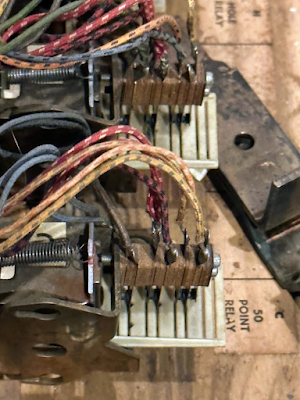
Of much more interest was my talk with "Jason", a mechanical engineer, who volunteers his time repairing these machines.  When I first saw him, he was changing out a transistor based innard for a mother board in a game manufactured prior to 1977.  That was a pivotal year for pinball:   Electronic motherboards appeared and took the place of 'wires' and transistors.  Here's what a transistor innard looks like in an old pinball machine.  Jason was changing out these innards and transforming the game into a motherboard/solid state game.  As the older machines age, parts are just not available.  He will use the same 'top', but the mechanics inside will be completely different.
Wires and Transistors - how every pre-1977 pinball machines looked inside. (above and below left).  The conversion to motherboards - pre1977 to post-1977 pinball machines (below right)


Here's Jason
Whenever I talk to someone who really enjoys either his job or his hobby, there's such enthusiasm.  Jason couldn't wait to show me the 'special' machines.  First up, is 'Humpty 
Dumpty'.  This game was designed in 1947 and it is the first game to employ 'flippers'.  However, they are NOT in the place you would normally expect.  See is you can find them:  
Yes, that's the flippers:  Right above the 10,000 yellow barrels which is about half way up the machine.  It's not until later, that flippers descend closer to the bottom of the machine.  And, it's not until the introduction of the solid state machines that flippers got bigger.  

Drake is an old time pinball player since he played a machine at the pool hall in Altus, Oklahoma during his last two years of high school.  His favorite machine at the museum was a Bally machine called Bows and Arrows.  He said this one has the features he was most accustomed to from that era.  It also has the small flippers and mechanical counters to keep track of your score.


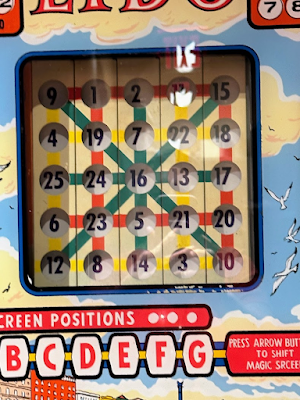
Another strange machine from the 1950's was one called "Lido".  It seemed to blend a gambling element, almost like a slot machine.  You could choose your 'level' to play depending on how many nickels you initially fed into the machine.  I think the photographs will help you get the picture.


I really wanted to play this machine, but it was one 'under repair'.  Jason told me it was almost impossible to have all the 'old' machines up and running all the time.  I decided to skip up to some of the first motherboard machines.  I noticed two things about the more modern machines: (1)  The flippers were about 1/3rd bigger, and (2) the machine would hide the ball, and you had to be prepared for the ball to squirt out in various places.  Initially, I would just stand there as the ball shot out about halfway down the board.  I gradually got better - about a C- worth of better.  Here's the machine I really liked which was one of the first to have an interactive monitor - the 'bride' would have different faces depending on your score with each ball.  At first, I didn't even realize what was happening.  Here's what it looks like - very futuristic, very silver (instead of red, blue, yellow and green).

Remember, I said I'd played the 'newest' game?  It shared more characteristics with the Bride of Pinbot than the Bow and Arrow Game.  Here's a look at the 'board'.  The ball, initially hidden from the player,  would squirt out from multiple places.  You had to be quick, quick, quick with the flippers.


The Pinball Museum is in the center of downtown.  It's in the Market Square which has been selling stuff continuously since 1882, just as the railroad arrived, thanks to that $10,000 bribe. 

The Center in the 21st century is home to a farmer's market, two museums, a few stores (like a candy store!), the local stage for live theater, and a miniature aquarium.  Here's my favorite aquarium shot.


We waved goodbye to Roanoke, and hit the road for Asheville.  It's in the mountains, and if the Canadian smoke ever clears, this place nestled up against the Great Smokey Mountain National Park should be lovely.  I'm already getting the vibe that Asheville is to North Carolina as Austin is to Texas.

Here are more pinball pictures.  I'm playing a Beatles pinball game.


Friday, July 7, 2023

From Big Lick to Roanoke

 When you move to a new town, even for a month, you learn so many things about the place.  Roanoke is a beautiful small city with an accessible downtown.  It's anchored by the beautiful Taubman Museum which I talked about in my last blog.  Curiously, though, I asked several people what they thought was the best attraction in Roanoke.  They ALL gave the same answer:  The Mill Mountain Star.  The "SW Virginia Living" magazine had a picture of the star all lit up in front of a full supermoon which I thought represented how the Roanokians feel about the star and by extension, their little city.

"Roanoke Star" - Symbol of Roanoke, the Star City

Roanoke sits in Roanoke Valley and is surrounded by the Blue Ridge Mountains, a range in the Appalachians.  We drove up Mill Mountain to check out the star and to take a short hike.  (Turned out to be VERY short - no, not my feet or my back.  It was hot, hot, hot and all about trees and only trees - thus, boring after the 10,000th tree.)  Here's what the star looks like during the day:


 The star was built in 1949, a symbol of the post WWII optimism.  There was an amazing amount of materials needed to built this.  Here are the statistics:


 Naturally, there's a lookout observatory platform, at the base of the star, and the Wells Fargo Building dominates the downtown skyline of Roanoke as the Empire State Building did in Manhattan when it was first built.  You can see the Blue Ridge Mountains in the background.


Here we are on the Mountain Star Trail doing our abbreviated hike.  You can tell we haven't been on the 'trail' long because I'm not beet red!  I'm admiring the forest of elm trees which Drake guesses are 40 to 50 feet tall.  And, as you can see, mostly these are saplings!


Roanoke is a railroad town.  The railroad transformed this town in the 19th century just as towns in the 20th and 21st century are being transformed by the infrastructure locations of technology giants.  The railroad was one of the major game changers of the industrial revolution as the computer has been  in the electronic revolution. 

The railroad stopping in your town immediately turned the town into the business hub of the region.  The Norfolk and Western Railroad came to Roanoke in 1882.  The town offered free land for the depot, tax exemptions and $10,000 in cash (can anyone say BRIBE?).  It worked.  Between 1880 and 1890, Roanoke, formerly Big Lick, became the fastest growing town in the South.

The railroad built the tracks and the depot down the center of town (about 700 residents at the time.)  One consequence of the location of the 'tracks' was south of the tracks became the African-American side of town, and north of the tracks was entirely Caucasian.  Jim Crow laws were vigorously enforced.  Below is a 'then' and 'now' picture.


These pictures are from the Roanoke Historical Society Museum called the "O. Winston Link Museum".  So, who is O.Winston Link?  He's a self taught photographer, lifelong Roanoke resident, who decided to document the end of the 'steam era' of the Norfolk Western Railroad in the 1950's.  He usually worked at night, carefully composed his photographs, used his engineering degree to plan his photos, set up photo flash bulbs to light what he wanted lit, and worked with two cameras.  People who worked on the railroad loved him, and train engineers would often slow or stop their engines, so he could get his 'shot'.  He had hundreds of negatives and photos since he processed all his photos himself.  There didn't seem to be a market for his photos until they came to the attention of the Museum of Modern Art in New York City.  The photographic curator knew genius when he saw it, and he promptly bought many of Link's photos.  Today, you can see his best photographs in the museum.  The museum has produced a wonderful 30 minute video about Link and his photographs.


I also really liked the stained glass windows commemorating O. Winston Link.


As a little lagniappe to the story of Roanoke and the railroad, we discovered an exhibition which is a homage to the hat.  Here's a collection of hats owned by the museum.  This exhibition is just charming.  The exhibition was dedicated as a birthday gift for 95 year old Sara Airheart, a longtime volunteer at the museum.  Here's a taste:


As always, if you want to see more pictures (including a lineup of prostitutes circa 1885), just click on the link: