Tuesday, August 26, 2014

Much Ado about Grocery Stores

When we move to a new location, there's a learning curve.  The internet and a smart phone are indispensable.  These electronic tools make 'finding' exciting instead of frustrating.  So, what do we find?  Well, first and foremost, a grocery store.  Berkeley was the easiest since the grocery store was on the ground floor of our apartment building.  This arrangement has spoiled me completely.

We just took the elevator down five floors with shopping bags over our arms.  I actually felt like I was in France or one of those other countries where people carry string bags and shop daily for food.    I didn't bother in New York City because I never cooked anything.  I've lived in at least three towns where there were no 'real' grocery stores. In Franconia, New Hampshire or Seal Rock, Oregon, it was ten miles to the grocery store.  Burlington, Washington had a 'sister town' (Mount Vernon).  The two Washington towns were like the Texas towns of  Hurst and Bedford so blended together they are really one town with two names.  In Austin it was either HEB, Whole Foods, or Sprouts.  Burlington, Washington really got me shopping organic, coop, and local since it's a farm valley.  Richmond shopping was convenient - they had a local store that sold only produce, meat, cheeses, and baked goods.  It was located next to a Walmart Super Center. (Yes, I shop with the evil empire for certain things.)  Logan, Utah was also a Walmart grocery town.  In Sun City I shop at three separate stores on 'grocery day'.    

South Lake Tahoe is a tourist town.  There's 'tourism' here 10 months of the year, with October and May being the 'dead' months.  Most of the store fronts are pitching something to the tourist trade.  For instance:   boat rental, paddle board rental, bike rental, ski rental, ski/beach apparel, bars, tourist restaurants, souvenir shops, art galleries, and surprisingly two competing 'real' grocery stores plus something called the Grocery Outlet.  A real grocery store has actual aisles, produce, meat, and a bakery.  This town is also loaded with drug stores, but the only discount 'box' store is an atrocious K-Mart.  It's probably the only K-Mart store in that company making money because they have a complete monopoly in South Lake Tahoe.  It's a terrible store filled with shoddy merchandise, complicated check-out procedures, and management who've apparently never seen a Walmart or Target.  What isn't here is a 'dollar' store - no Dollar Tree, no Family Dollar, no Dollar General. You have to drive to Carson City - basically an hour over a 9000 foot mountain to find those or a Walmart or a Target.

I think about grocery stores.  They are and aren't all the same.  In America, we take for granted that every grocery store will have wire push carts, baskets for the light shopper, and well organized head high shelving with multiple choices in the staples.  It will be well lit, with refrigerator cases keeping the cold food cold.  During the holiday season, you can expect Christmas carols over the store speakers.  There will always be beer, both cold and room temp, and sometimes wine, and a little more rarely, hard liquor.  If it's a major store, there will be a bakery and delicatessen.  There will be a checkout with a scanner of those black lines helpfully found on each and every product, a cashier to move the items across it, and usually a bag person.  You can find a combination of a sea food market, a cafe, a coffee shop, a salad/soup bar, a florist, a pharmacy, a bank, a nail technician, a massage therapist, an optometrist, a post office, or a hair dresser depending on the individual store and the location.  I've yet to see a funeral home inside a grocery store, but I figure it's just a matter of time since cremation is gaining popularity.  Just for fun, here's a list of the grocery stores I've shopped.  It's pretty comprehensive:  Walmart, Albertson's, Safeway, Fred Meyer, Kroger, Fry's, Whole Foods, HEB, Smith's, Sprouts, Trader Joe's, Shoprite, Shop Easy, Winn Dixie, Bashas, Aldi, A&P, Brookshire,  Food Giant, Fiesta, Market Street, Piggly Wiggly, Price Chopper, Reasor's, Sunflower Markets, and a new one in South Lake Tahoe called Raley's.

All grocery stores are not the same.  The products are slanted toward regional taste buds, and you can find interesting surpluses and deficits.  For that reason, there's no 'best' store.   In New England you can buy three kinds of salsa; in Texas thirty kinds.  By contrast, New England overflows with clam chowder - fresh, frozen and canned.  The South is the land of Dr. Pepper (all the flavors in every size) and pimento cheese.  You can't buy ANY kind of pimento cheese on either the East or the West Coast.  I made my own in Berkeley!  You have to blow the dust off the cans of Dr. Pepper in certain parts of the country.  Some regions swell the soft drink aisle with Coke while other regions are top-heavy with Pepsi.  Tea bag selection is at its zenith on the Northwest coast.  Any grocery store in the Northeast has an entire aisle devoted to food aiding the preparation of Italian food and a whole section of Kosher food.  Every Southwest grocery store has an extensive Mexican aisle.  The West coast stores have an entire Asian aisle with both canned, processed and fresh food items.  The grocery store in Logan, Utah had an aisle devoted to gigantic quantities - such as a 2 gallon jar of pickles or 25 pound bags of cereal.  A Southern grocery store is chock full of junk food.  (Yes, EVERY American store is loaded with non-nutritious, sugar laden, fried in palm oil, and dregded in salt food, but Southern grocery stores seem to revel in how much revolting, really, really bad for your long-term health food can be packed onto their shelves.

The last fun thing about finding the local grocery store is the scenery getting there.  Some places have the lock on the scenery, and South Lake Tahoe is one of the best scenic drives 'to the store'.  So, I'll end this Seinfeld blog (all about nothing), with a snapshot taken along the route to the grocery stores.
The Sierras on the road to Safeway
              

Thursday, August 7, 2014

Victorian Architecture and a Farewell to San Francisco

Haas-Lilienthal House - San Francisco, Nob Hill

We took our last outing into San Francisco today.  We used transit exclusively - at the cost of $20, which must seem excessive to people living in the prairie culture, but it would have cost far more in both gasoline and parking fees if we had driven our car into the city.  I saw one garage which would give you a day's parking for only $25 - if you arrive after 9am and leave the garage before 6pm.  It was well off the beaten tourist path, so you would taken a bus or cable car anyway to get to any attraction.

Today we went to the Haas-Lilienthal House, the only standing Victorian house in San Francisco with it's original furnishings that is open to the public.  This house was built in 1886, and it survived the 1906 earthquake easily.  However, it was almost consumed by the fires which raged three days and swept across San Francisco.  Here's a very revealing aerial photo taken in May of 1906 (Earthquake:  April 18, 1906).

What we have here is mainly fire damage.  San Francisco was a 'modern' city in 1906, and people had gas lighting and gas cook stoves and gas fireplaces. The quake ruptured not only the gas pipes, but also the water pipes.  Once the escaping gas caught fire, there was no water to extinguish it.  Almost 40% of the city was destroyed before the fires were brought under control.  The fire officials of the time finally realized they had to create artificial firebreaks.  Moving ahead of the fire, they dynamited the buildings of entire streets.  One of the dynamited streets was Van Ness which contained the mansions of the wealthy.  The Van Ness firebreak was one block from the Haas-Lilienthal house, and thus the house we toured today was saved.
 You can see where the fire 'stops' at Van Ness at the top of the picture.  Notice Market Street - in 2014, the BART runs up and down this street which is in the heart of San Francisco bisecting the city like an arrow pointing northeast.

This San Francisco house was built in 1886 by a moderately wealthy Jewish family whose roots were Bavarian, and whose business was the wholesale grocery trade.  I couldn't help contrast the San Francisco house with the Maymont House in Richmond, and the Vanderbilt Breakers in Newport.  Each represents a 'step' up on the wealth scale.  The Vanderbilt houses were opulent; the Maymont House was ostentatious, while the Haas-Lilienthal house was comfortable.  Here's what I mean:


Maymont Dining Room


This dining room at Haas-Lilienthal is nice, but certainly does not reflect the level of wealth finance or railroad construction and ownership brought in the 19th century.  All three houses are contemporary to one another being built within 7 years, 1886 - 1893.  Much of the craftsmanship of Maymont and Breakers was created specifically for these houses by individual craftsmen, and in the case of the Breakers, craftsmen imported from Europe.  By contrast, Mrs. Haas went down to Market Street and 'picked out' her architectural details manufactured by machines, just as new home owners today pick out their cabinetry and counter tops.  Granted, Haas-Lilienthal is all first quality, but it is manufactured quality mimicking individually crafted details.  No one appeared in the San Francisco house to hand paint gold leaf around the carefully crafted plaster molding.

The one interesting fact the ancient tour guide offered (three times) was the typical Victorian crown molding around the ceiling of the 'first parlor'.  The top level is the 'egg and dart'; the second level are the dentals - we were specifically cautioned not to call them 'teeth' -, and the third level closest to the floor are the bay leaves or laurel leaves - all of which represent symbols going back to Greek and Roman times.
This is a perfect example of machine routed molding rather than hand carved molding.
There are more pictures of the various rooms of the house if you wish to flip through the pictures. 


This was our last outing into San Francisco.  This sightseeing tour impressed upon me how many attractions have been in San Francisco for the past 40 years.  Our first trip here was in 1974, and in 2014, you can still ride the cable cars, buy cheap souvenirs in Chinatown, take the boat to Alcatraz, shop at the Piers, walk through Golden Gate Park, and even across the Golden Gate Bridge.  The fog still rolls in and out, and some days in the shank of summer feel like a chilly autumn day.  You need to pick your walking routes carefully in the city unless you're into mountain climbing which is what some of the steeper hills feel like as you trudge up and down them.   We've enjoyed this summer on so many levels.  If it weren't for the damn earthquakes, this place would be a paradise to live in.  We leave here in 6 days.  My prayer is I get out of town before the ground shakes.    

Wednesday, August 6, 2014

Golden Gate Park

Golden Gate Park is still as magnificent as ever.  I first saw it about 40 years ago, and it hasn't changed much.  If anything, it's been improved thanks to severe ocean storms and earthquakes. The origin of the park lies in nineteenth century San Franciscans deciding to compete with the newly created Central Park of New York City by developing a great park of their own.  The Golden Gate Park is the fifth most visited urban park in the United States.  Central Park may be the number one visited park, but the Golden Gate is 174 acres larger being 1017 acres.  Originally, the park area was sand dunes, but over a fifty year span, hundreds of thousands of trees were planted, and today, the dunes are a distant memory.

Japanese Tea Garden
One of the things I love most about the northwestern United States coast are the flowers. The climate is wonderful for flowers.  Golden Gate Park is filled with them.  The Conservatory of Flowers is a gigantic greenhouse.  The Japanese Tea Garden has both flowers and sculpted trees.
 The Rose Garden showcases the most beautiful roses I've seen since The Portland Rose Garden (which is the gold standard for roses in my opinion).     My favorite roses are the multi-hued ones, and this garden was filled with them.  Poor Drake, we were trying to catch a bus when he took a short cut through the Rose Garden.  We missed at least one bus as I lingered snapping pictures.

Speaking of buses,  I loved the subways and buses in New York, and I've loved the BART trains and the buses here.  The bus system in San Francisco is efficient, punctual and almost completely covers the city.  We've crisscrossed the city on buses.  Usually time is not exactly pressing for us, so if it takes us an hour to use public transit rather than 40 minutes to drive, we consider the extra 20 minutes as just sight seeing opportunities.  We're headed to our last attraction tomorrow - the Haas-Lillenthal House.  It's an 1886 Victorian which survived the big earthquake of 1906, and it's furnished with the original furniture and ornamentation.  It's also in a part of the city we haven't seen this trip.  We'll take the Bart into the city from Berkeley and catch a bus across a new part of the city.  

We've pretty much passed on the destinations we've seen before avoiding Alcatraz, the Piers, Ghiradelli Square, the cable cars, and a host of others.  This trip is actually our fourth time to San
Francisco.  Our choice of attractions this trip has pretty much centered on art exhibits, wine and getting to know areas outside San Francisco.  My favorite exhibit was "Gorgeous" at the Asian Art Museum.  Our last exhibit was at the deYoung, located in the Golden Gate Park, and we came for Modernism, a traveling exhibition from the National Gallery of Art.  I just couldn't resist dropping by the Japanese Tea Garden for old time's sake.

One of the unlooked for bonuses of this vagabond life is I'm getting intensive geography lessons about parts of the country of which I only had a hazy understanding of the lay of the land.  Here it's been fascinating to learn first hand about the microclimates which dot the Bay Area.  The weather can change by ten or fifteen degrees or go from sunny to overcast to fog by traveling ten miles.  From the viewpoint of the deck outside our door, we've observed the quintessential San Francisco image:  Fog rolling in over the Golden Gate Bridge.

Another real plus to living in the second most food mad city in America are the wonderful restaurants we've found here, and the joy of finding excellent produce in the Farmer's Market every Saturday just two blocks from this apartment.  I've been trying to store up for the restaurant desert of Sun City.  I suspect South Lake Tahoe (our next destination) will be somewhere between the two.

I close with a picture of one of the roses from the rose garden.  As always, there are more pictures for my art friends and my flower friends.   If you want to see them, follow the link.

https://plus.google.com/u/0/photos/115478608971584948192/albums/6042354458532970433?authkey=COXfnfS-tb_vjgE    

Sunday, August 3, 2014

Naked Wine

We couldn't leave here without another trip to wine country.  After all, the town of Napa is only a one hour drive.  This was the last extended family time we got to spend with Sarah before she left for New York.  (Can you imagine?  She wanted to spend a couple of weeks with her HUSBAND before she has to return to New Haven for the start of the final year at Yale.  I mean, REALLY!)  Just kidding....learned this summer visits are better than cohabitation with your adult child.  Don't get me wrong - things went swimmingly.   We loved being able to help her with a place to live while she kicked off her start-up.  We didn't make the mistake of expecting her to live in our handkerchief pocket, and we all enjoyed the time we got to spend together - the most in the past 10 years.  However, despite all the positives, it just felt like having a long term guest, and we missed our privacy.  Smooth spots went each way - Sarah got her laundry done, and she cooked for us whenever she got the chance.  She already knows more about cooking than I've learned in the past 40 years.

As a final fling, we just decided to take off for Napa and see if we could hit the downtown tasting rooms on a Saturday.  Thanks to Emily (friend of Sarah) we went to Naked Wines.  Drake had suggested we try to find a tasting room which represented more than one winery, and Sarah remembered the Naked Wine, a tasting room they couldn't get to when they visited Napa in January.  We settled into seats at our own table, and proceeded to taste a wide variety of wine.

We have been solicited to join the Wine Club at every single winery we visited out here.  Basically, they are a very bad deal.  Usual deal:  They pick the wines from their bottles and send them to you. They send you a case or at the least a half a case and charge shipping every month.  We didn't find a single winery where we enjoyed ALL their wines.  Plus, the prices were pretty steep even for members.

Naked Wine is a totally different animal.  They represent hundreds of small wineries.  Their 'club' members are actually investors in these wine makers and their wineries.  Naked Wine invests not only capital, but also bottles and labels their participating wineries output, so small vintners can get their product out on the market.  In return the "Angels" (investors) get first shot at the wine at reduced prices. Each Angel pledges $40 each month - which is less than our monthly wine expenditure.   The genius is there are hundreds of different wines to choose from out of over 1000 wineries from all over the world, and you choose when to spend the money in your account.  This is exactly what we've been looking for.

Hey, Emily, your sommelier classes just paid off....for us!  Thanks.


Thursday, July 31, 2014

We Need Sports Books!

As everyone knows, I'm a great supporter of Donor's Choose especially for teachers who are personal friends.  I loved being a teacher on many levels, but one area of frustration was the unwillingness of the State of Texas to provide the necessary funds for supplies to be able to teach the most effectively.  For the first ten years of my teaching career, I was handed a grocery bag with a box of chalk, a box of Bic ballpoint pens, a 2"x 3" box of paperclips and a felt eraser.  It was so paltry, it was insulting.  I was extremely fortunate because my principal actually bought enough xerox paper to last the year.  I knew many teachers in other schools who had to buy their own paper.

Texas isn't the only state that expects teachers to buy supplies.  One of my young friends from Utah started teaching last year, and she's one we really, really, really want to keep in the public school system - she teaches developmentally delayed pre-schoolers.  (Boy, talk about a nightmare job, but these kiddos are her calling.)  Anyway, as a graduation gift, I sent her $300 of supplies to open up her classroom.  I'm talking stuff you office folks just completely take for granted - like a stapler!

One of the ways I solved my supply problems was to involve my great Methodist Church (St. Paul's in Hurst), and they poured supplies, magazines and anything else I needed into my classroom - including PEOPLE who volunteered and spent time at the school.  Supply problems are annoying, but, hey you can teach without a hole punch.

What you can't teach without are learning tools.  That's when state legislators need to be hung up by their thumbs for not appropriating funds.  We are not talking teacher's salaries here; we are talking books.  Yes, books.  My friend, Shannon, teaches in a district in central Texas.  She's a children's librarian for two elementary schools.  The area is rural.  That means the normal outlets where poor children have book access is very limited - like limited to SCHOOL.  They don't go to the public library because either there isn't one, or it's too far away.  Do I need to remind anyone of the price of gasoline?  Rural children from poor families don't have the financial resources to hit Barnes and Noble or shop on-line for books because of money.  In many rural homes, there may be cable or dish TV, but the budget doesn't include internet.  And in some of these student's families, books are of no importance because their parents never developed the habit of reading.

Yes, reading is a habit that's formed in childhood - like brushing your teeth, playing video games, watching TV, or developing any other hobby or use of time.  Lifelong habits start in childhood.  Reading is certainly one which is a predictor of being a successful, productive member of society.  Ironically, the onset of the Electronic Age has actually upped the value of reading.  It's a predictor of how well you do in school, how much higher education you pursue, how good of a job you land, and whether or not you wind up in prison.

If I haven't convinced you at this point to click on the link below, then your heart is stone and your citizenship quotient is zero.  Shannon needs SPORTS BOOKS.  She's doing her job, the most important part of her job - and that's to hook kids on reading.  It's a no-brainer:   After the 3rd grade, reading is all about perfecting the skill.  Kids are stubborn and short sighted - you have to give them books they want or they just won't read.  Donate ANY AMOUNT - yes, I'm talking as little as $5.  You may still be able to put in the code word INSPIRE and get your donation matched.  We have a lot of money to raise for this one.  42 books cost more than you think.  Books for kids need to be library quality which are different than flimsy paperbacks - those last about one semester in the hands of fourth graders.  Shannon always includes the prices she must pay for the books.  Donor's Choose vets each project.  There's no money going anywhere except for the books.  Click.  Donate.  Please.

http://www.donorschoose.org/project/touchdown-we-want-sports-books/1253431/?rf=page-siteshare-2014-07-project-teacher_1520846

Friday, July 25, 2014

Did you Ever Want to See Big Sur?

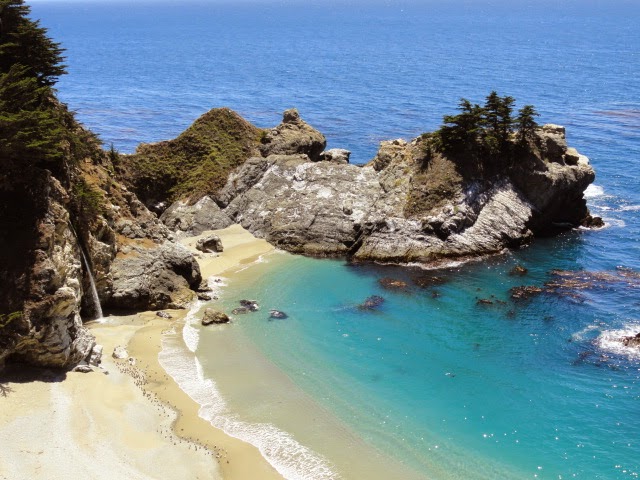
We just finished a jaunt down Highway 1 from Monterrey, California to Morro Bay; it's about 100 miles.  It took us two days to drive and hike this area, and we feel like we just scratched the surface. Undoubtedly, some of the most scenic coastline
McWay Cove and Waterfall
I've seen on the American mainland.  We started with gigantic coastal redwood trees, moved onto protected dunes, hiked inland to a waterfall, did scenic driving and watched whales.  As always, if you want to wade through them - the pictures tell the story.

https://plus.google.com/u/0/photos/115478608971584948192/albums/6040107970317504769?authkey=CKKr6Nrf0ayXcg

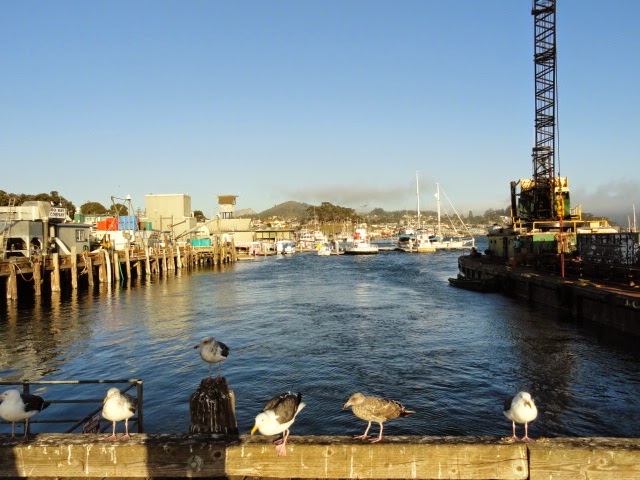
Morro Bay
You can't take pictures of the attitudes you encounter on Highway One.  Monterrey is all about tourism at the tackiest level.   The harbor and wharf were clam chowder in a bread bowl you carry around, cotton candy, ice cream, plastic souvenirs and tons of people in Bermuda shorts.  Pebble Beach is exclusivity and the residents of this community, littered with famous golf courses, will let you have a grudging peek at the high priced scenery they've secured for themselves for by charging you $10 to drive 17 miles along the Pebble Beach coastline.  Carmel is all pretension; it's for the nouveau riche who want and need to throw around their new big money in a loud and boisterous fashion.  You can still catch hints of the hippies who settled in and around Big Sur in the 1960's and '70's.  They built small cabins, stores, and restaurants in wood taken from the forests and they are still perched precariously on the bluffs along the coastline.  Morro Bay is about working the sea for a living.

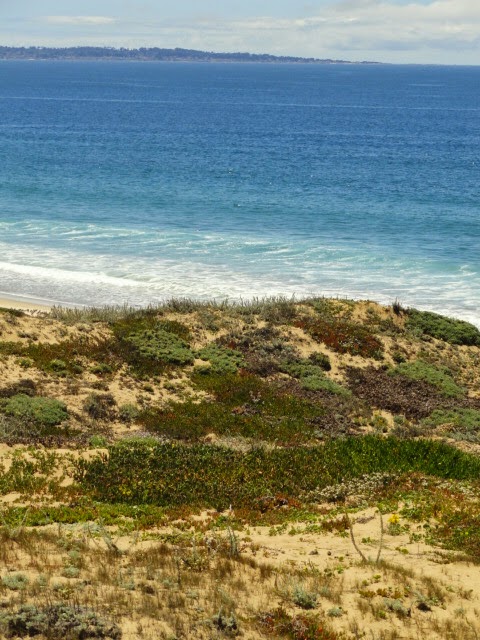
Another feature of this coast are the dunes.  The sand dunes are covered with vegetation that has specifically adapted to the climate and region.  We took a dune hike which was hellishly hard since one-third of it was slogging through deep sand, but worth it to see the plant life up close.
Dunes at Marina State Beach

We stayed in Carmel and had a hotel room with an Pacific Ocean view.  One of the highlights for Drake was the evening we sat out on the balcony with the binoculars.  We saw whales spouting, and jumping completely out of the water just like the Pacific Life commercial logo.  We were very fortunate to have almost clear weather at the coastline for most of the entire trip.

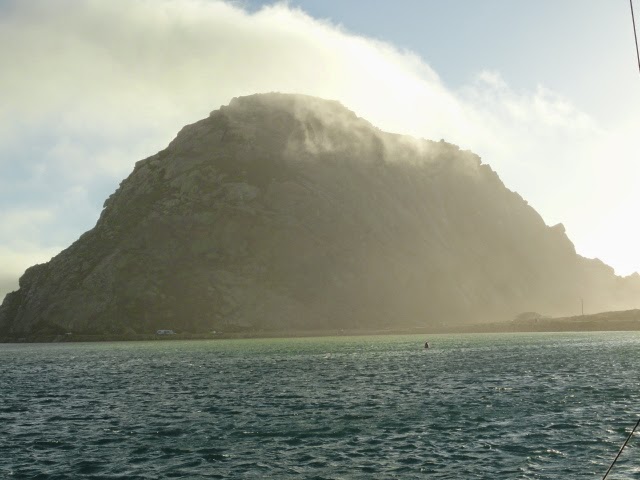
Other than the amazing scenery, my favorite of the trip was the Morro Rock.
Morro Rock
 It's a gigantic rock (539 feet high) sitting in the center of the Morro Bay Harbor.  The rock is actually the remains of a 21 million year old volcano.  There are seven of these ancient volcanoes in a string along the California coast.  The 'Rock' is the most visible remains of the seven.  It was originally an island, but was quarried (and made shorter and smaller) in the early 20th century.  The entire town of Morro Bay and the area surrounding it is a National Bird Sanctuary.  Guns are banned here since any kind of hunting is illegal.  The Rock is no longer an island, no longer a quarry, and it has been completely taken over by birds.  There are huge marsh areas near the town and these as well as the coastal shoreline are habitats for several endangered birds as well as on the migration path of several species.

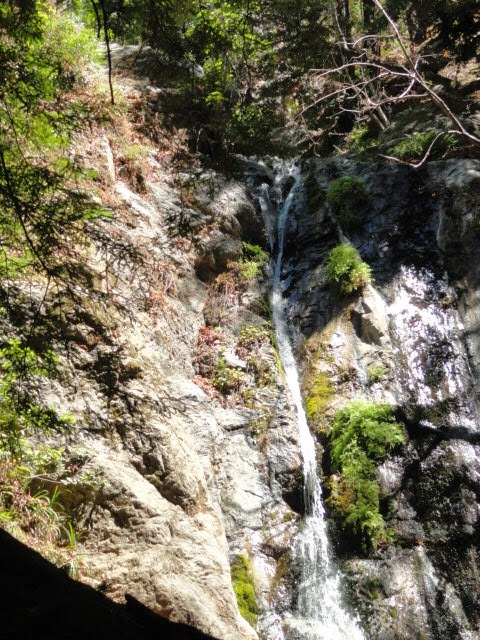
I'd recommend this trip to anyone with one caveat - avoid anything inland - you'll be disappointed.  The Pfeiffer Falls hike was a lot of energy expended for little return.
Waterfall, Pfeiffer State Park
  Also in hindsight, we would have skipped the 17 Mile Drive - better scenery just down the road.  Expect to be ripped off anywhere in Carmel and Big Sur - they know their attraction, and the hotel room prices are jacked up.  They can command those prices since they are sold out during the high season.  We also decided to skip the Hearst Castle in favor of looking for a coastal hike along the Pacific Bluffs outside of Morro Bay.  That fizzled when the fog rolled in.  I did find out there's another 'wine area' in California - around Salinas and Soledad in the inland Central Coast area.  They seem to have a nascent wine tour attraction developing.

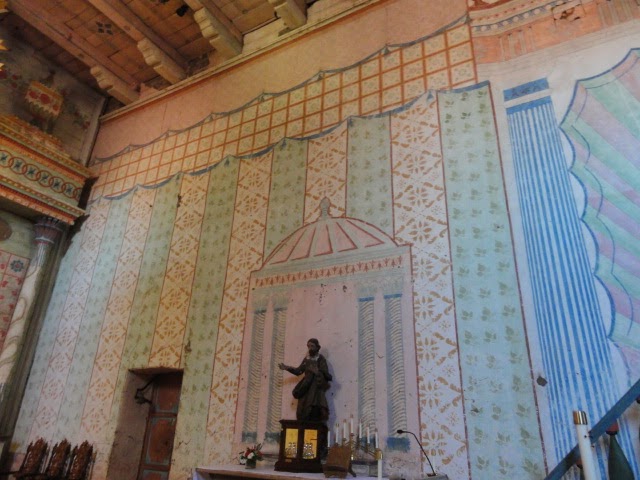
One off the cuff stop turned out to be our history lesson for the trip and very fascinating.  We stopped at Mission San Miguel Archangel.  It is the 16th of the 21 missions the Spanish Jesuits built in California during the 18th and early 19th century.  The sanctuary of the mission we toured has never been repainted, since it was originally painted by the natives under the tutelage of the Jesuits.
Sanctuary, Mission San Miguel Archanger

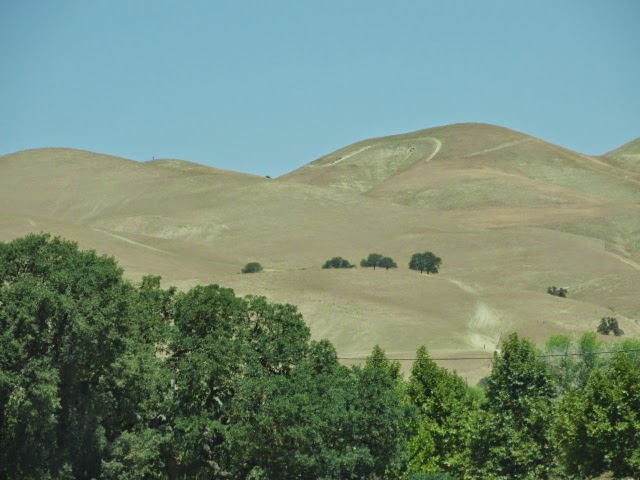
The weather and terrain is all over the place up and down the Central Coast.  Temperature depends on how far you are from the sea, and whether or not there's fog.  Coming back north to Berkeley, we jumped over to Highway 101 ( parallel to Highway 1 on the coast), but about 40 miles inland, the temperatures were summertime hot.
Inland, central coast
 This trip was just a dabble.  There is lots and lots more to do between San Jose and San Luis Obispo.  Perhaps a several month stay during another summer.              

Monday, July 21, 2014

Bleacher Baseball

With regard to baseball, Drake self-describes himself as an anachronism.  On Sunday afternoon, I couldn't have agreed with him more.  We took in an Oakland game (rooting for the Orioles - or 'Ranger's East' as we refer to the O-birds) with Sarah, Amy, her husband Daniel, and a couple of their friends.  Due to economic constraints of the PhD candidates, we decided to go for Bleachers, General Admission tickets.

If you've ever listened or watched the Rangers (or now the Astros) play the Oakland Athletics, there's constant noise.  What had always struck me was the inordinate amount of noise coming from a relatively small group of people.  The A's notoriously draw small crowds to their park.  The Oakland Coliseum, also home to the Oakland Raiders football team, is everything a baseball stadium shouldn't be in this day of designer baseball parks.  It was ironic the Orioles were playing here when we took in a game.

The Orioles baseball park, Camden Yards, was the first in the wave of 'retro ballparks' built since 1992.  These parks have been designed to enhance baseball for the fan.  Wonderful seats, great views, interesting configurations, and architectural features.  The Ballpark at Arlington (the Texas Ranger's park) was consciously modeled on Camden Yards as were several others.  Ballpark construction seems to happen in waves.

In 1965 the Astrodome ushered in the multi-purpose enclosed stadiums turfed in artificial grass.  It was billed as the Eighth Wonder of the World when it opened.   (Sidebar:  Originally, the Astrodome had clear lucite panels in its ceiling and a special Bermuda grass planted on its floor.  The players began to complain they couldn't see fly balls, so the panels were painted white. The grass promptly died.  For most of 1965 the Astros played on dirt painted green.  Chemturf, a new product, was promptly renamed Astroturf and the stadium was carpeted.)  Within ten years there were several domed stadiums which were venues for baseball, football, concerts and commercial shows [think RV, home and garden, etc].

The Oakland County Coliseum was built during this era, just not enclosed since weather was not an issue in the Bay area.  It's the last stadium in the country where professional baseball and professional football share a facility.   The foul territory is gigantic compared with more modern baseball facilities; the pitchers sit out in the open down the sides of the foul lines rather than in a bullpen, and the interior of the stadium is like a rabbit warren.  We actually had to go 'down' a long tunneled ramp to sit in the bleachers.

Ah, the bleachers.  In baseball, the 'bleachers' are the perimeter seating ringing the outfields.  These are historically the cheapest seats in the park, and originally were wooden planks with no backs and no covering.  The sun bleached out the wood, and thus was born the term 'bleachers'.  Bleachers have been shrinking since fans expect a cheap ticket to sit in the far reaches, and no professional sport these days is about a cheap anything.  Bleacher fans have morphed from fans into fanatics as the number of bleacher seats decline, and each team's bleacher occupants take on a group character.  The Cubs 'Bleacher Bums' were the forerunners of this type of fan.

Oakland bleacher fans sit on the right and left sides of center field, and each group has it's own personality.  The fans on the right field side are acknowledged as the rowdiest bunch in the park with the fans on the left field side coming in a close second.  First, I noticed the flags.  Big flags, color guard sized flags being vigorously waved at the start of every inning, and before any batter coming to the plate with men on base.  The right bleachers won the flag game - I guess someone on their front row has band color guard experience since there were about 20 flags and they waved in UNISON as if choreographed.  All flag wavers sit on the front row.  

The other feature of the Oakland bleachers was the musical accompaniment. Our side of the bleachers had three snare drums, two cowbells, and three medieval heralding trumpets, albeit in green plastic.
  
Drummers beat rhythmically throughout the ENTIRE game.  Drummers also sit on the front rows of the bleacher sections.  One of our drummers sported waving curled, shoulder length California golden blond hair, a six pack abdomen, cut off jean shorts and nipple rings.  Flag wavers each own their own flag from pristine green and gold to tattered and faded.  They wave in time to the drum beats while trumpets and cowbells enhance the drum beats.  It's a repetitive concert using three instruments, well, four, actually.  The fourth instrument in the bleachers are voices.  Everyone chants, and anyone can start a chant.  It's often picked up by the rest of the stadium crowd, and the bleacher aficionados don't need no stinkin' MAKE NOISE directions from the scoreboard.

Bleacher fans are also known for heckling particular players on the opposing team.  During the Oriole's game, Manny Muchado came in for particular vilification complete with rhythmic booing, a photographic head shot of him waved around on sticks, and 'Manny Sucks' chants every time he appeared at the plate to bat.  (The A's fans do not forgive:  Muchado got into it with Donalson the A's 3rd baseman on June 9th, and this was their first opportunity to dish it back to him.  He struck out twice during the game, but managed a hit much to the fans disgust in his third at bat.)  There's also singing to various songs throughout the entire game over and above the iconic "Take Me Out to the Ballgame".

Drake attends baseball games to watch every nuance of the game.  Bleacher fanatics leap to their feet at every crack of the bat (literally), and obstructed his view repeatedly.  Over the years, he's grown more and more annoyed with fans who come for the party rather than the game.  The ultimate party boys, three of them, sat in front of us.  They receive the 'ultimate' accolade since Drake detected they had smuggled hard liquor into the stadium in their sunblock tube.  GACK!  My tongue and mouth just puckered into rejection of that liquid.  We spent a happy five minutes speculating how they had cleaned out the sunblock, or if they had, and how they filled it with booze.

I thought the party atmosphere enhanced a game in which I had no real interest in the outcome.  The A's crushed the Orioles, Sonny Gray pitched a terrific game hinting at a no-hitter into the fifth, and the party rocked for the entire game.  I concentrated on keeping score, eating a terrific corndog, and cheering for the former Rangers on both teams.  Drake, well, he was just a curmudgeon, and if you ask him, he's PROUD to be one.