Wednesday, September 26, 2018

Farewell, Saratoga Springs

Our time is coming to an end in this charming upstate, New York town.  We would have stayed longer except for one little hiccup:  Jury Duty.  That's what you get when you get a new driver's license.  It's the invisible lagniappe the Arizona DMV attached to our shiny, new licenses.  I was supposed to report last March (IN SCHOOL), then June (already left the STATE), so finally, now I have to appear on October 15th.  Now, don't get me wrong.  I'm done my jury duty - about four or five times in Tarrant County, Texas.  You'd think that'd be enough for dismissal.  You'd think being over 65 would be enough for dismissal.  You'd think because I only live in the flippin' state about 6 months each year would be enough for dismissal.  No, they want me to pay their state income tax, and serve on their juries.  SO BE IT.  They just registered a new Democrat eager to turn this state purple and then blue.

Saratoga Springs is about as far away topographically from the desert as one can get.  It's magnificently, brilliantly green instead of brown.  Huge trees of every variety both evergreen and deciduous cover the lovely worn down hills of the Adirondacks.  And water, well, there's water everywhere.  Thanks to glaciers scraping back and forth, there are tiny ponds, a network of creeks, rivers (including The Hudson River) and one huge Lake (Lake Champlain).  The abundance of navigable bodies of water triggered the history of the area.

When we first arrived here, we encountered a sign which read:
History
Health
Horses
The American history of Saratoga Springs is this is the place of a turning point in our favor in the American Revolution:  The Battle of Saratoga.

There's a national battlefield, but I really like the monument

They're pretty serious about Early American History around here.  Meet Ken and his personal cannon.  Yep, Ken owns his own cannon cast from an original one lost in Lake Champlain in the 18th century.  This man is a serious re-enactor.  I said, "Ken, why did you buy a cannon?"  He replied, "I go to a lot of schools, and it's a great way to teach the American history of this place."  Good enough for me, Ken

It didn't take us long to start drinking at the various natural springs dotting Saratoga Springs.  Mostly they are all YUCK - super carbonated, iron tasting, sulphur tasting or some disgusting combination.  Finally, someone tipped us the best tasting water in the area is from Spring #1, and there are four spigots continually running spring water.  There's always three to six people filling everything from personal water bottles to five gallon jugs.  And, I can testify, the water is delish.  Those other springs, not so much.

However, those other springs were flowing money in the 19th century.   As soon as the railroads built lines from Boston and New York, 'spas' and hotels appeared.  Entire families arrived for six to eight weeks to take the 'springs cure'.  Saratoga Springs as well as surrounding towns such as Ballston Spa cashed in.

A famous prize fighter with discretionary cash arrived in summer time Saratoga Springs to find bored men accompanying their wives, children, or sisters for the cure.  Not for long.  The prize fighter got together with some heavy hitters in the racing business, and the Saratoga Race Track was born in 1863 one month after the Battle of Gettysburg.  They've been racing thoroughbred horses here ever since.  The big race, named after Henry Travers (one of the racing heaving hitters) is still raced and named the Travers Race.  It's the premiere race of the Saratoga track season.


This cup, named "Man O' War" is presented at the
Travers Race every August
An off-shoot of the race track is that Saratoga Springs is the location of National Racing Museum.  After visiting, I thought the 'national' designation was a little ambitious, but there were lots of interesting artifacts as well as far too many paintings of famous horses by mundane artists.  I was intrigued by the four trophies handed out for the Kentucky Derby, the Preakness and the Belmont.  (Yes, I said four.)  
Kentucky Derby Trophy
Preakness Trophy - isn't this a hoot!
Belmont Plate - kind of boring
Yes, that's only three trophies, BUT when a horse wins all three, he's a Triple Crown winner and there's a special pyramidal trophy awarded - thus, occasionally, the fourth trophy.

Each side represents one of the races in the Triple Crown
By far the most fascinating exhibit was the genealogical exhibit.  Did you know ALL thoroughbred race horses trace back to one of three Arabian stallions and a small variety of 'promising dams' bred in England in the 18th century.  Today, 90% of the thoroughbreds can trace their lineage to one of the three stallions - the one who was 'FAST'.  Look at this chart!


We've discovered there should be a fourth "H" on the sign, and it should read "Heifer".  Surrounding Saratoga Springs are farms, a few horse farms, but lots and lots of dairy farms.

We actually took a 'Cheese Tour' around rural upstate New York.  In my fridge right now, there's about half a dozen types of cheese as well as a pint of maple walnut ice cream.  These farms look like picture postcards.  Many of the barns and houses date back to the late 18th century or early 19th century.  
Notice how the bricks are handmade
I had to laugh.  An older woman at this farm selling doughnuts confided HER house just down the road was twenty five years older.

The fifth "H" on the Saratoga Springs sign should be "Heritage".  There are wonderful houses here.  Some date back to the 18th century.  Mostly, though, the town was built in the 19th century.  We found some wonderful examples of architecture here.
That's Drake with the 'other' Jan Sartor

The house above dates from the 1820's.  Here's another one from the Victorian era in the French Empire style.


And, here's a Federalist house from the late 1700's.  


However, when it's all said and done, Saratoga Springs defines itself by its horses.

We've loved living here.  The apartments have been nice, and Drake's had a garage.  The food has been excellent, especially if you love Italian.  I also perfected a recipe here:  Maine Lobster Rolls.  Maine's version uses no mayo or celery.  The lobster is sauteed in flavored butter and served on those weird hot dog buns which look like a folded piece of white bread.  Yum!  The one food downfall was no matter how many places we tried, there's NO MEXICAN FOOD HERE!!!!  I'm about to die from craving Tex/Mex.

What initially attracted us to this place were the cultural performances.  We've seen five ballet performances by the New York City Ballet.  We've seen four performances by the Philadelphia Symphony Orchestra, and we've seen six performances by the Lincoln Center Chamber Society.  With the exception of one ballet which, as we watched, we realized we've always hated, all the performances were wonderful.    

Time to pull up my galoshes and get ready to leave, and we've so needed them.  It's rained constantly for the past four months with the accompanying high humidity.  Everyone up here has complained loudly about the summer weather.  I just thought I was living in summertime New Orleans.  Otherwise, we are sad to leave especially since we are on countdown:  Just over 30 days to wait, and Lucky will be here!


Saturday, September 22, 2018

Fort Ticonderoga - Iroquois Meaning the Place Between Two Waters

Upstate New York is ALMOST as chock full of American history as coastal Virginia.  The last stop of our mini-vacation to up-up state New York was Fort Ticonderoga.  This is a place that rings some tiny bell in the back of your mind.  You KNOW you've heard of it, and you know it was important for some reason lost in the mists of your memory.

This place calls itself "America's Fort", but it's really not.  It was built by the French, renamed by the British, and captured by the Americans.  This fort is all about the military strategy of the 18th century.  In an era of few roads, whoever controlled the waterways controlled vast areas of land.  Sitting at the southern end of Lake Champlain, this fort was fought over six times and changed hands three times.  With the advent of the railroad, the gasoline combustion engine, and a reliable road network overland, Fort Ticonderoga fell into disuse, and was literally falling down when a privately funded non-profit group decided to restore it.  Their restoration efforts started in the early part of the 20th century, and  continues today.

For Americans, there is a fascinating story associated with Fort Ticonderoga and the American Revolution.  Washington, the Continental Army Commander, had problems not only with an untrained army, but also with a lack of material to fight the war against the British.  (That's why the victory at Saratoga was so important - it convinced the French to finance the war.)

It's 1775, and the war has just started.  Two young, impetuous Patriots present a crazy plan to Washington.  Benedict Arnold and Ethan Allan, with a small force of men and by using the element of surprise, propose to capture Fort Ticonderoga from the British.  Washington agreed.  To the astonishment of everyone, they succeeded on May 10, 1775!  The British retreated back into Canada.  As amazing as that feat, it's really not the story.

In early winter, 1775, Henry Knox, a 29 year old bookseller from New Hampshire went to Washington, whom he had met in the Bunker Hill/Breeds Hill battle in Boston, with an REALLY insane plan.  Knox convinced Washington he could bring the artillery from Fort Ticonderoga to the hills overlooking Boston
and thus drive the British out of Boston.  Again, with nothing to lose, Washington requisitioned $1000 dollars and sent Knox north to the fort.

Knox arrived at Fort Ticonderoga on December 1st, and he promptly began directing the removal of the cannons from their carriages. 

Knox lashed the cannon onto large sleds, planning to use oxen to pull the sleds when he couldn't use the rivers.  He devised a route consisting of floating the cannon on rafts, sliding them over frozen rivers and creeks, and sledding them through snow on a route between Fort Ticonderoga and Boston.  He called it his "Noble Train of Artillery", and it consisted of 59 cannon and other assorted artillery pieces together their carriages, cannonballs, black powder canisters, and all the other sundries necessary to the firing of 18th century artillery.

This gives you an idea how large the cannon are
As always, the weather refused to cooperate!  First, he couldn't get snow for his sleds to get started, then, several feet fall all at once.  He barely rafted the cannon across Lake George (a small lake just north of Saratoga Springs) before it froze solid.  The farther south he traveled, he discovered the large rivers such as the Hudson River weren't frozen solid enough to bear the weight of oxen and cannon.  He tried to cross the Hudson River on January 5th with one cannon on a sled pulled by a team of oxen. The ice cracked, the oxen were cut loose so they wouldn't drown, and the trial cannon wound up at the bottom of the river.  It was a shallow place, so the valuable cannon was  fished out by Patriots from the tiny village of Albany.  

Knox waited, testing the ice each day.  In a few days, he was able to slide his precious cargo across the river on ice.  Then, he went up and down hills and the Berkshire mountains dragging the artillery across Massachusetts.  He covered 300 miles in the dead of winter with thousands of pounds of artillery.  When the British awoke on March 7th to discover the  hills around Boston ringed with American cannon, they had no choice but to evacuate the city.  Not too bad for a bookseller!

Post revolution, the Knox's cannon dispersed over the Eastern seaboard and all the way down into the Caribbean.  In the 1930's the Fort Ticonderoga restoration group went on a cannon search and returned the cannon to the Fort.  Some of the cannon are British, some are French, and some are Spanish, but they represent some of the original cannon as well as others from the same period.  They all date back to the 18th century.  

Slowly, the Fort has been restored, and the foundation has scored a donation of a collection of period weapons including swords, powder horns, as well as muskets which is outstanding.  
Collection of swords
I thought the carved powder horns were the most interesting.  These were not carved by ordinary soldiers sitting around the campfire.  Instead, master carvers followed armies and sold the carved powder horns to soldiers as mementos of their service.  Here's an example:

The restoration has been done by utilizing as much of the original material as possible.   The fort was literally in ruins when the restoration started.  

I thought the most fascinating aspect of the Fort were the people.  I've been in other citadels and forts which have college kids dressed up parading around, but at Fort Ticonderoga re-enactment is taken a step farther.  The re-enactors are full time employees of the foundation and each brings an 18th century skill to the table.  Visitors as they take the self-guided tours meet these people as they perform their specialty skill.  Here's one of the cobblers.  They make the shoes of all the re-enactors using 18th century tools.  The cobbler told me he trained with a master cobbler for three years using tools which are over 300 years old.  
He's putting new soles on a pair of shoes
The cobbler told me in the British army of 1750, a soldier was issued a pair of shoes and five pairs of soles.  His shoes (and soles) were expected to last for three years.

When I asked him why he wasn't portraying the American army, he replied they switch each year.  One year they are the French army of 1740; the next year the British army of 1750, and the following year, the American army of 1775.  Next year they will be Americans.   I noticed a wooden bowl and spoon on the bench behind him, and I found out there are cooks who make 18th century recipes for lunch for the staff and re-enactors.  If you are eating outside the break room, you're expected to be eating the type of food someone of the period would have been eating.  The cobbler had pea soup for lunch the day we visited.  Vegetables for use by the cooks are grown (on a smaller scale) in the King's Garden which is adjacent to the fort.

Equally interesting were the tailors.  They make all the uniforms and clothes for the re-enactors.  The day we visited, they were working on miniature uniforms for children who visit to try on. 


In contrast to the cobblers, the tools used by the tailors have really not changed much in 300 years.

There was also a cannon firing demonstration.  It took a well-oiled team to fire a cannon successfully with more steps than I thought possible.  

We have an American loyalist officer (green), a regular British Army officer (red), and a lowly British seaman in high water trousers.  This small cannon has a range of 400 yards - that's four football fields.  Cannon generally shot a six pound ball (think small bowling ball) or a three pound ball (think tennis ball) propelled by a canister of black powder which was ignited by flame applied to a flammable material jammed up next to the canister of powder.  Muskets shot a ball the size of a marble on the same principle.  Here are some examples of actual 'shot'.
Yes, that's my foot & the shadow of my hands.
I couldn't quite get the big cannon balls on the back row
I also enjoyed the mini-history lesson of the fort presented with maps, pictures, and sometimes life sized figures such as these
This is a Mohawk warrior, a British ally in 1750

Here's David Perry, a British citizen of the Colonies, fighting with the British against the French in the French and Indian Wars.

In twenty five years, David Perry, might be a Patriot/Rebel fighting against the British.

Our last tour were the King's Gardens.  In the 18th century, the gardens were less about flowers and more about feeding the army occupying the fort.  Reduced in scale these days, it still is representative, complete with heritage plants, of the types of vegetables which would have been grown in the late 1700's.  Today, it's not only veggies, but also about flowers as well as having a quiet place to enjoy nature.

This gardener was out picking strawberries

And there were beautiful flowers in the 21st century
All in all, this was a great way to end our small trip.  The Fort and its history was really interesting and well done.  As always, there are pictures.  Using the slideshow feature will give you picture captions.  Click on the below link to see the pictures.


Lake Placid and the Adirondacks

We took a mini-vacation to see Lake Placid, New York.  This tiny town hosted the Winter Olympics in 1932 and in 1980.  Today, its Olympic sites of ice rinks, bobsled, luge, and skeleton track, and ski jumping towers make it a major training facility for Olympic athletics.  There are also World Championships held here for luge and skeleton.  The weekend after we left there was a 'half' Iron Man competition.  The full length one is held in the Spring.  There's also a first class Olympic Museum.  Thank heaven the museum was great because the rest of Lake Placid was a real let down, especially for Drake because this was a 'must see' place for him.


Lake Placid is in the heart of the Adirondacks. This map of the Adirondack Park shows how glaciers raked back and forth across this area gouging out streams, rivers, and lakes.  Lake Placid is one of the bigger glacial lakes.  What surprised me was the Lake is in the shape of an "H" with two islands in the center of it.
  
Lake Placid isn't even in the town of Lake Placid.  The lake inside the town is called Mirror Lake, and it's really just a big pond.  It's where the town beach and swimming area is located. 


This town is an Eastern version of a ski town.  It's all about the snow and ice here.  Everyone awaits the snow for skiing, snow shoeing, snow mobiling, and, of course this close to Canada, for the hockey season to begin.  The Olympic sites provide good paying jobs for the people who maintain them since they are New York State employees.  The day we went to see the facilities, I talked to a woman who was resurfacing the enclosed areas of the bobsled track.  She was guzzling water since it was enclosed, and the heat and humidity was taking it's toll on her.  Terrible weather (hot/humid) has been the norm this summer.

All people could talk about in Lake Placid was the weather.  They've never seen such a hot summer.  In the Lake Placid area, which is just a few hours north of Saratoga Springs, the weather has also been without rain.  Here it's been hot, humid AND rainy.  The summation of the coming autumn was:  "Well, it's been so darn hot here, I expect there won't really be any leaf color.  The weather will plunge, and the leaves will fall off the trees.  That happens sometimes."  That made me feel better since I've been trying to figure out how to see some 'color' up here before we leave.  It's just not going to happen.


We toured the outdoor venues left over from the 1932 and the 1980 Olympics, as well as the Olympic Museum.  I will say the ski jump site was just flat scary.  First we took the ski lift to the top of a mountain, then, we took an elevator another 27 floors up to the place where the jumpers are at the top of the hill.  That's the large ski jump.  Ski jumpers are just adrenaline junkies.  No one who wasn't would ever do this. 
The cars below really give you some perspective!
You can walk up, and up, and up. 
The top of these stairs are where the jumpers start

Ski jumper at Lake Placid in 1980 Olympics
The museum was filled with interesting exhibitions.  My favorites were the torches, the medals, and the clothes.  Here's the 'wall of USA Olympic uniforms'.  As you can see, some were more successful than others.
1932 to 2014

I asked someone if Lake Placid would ever host another Olympic game, and the answer was an emphatic "NO".  In 1932 there were 14 events in four categories:  sledding, skating, skiing, and ice hockey.  Almost all the events were men only.  This was the last Winter Olympics without alpine skiing.  There was cross-country, ski jumping and the Nordic combined - all for men only.  There was no downhill or slalom.  There were three demonstration sports:  curling, sled dog race, and speed skating for women.

By 1980 there were 38 medal events.  This Olympic games is best remembered for two things:  The American, Eric Heiden, collected five gold medals in speed skating, and the American men's hockey team composed of college kids (no American professional hockey players were allowed to compete in 1980) beating the world champion Soviet Union team.  It's still called the 'Miracle on Ice', and it was the first time I can remember hearing the "USA" chant.  I remember watching that game; it was thrilling.

Today, the Winter Olympics has 102 events.  There's no possible way the tiny town of Lake Placid would be able to host a modern event.  The population of the area is so sparse, as well as hard to get to, all the event venues would be wasted once the games were concluded.  The expense to create the venues would be astronomical.  There's also no infrastructure to support a modern Olympics.  Everyone seems more than happy to be a touristy ski town with a few world class athletes walking around.  

Of much more interest was the rest of our mini-trip.  First, we stopped in Elizabethtown at the History of the Adirondacks Museum.  What fun!  There were two exhibits which were really fascinating:  First, there was an exhibit of New York suffragettes.  Here's Alice Paul, a woman almost lost to history.  She was directly responsible for the national campaign to get the vote for women.  She worked for Civil Rights her entire life.  

The other exhibit I loved was the gallery of World War I propaganda posters.  This is the 100th anniversary year of the end of that war (November 11, 1918).  There have been several exhibits commemorating a war nobody really remembers or even understands.  My grandfather fought in the trenches with the American Expeditionary Force, the fancy name for the American army sent to Europe in 1917.  It was the first mechanized war.  There was long distance artillery, tanks, machine guns, and airplanes dropping bombs.  

When the United States entered the war it was deadlocked in trench warfare which consisted of men being routinely slaughtered by automatic fire as they 'went over the top'.  (The real war criminals in WWI were the Generals on both sides - using 19th century tactics in the first industrialized war - causing huge numbers of men to be killed and wounded.)  This is also the war that introduced 'chemical weapons'.  The mobilization of men and material by the United States turned the tide of the war in favor of England and France and their allies.  The Armistice of WWI also sowed the seeds that resulted in WWII.    

The propaganda posters were designed to overcome the pacifist popular opinion as well as 'sell' the idea of getting involved in a foreign war.


And, some posters shilled popular songs related to the war


And this was the first war in which women were asked to 'step up' into the manufacturing work place and replace the men in the armed services.  Women never left the workplace after 1917.  Right to vote for women was closely tied to their mobilization during WWI, and the result was women's suffrage passed as a Constitutional Amendment in 1920.

If you want to see the landscapes of the Adirondacks, the Olympic sites, the Olympic Museum, and the History Museum, well, just click away on the pix.  If you look at the pictures as a 'slideshow', you can see the picture captions:


Monday, September 3, 2018

National Bottle Museum, Ballston Spa, New York

Everyone knows how much I adore visiting unusual places, and it's a fact I've never met a museum in which I couldn't find something to like.  I've been agitating to visit the National Bottle Museum ever since I found it, and I finally wore Drake down.

This place is all about the world of bottles prior to the advent of Michael Owens' bottle making machine which started mechanized production of glass bottles around 1905.  Prior to the invention of this machine, bottles were mouth blown by master craftsmen.

The 'production line' consisted of a master glass blower, his apprentice(s), and the carry boys.

The most efficient way to ' mouth blow glass bottles' - especially ones of size was to 'gather' the glass out of the furnace, (see the blob on the end of the stick in the above picture),  and blow the hot glass into a mold.  The master would blow the hot glass, and it would expand to fit the mold.  Then, it would have to be slowly cooled.  The 'initial puff' took a lot of lung power, and often this was one of the jobs of the apprentice.
  
Now, look at the picture below,  A 'carry boy' - sometimes a child, but always the low man on the glass blowing totem pole -  literally carried the blown glass bottles to the cooling area. See, the black guy holding the bottle?  He's the 'carry boy'.  The blown glass demi-john (type of bottle) is being carried in a 'snap case' which is how he's pulled the glass from the mold.  The blow pipe is being cut off.  Then, he'll carry the bottle to the cooling area.  That's the manual glass blowing by mouth craft in a nutshell.


These two pictures (above) show the process of blowing a glass bottle.   In the glass blowing factory, there would be teams blowing glass into molds for ten to twelve hours a day.   It was a system which was completely turned upside down by the bottle making machine invented in 1905.  An entire group of craftsmen (glassblowers) and their apprentices and helpers were suddenly out of work because of mechanization of their jobs. Glassblowing went from being a blue collar trade to being obsolete in the manufacturing world.  

We had a wonderfully knowledgeable guide (Gary) who is an actual historian, and he has worked at the bottle museum for about twenty years.  He knows EVERYTHING about bottles.  For instance, bottles are categorized by their shapes.  There's a 'whiskey' bottle shape, a 'milk' bottle shape, a 'medicine' bottle' shape.  There are shapes called 'figures', as well as things created by the glassblowers playing around with end of the day glass leftovers.  These are known as 'whimseys'.  I loved the whimsey's.)  Here are some:
The figure in the front is a bank!  
Here's a figure bottle which is actually the original Poland Spring water bottle

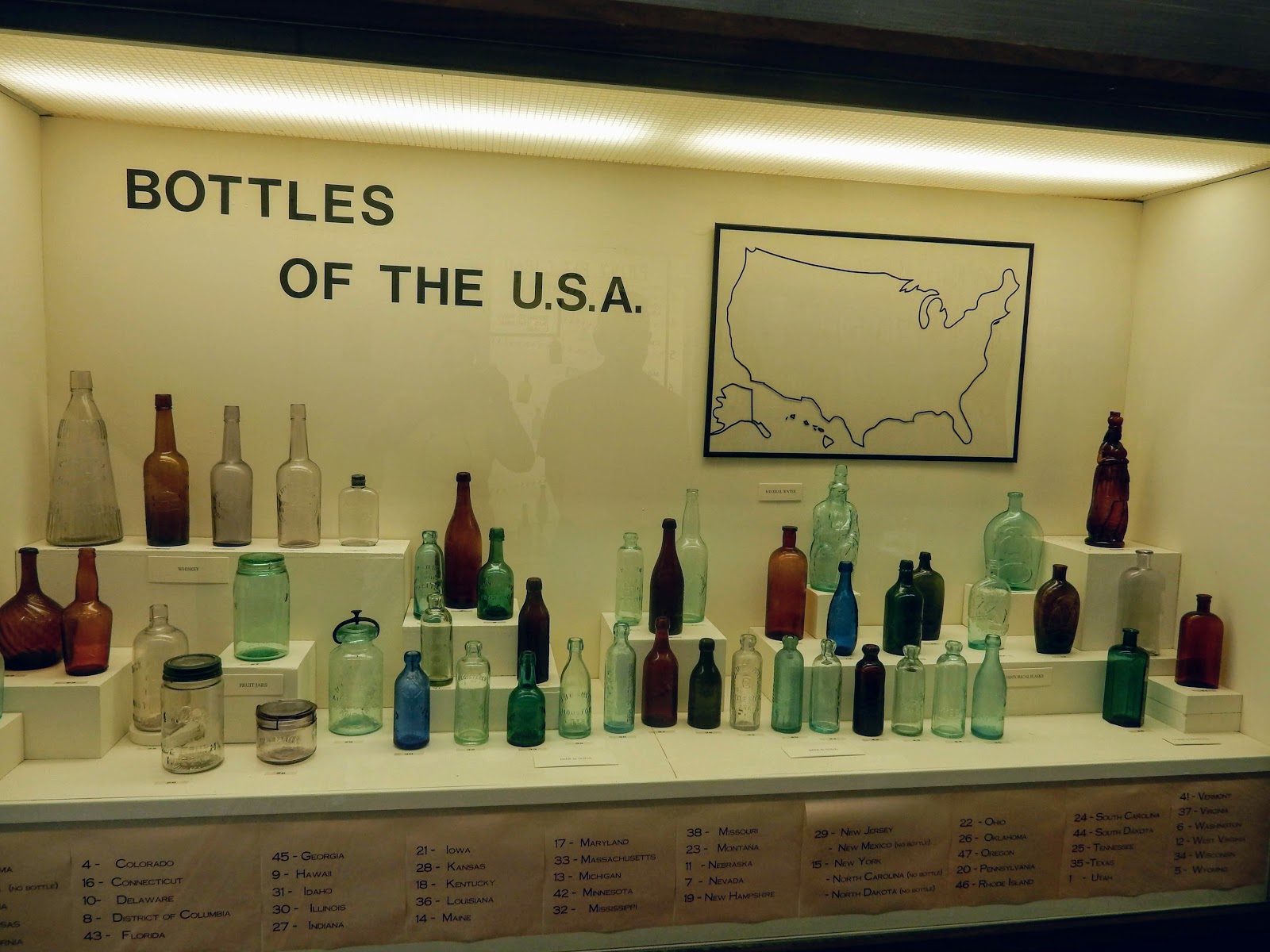
One of my favorite displays were the different bottles associated with the fifty states.  The Poland Spring bottle (above) was the "Maine" bottle. 

You can guess which state this bottle is associated with:

I thought the variety and colors of medicine bottles were the most interesting.  Here's Drake in front of an actual pharmacy counter circa 1900. 
 
Pharmacists compounded their own medications from their stock of powders and tinctures.  They kept records usually under the clients' names.  Here's a pharmacist's record book:

The museum had a collection of 'poison bottles'.  In a time of low literacy, poison bottles couldn't just be labeled with words.  The solution to preventing accidental poisonings was to create bottles with raised bumps and/or pictures to indicate poison contents.  The second purpose of such 'bumps' was to show by feel in low light, or no light which of your medicine bottles contained poison.

In addition to bottles, the museum had two exhibitions:  The first was a collection of stoneware from potteries created from clay deposits along the Hudson River.  When the clay was exhausted, the pottery factory either moved or went out of business.  Here's a chamber pot manufactured in the 19th century in "West Troy" which is about 25 miles from Saratoga Springs.  
The patriotic theme was handpainted - circa the Civil War
The other exhibition was a paperweight collection donated by an early supporter of the museum.  Here's my favorite paperweight:

Another novelty collection were the glass pieces which contain a small amount of uranium!  Under black light, these pieces glow fluorescent green.

Finally, the museum is continually sorting through donated glass bottles.  A few are noteworthy and added to the collection, but most are duplicates upon duplicates of items the museum already owns.  The museum has devised a clever way to both raise money for the museum as well as send along bottles which they don't wish to add to their collection.  

If you donate $5, you get to pick a prize.  The staff has wrapped give away bottles in tissue paper, and you select (sight unseen) a bottle from the tissue wrapped pile to take home with you.  We donated $10, so I got to pick two bottles from the pile.  I scored two glass medicine bottles blown into molds circa 1875!  How cool is that! 

This museum is well worth a visit.  It unfolded to us thanks to the expert and interesting commentary by Gary.  My pictures start with scenes from Ballston Spa, New York - the location of the museum, as well as the birthplace of Abner Doubleday.  Then, there are more pictures of the contents of the National Bottle Museum.  Click on the link if you are interested.