I've been waiting impatiently to get to the famous botanical garden before the summer season is over. No matter how well done, an autumn and winter garden are just not as good as a spring and summer one. First, though, we had to buy something to sit on. Due to the wedding boxes we drug from Arizona to Austin, we had to leave behind the easy chairs we normally travel with. We buzzed over lots of Richmond following up on thrift stores and Craigslist items. In two days we managed to buy two easy chairs - Drake actually got a great leather recliner - as well as a table and chairs, a six foot bookcase (there are no drawers or shelves in this apartment), two chests of drawers; mine is missing the bottom drawer, but for $10 it was a bargain, and I just consider the open area to be shoe storage. We acquired all of this is two days for under $200. Since it's all going to be resold or donated in December, it doesn't pay to go upscale.
Then we had to go get our health club settled. This one is swank, swank, swank. It's gorgeous, new and reasonable. Boy, are we going to be spoiled when we leave here. They provide all the towels, both work-out and bath towels. There are hairdryers and air diffusers (cool air blows on you) in front of the individual lighted makeup stations). There is an indoor salt water lap pool, an exercise pool and a spa. There's another pool and health food restaurant on top of the building, and the parking is covered. All the exercise equipment is the latest,and there's a large selection of classes included in the price. It's less than 10 minutes from the apartment. Of course, now I have to go exercise. There's always a fly in the ointment, isn't there?
Yesterday, perfect weather day incidentally, we headed for the Lewis Ginter Botanical Garden a highly touted 'must see' United States garden. Ginter was a wheeler dealer of the 19th century who made and lost four fortunes in his lifetime. The last fortune was made in real estate as he developed the first Richmond suburb. The property where the garden is located was purchased by him to be used by Richmond bicyclers in pursuing the new bicycling craze that was sweeping the country in the 1890s. (Bicycling did more to modify the heavy, unwieldy women's clothes of the 19th century than the previous 100 years of clothing reform.) After his death, Ginter's niece, Grace Arents, purchased the bicycling property with the clubhouse and founded a convalescent home for sick children along with her companion, Mary Garland Smith. ("Companion" is exactly how the brochure describes her!) Grace died in 1926 leaving life rights to Mary of the property and the stipulation upon Mary's death, Richmond would turn the property into a botanical garden and name it after her Uncle Lewis. Well, Mary lived to be 102! She didn't die until 1968. The property was pretty much abandoned, and languished until in 1981 when a group of committed horticulturists and botanists got the botanical garden off the ground. In about 30 years the City of Richmond has managed to sponsor the creation of a nationally famous botanical garden thanks to this group of citizens.
It's not very big when compared to Montreal's garden, but each area is exquisite. There are also 14 buildings - gazebos, and the like, scattered throughout the property with numerous benches and places to simply sit and contemplate the beauty of this place. There's an imposing glass conservatory with a dome sitting in a lawn area used for concerts. As always, the pictures tell the story.
https://plus.google.com/u/0/photos/115478608971584948192/albums/5920903614294834001?authkey=CIjS6J-CvK-DwgE
Saturday, September 7, 2013


Friday, August 30, 2013
Hello, Richmond
We arrived in our new destination, Richmond, Virginia, on Sunday evening after having a Saturday afternoon farewell meal with Sarah and Jay. I fed Al, the cat, several tuna treats, and then we hit the road. The move out of New Haven was very easy because other than our personal toiletries and clothes, we used all of Sarah's stuff. We still managed to leave the crucial cable that connects the TV and the computer attached to Jay's TV. Oh well, I'm sure they will be able to use it.
Sunday afternoon on the way to Richmond we decided to take the heavily traveled I-95 just south of Baltimore down to the infamous Washington DC Beltway (which actually is just the western freeway loop around DC), then reconnect to I-95 and come into Richmond. Simple, straightforward, and overwhelming. It reminded me of the new Southwest Freeway through Houston with six lanes on each side, and HOV lanes, and separated lanes that got on and off at every exit. We breezed right through, and realized we never wanted to push our luck and drive it again. Observing the northern traffic, (we were driving south, of course) on the same route, with the same number of lanes (numerous) at one point there was a 20 mile long bumper to bumper traffic jam. Mind you, this was Sunday afternoon. Chatting with someone when we arrived in Richmond about the I-95 route, she laughed and said it was almost always horrendous, and you had to know both the college and pro football schedule on Saturday and Sunday to make sure you don't try to drive anywhere you can get caught in standstill traffic.
Richmond has surprised me. It feels a little like Tulsa - rolling hills, but much more heavily forested. Trees grow naturally here - there's thick forest of mixed deciduous and evergreen everywhere. I think the autumn is going to be breathtaking. It's also rather comforting to be in a part of the country where I recognize most of the vegetation. This town seems to be the crepe myrtle capital. They are a bit faded now, but in July there were undoubtedly gorgeous. They march in well trimmed rows around the various shopping centers. They have signage ordinances here, and it's maddening to try and find a store by peeping through the crepe myrtle branches since low profile signs are suffering from vegetation encroachment.
Anyway, we started house hunting on Monday morning. We decided that after New Haven, we have had enough 'downtown living'. It's fun in that there are lots of individually owned restaurants that are walking distance, and lots of cool shopping, but it's also constant noise. This time we are opting for suburban living with broad smooth streets, right turns on red, and left turn lanes at every major light. The bitter is that most of the eating choices are fast food or chains in the part of town with the smooth, wide, well marked streets.
It took us about two days to find an apartment. We signed the three month lease on Tuesday, and moved in on Wednesday. On Thursday we did blitzkrieg shopping driving all over Richmond and beyond looking for the additional stuff we needed - like chairs and a table - to get set up. We found almost everything, as well as got the Fios set up. Speaking of Fios, (Verizon's TV/Internet/Phone), guess what? You can't just pick up your cables and box after you get signed up. No, they MAIL you the box of equipment. It was supposed to come on Friday, but we got the 'box' a day early. That's why I'm on the Internet.
We also discovered on our trip to the Post Office to get our 'mailbox' key, that it will be 7 to 10 days BEFORE WE CAN GET THE KEY. I guess some blacksmith is going to have to devise it, and then get it blessed and finally, finally, deign to give it to us. Our new address is: 9409 Brightway Court, Henrico, Virginia 23294. Apparently we live in a town that only the post office cares about. Everyone else who lives here thinks they live in Richmond. According to anecdotes, you could address my mail to the address above except put Richmond and it would get to me. I asked what happens if we get mail before we can get the magic key. The postman answered, "Oh, it will just pile up in the box." SWELL.
I also have ANOTHER library card. New Haven was very generous with theirs - I will using it for another three years. This Tuckahoe (another mysterious town) library is new and very nice. I was trying to figure out how many library cards I've acquired. I think I have nine. I should have a nice collage soon.
So, tomorrow is the final furniture quest - a chest of drawers for Drake. Oh, and did I mention the apartment features? It's a 2/2 that's been newly remodeled with new floor coverings, counters, sinks, and appliances including a Maytag stacked washer, dryer IN the APARTMENT. We also have air conditioning, which now seems 'cold' to me after the New Haven hot box, a dishwasher and a garbage disposal. High cotton. It's also in the back of the complex, so we look at trees rather than parking lot. Absolutely perfect except for one tiny thing...it's on the second floor. I can walk the stairs - did that in New Haven, but Drake is insisting that I help carry the furniture up the stairs. Well, I did it, but my back hurts. The recliner bottom (one of the pieces we bought) was just awful as was the big mattress. I'm contemplating throwing the pieces down the stairs and seeing what survives when we leave.
We are all unpacked. I've made the four hour re-set up the household and kitchen store run while Drake was getting the Internet set up with the equipment we couldn't be trusted to carry out of the store, and doing the laundry. After we get the last chest, AND manhandle it up the stairs, it's two days of rest for me. I'll be raring to go after that. Lots to do here.
Sunday afternoon on the way to Richmond we decided to take the heavily traveled I-95 just south of Baltimore down to the infamous Washington DC Beltway (which actually is just the western freeway loop around DC), then reconnect to I-95 and come into Richmond. Simple, straightforward, and overwhelming. It reminded me of the new Southwest Freeway through Houston with six lanes on each side, and HOV lanes, and separated lanes that got on and off at every exit. We breezed right through, and realized we never wanted to push our luck and drive it again. Observing the northern traffic, (we were driving south, of course) on the same route, with the same number of lanes (numerous) at one point there was a 20 mile long bumper to bumper traffic jam. Mind you, this was Sunday afternoon. Chatting with someone when we arrived in Richmond about the I-95 route, she laughed and said it was almost always horrendous, and you had to know both the college and pro football schedule on Saturday and Sunday to make sure you don't try to drive anywhere you can get caught in standstill traffic.
Richmond has surprised me. It feels a little like Tulsa - rolling hills, but much more heavily forested. Trees grow naturally here - there's thick forest of mixed deciduous and evergreen everywhere. I think the autumn is going to be breathtaking. It's also rather comforting to be in a part of the country where I recognize most of the vegetation. This town seems to be the crepe myrtle capital. They are a bit faded now, but in July there were undoubtedly gorgeous. They march in well trimmed rows around the various shopping centers. They have signage ordinances here, and it's maddening to try and find a store by peeping through the crepe myrtle branches since low profile signs are suffering from vegetation encroachment.
Anyway, we started house hunting on Monday morning. We decided that after New Haven, we have had enough 'downtown living'. It's fun in that there are lots of individually owned restaurants that are walking distance, and lots of cool shopping, but it's also constant noise. This time we are opting for suburban living with broad smooth streets, right turns on red, and left turn lanes at every major light. The bitter is that most of the eating choices are fast food or chains in the part of town with the smooth, wide, well marked streets.
It took us about two days to find an apartment. We signed the three month lease on Tuesday, and moved in on Wednesday. On Thursday we did blitzkrieg shopping driving all over Richmond and beyond looking for the additional stuff we needed - like chairs and a table - to get set up. We found almost everything, as well as got the Fios set up. Speaking of Fios, (Verizon's TV/Internet/Phone), guess what? You can't just pick up your cables and box after you get signed up. No, they MAIL you the box of equipment. It was supposed to come on Friday, but we got the 'box' a day early. That's why I'm on the Internet.
We also discovered on our trip to the Post Office to get our 'mailbox' key, that it will be 7 to 10 days BEFORE WE CAN GET THE KEY. I guess some blacksmith is going to have to devise it, and then get it blessed and finally, finally, deign to give it to us. Our new address is: 9409 Brightway Court, Henrico, Virginia 23294. Apparently we live in a town that only the post office cares about. Everyone else who lives here thinks they live in Richmond. According to anecdotes, you could address my mail to the address above except put Richmond and it would get to me. I asked what happens if we get mail before we can get the magic key. The postman answered, "Oh, it will just pile up in the box." SWELL.
I also have ANOTHER library card. New Haven was very generous with theirs - I will using it for another three years. This Tuckahoe (another mysterious town) library is new and very nice. I was trying to figure out how many library cards I've acquired. I think I have nine. I should have a nice collage soon.
So, tomorrow is the final furniture quest - a chest of drawers for Drake. Oh, and did I mention the apartment features? It's a 2/2 that's been newly remodeled with new floor coverings, counters, sinks, and appliances including a Maytag stacked washer, dryer IN the APARTMENT. We also have air conditioning, which now seems 'cold' to me after the New Haven hot box, a dishwasher and a garbage disposal. High cotton. It's also in the back of the complex, so we look at trees rather than parking lot. Absolutely perfect except for one tiny thing...it's on the second floor. I can walk the stairs - did that in New Haven, but Drake is insisting that I help carry the furniture up the stairs. Well, I did it, but my back hurts. The recliner bottom (one of the pieces we bought) was just awful as was the big mattress. I'm contemplating throwing the pieces down the stairs and seeing what survives when we leave.
We are all unpacked. I've made the four hour re-set up the household and kitchen store run while Drake was getting the Internet set up with the equipment we couldn't be trusted to carry out of the store, and doing the laundry. After we get the last chest, AND manhandle it up the stairs, it's two days of rest for me. I'll be raring to go after that. Lots to do here.
Saturday, August 17, 2013
A Few Thoughts on Connecticut
We took a fast trip to the Hudson River Valley to see the Franklin D Roosevelt home and Presidential Library at Hyde Park. It was a fun trip, and a fact finding trip to see if the Hudson Valley in New York is a possible summer destination for next year. We are winding down our time here in Connecticut. We'll be leaving for Richmond next weekend, and three months of fun and exploration in the Old Dominion (Virginia's nickname).
Connecticut was more interesting that I expected. Initially, my expectation was that it would be a solid metroplex stretching into New York City. That was completely wrong. Most of the state is rural. I mean really rural - two lane roads, mixed growth forest, and small farms. The baffling traffic quirk is the 'roundabouts' on the rural roads. We could never figure out what they were for.
Connecticut has also been settled forever, at least in terms of Europeans in the United States. It was quite common to run across towns settled in the 1600's. New Haven was first settled by Europeans in 1638. As you move northward along any river (all of which empty into Long Island Sound), the dates of the settlements get later, all the way into the 1740s. That makes for a lot of dead people everywhere - and they are all buried with increasingly elaborate markers. I would estimate a good 5% of this state's land is covered with cemeteries.
I learned that Connecticut was the first hotbed of American manufacturing. Everything from hats to clocks to shoes to other small consumer goods. The small towns are filled with red brick mills and small manufacturing plants - most of which are now empty and deteriorating. There are some things still manufactured here - like Pez candy and dispensers. (That's in Orange, Ct.) There was also a huge ship building industry in Connecticut that endured for over 200 years.
They do have their own soda company in Connecticut. Foxon makes and distributes cola, root beer, lemon-line, and ginger ale. Most of the local restaurants carry it. The root beer is especially good. Connecticut also has a founding father who is the only person to sign all four major American Independence documents (Declaration of Independence, Articles of Confederation, Constitution and Bill of Rights). He's buried in the Grove Cemetery in New Haven, and his house still stands in New Haven - close to Yale, of course. I ran across the Hopkins School, founded by the Governor of Connecticut in 1660, and it's still in operation today as a 7th - 12th grade day school. The most complete dinosaur tracks in the United States are in Connecticut - discovered by a construction worker, and preserved and excavated by Yale professors of paleontology.
Yale dominates everything around New Haven, and really in the entire state. The university architecture is beautiful, the art amazing, and I discovered this week that they have their own forest, of course. Every time I turn around, I'm exposed to another historical mover and shaker that went to this University. Their professors over the centuries are famous, and they have sent luminaries from their student bodies into every profession.
However, I have discovered there are certain things that can not be found in Connecticut. Here's a partial list: Fountain Dr. Pepper. Yes, you can buy it bottled in the stores, but nobody carries it as a fountain drink. Then I went looking for pimento cheese spread - it doesn't exist - ANYWHERE, nor do corn dogs. The closest thing to a corn dog is something called 'pretzel dogs'. They are cocktail wieners wrapped in pretzels. They are OK, but they're no corn dog.
Naturally, there are no chicken fried steaks either.
There is lobster, lobster and more lobster including a lobster sub at Quizno's. The shellfish including clams, mussels, scallops, and shrimp is all delicious here, like everywhere else in New England. I've found a delicious canned Clam Chowder that I'm trying to stock up on since this region is the only place I can buy this particular brand.
It's been kind of fun living close to a university again - even Yale has a 'campus corner' and a bunch of cheap eateries. It has not been fun revisiting non-air conditioned living space. We've been pretty lucky. Only about 2 weeks up here were really unbearable. We had to vacate the apartment during that time by 10am and only returned close to dark each day. It was still miserable, and almost impossible to sleep because it was so hot. We upgraded to five fans (in 546 square feet), all of which we used. The small space didn't bother us in the slightest. I think it would have if I'd tried to cook while here. The kitchen, even though Jay and Sarah added two rolling carts to have SOME counter space, and I added a large cutting board covering the stove top, is just not conducive to any type of cooking. It's so small that the tiny microwave sits on top of the fridge - there's no other place for it. We have to 'swap out' the coffee pot and the toaster. You can't have both plugged in at the same time.
I'm also ready to leave the antiquated bathroom - you know where the hot water comes out of one faucet and the cold out of another - it makes face washing and shaving such fun - you're either boiled or frozen. The cold water here is COLD out of the tap which gives me an inkling of how cold it really must be here in the winter. Fortunately, this apartment doesn't have any northern exposure windows nor any western. We have some other 1929 anomalies
in this apartment including the original wooden lined icebox, glass doorknobs, extra wide window sills (good for cat), and all the hardware in the apartment is solid brass - mostly painted over unfortunately. Overall, it's been a fine place since the bed is good, Sarah has our LazeBoy couch with the two recliners at each end, and Jay left his flat screen. We have also enjoyed the revolving garage sale on the first floor landing. When people move out, they leave various items they no longer want as freebies. We've scored some great finds - including coffee pots, insulated glasses, trash cans, and some other small stuff. It drives the management here crazy, but I've enjoyed it.
The biggest reason we are ready to move on, other than itchy feet, is the traffic and the constant noise which is getting on my very last nerve. After almost six months in Sun City, the town that rolls up at dark, the noise assault here has been not so much a surprise, but mainly an annoyance like a dripping nose or an itch that won't stay scratched. The constancy just drives me nuts. It does get quiet for about two hours between 3 and 5am on weekdays, but I can't even say that on weekends. With the noise also comes LIGHT - the bedroom is never dark with the security lights and street lights.
We have enjoyed our temporary pet ownership. Al, as I call the cat - who Drake will insist I explain is called "Jackson" by his real owners). Al is short for Alice, our former cat of 19 years, and he doesn't seem to mind the name change. He's enjoyed being 'our cat' since we spend a lot of time telling him what a great cat he is, and spoiling him. I'm sure we've given him some bad habits, but we were also free. You have to take the bitter with the sweet.
On to Richmond!!!! American history, here I come.
Connecticut was more interesting that I expected. Initially, my expectation was that it would be a solid metroplex stretching into New York City. That was completely wrong. Most of the state is rural. I mean really rural - two lane roads, mixed growth forest, and small farms. The baffling traffic quirk is the 'roundabouts' on the rural roads. We could never figure out what they were for.
Connecticut has also been settled forever, at least in terms of Europeans in the United States. It was quite common to run across towns settled in the 1600's. New Haven was first settled by Europeans in 1638. As you move northward along any river (all of which empty into Long Island Sound), the dates of the settlements get later, all the way into the 1740s. That makes for a lot of dead people everywhere - and they are all buried with increasingly elaborate markers. I would estimate a good 5% of this state's land is covered with cemeteries.
I learned that Connecticut was the first hotbed of American manufacturing. Everything from hats to clocks to shoes to other small consumer goods. The small towns are filled with red brick mills and small manufacturing plants - most of which are now empty and deteriorating. There are some things still manufactured here - like Pez candy and dispensers. (That's in Orange, Ct.) There was also a huge ship building industry in Connecticut that endured for over 200 years.
They do have their own soda company in Connecticut. Foxon makes and distributes cola, root beer, lemon-line, and ginger ale. Most of the local restaurants carry it. The root beer is especially good. Connecticut also has a founding father who is the only person to sign all four major American Independence documents (Declaration of Independence, Articles of Confederation, Constitution and Bill of Rights). He's buried in the Grove Cemetery in New Haven, and his house still stands in New Haven - close to Yale, of course. I ran across the Hopkins School, founded by the Governor of Connecticut in 1660, and it's still in operation today as a 7th - 12th grade day school. The most complete dinosaur tracks in the United States are in Connecticut - discovered by a construction worker, and preserved and excavated by Yale professors of paleontology.
Yale dominates everything around New Haven, and really in the entire state. The university architecture is beautiful, the art amazing, and I discovered this week that they have their own forest, of course. Every time I turn around, I'm exposed to another historical mover and shaker that went to this University. Their professors over the centuries are famous, and they have sent luminaries from their student bodies into every profession.
However, I have discovered there are certain things that can not be found in Connecticut. Here's a partial list: Fountain Dr. Pepper. Yes, you can buy it bottled in the stores, but nobody carries it as a fountain drink. Then I went looking for pimento cheese spread - it doesn't exist - ANYWHERE, nor do corn dogs. The closest thing to a corn dog is something called 'pretzel dogs'. They are cocktail wieners wrapped in pretzels. They are OK, but they're no corn dog.
Naturally, there are no chicken fried steaks either.
There is lobster, lobster and more lobster including a lobster sub at Quizno's. The shellfish including clams, mussels, scallops, and shrimp is all delicious here, like everywhere else in New England. I've found a delicious canned Clam Chowder that I'm trying to stock up on since this region is the only place I can buy this particular brand.
It's been kind of fun living close to a university again - even Yale has a 'campus corner' and a bunch of cheap eateries. It has not been fun revisiting non-air conditioned living space. We've been pretty lucky. Only about 2 weeks up here were really unbearable. We had to vacate the apartment during that time by 10am and only returned close to dark each day. It was still miserable, and almost impossible to sleep because it was so hot. We upgraded to five fans (in 546 square feet), all of which we used. The small space didn't bother us in the slightest. I think it would have if I'd tried to cook while here. The kitchen, even though Jay and Sarah added two rolling carts to have SOME counter space, and I added a large cutting board covering the stove top, is just not conducive to any type of cooking. It's so small that the tiny microwave sits on top of the fridge - there's no other place for it. We have to 'swap out' the coffee pot and the toaster. You can't have both plugged in at the same time.
I'm also ready to leave the antiquated bathroom - you know where the hot water comes out of one faucet and the cold out of another - it makes face washing and shaving such fun - you're either boiled or frozen. The cold water here is COLD out of the tap which gives me an inkling of how cold it really must be here in the winter. Fortunately, this apartment doesn't have any northern exposure windows nor any western. We have some other 1929 anomalies
in this apartment including the original wooden lined icebox, glass doorknobs, extra wide window sills (good for cat), and all the hardware in the apartment is solid brass - mostly painted over unfortunately. Overall, it's been a fine place since the bed is good, Sarah has our LazeBoy couch with the two recliners at each end, and Jay left his flat screen. We have also enjoyed the revolving garage sale on the first floor landing. When people move out, they leave various items they no longer want as freebies. We've scored some great finds - including coffee pots, insulated glasses, trash cans, and some other small stuff. It drives the management here crazy, but I've enjoyed it.
The biggest reason we are ready to move on, other than itchy feet, is the traffic and the constant noise which is getting on my very last nerve. After almost six months in Sun City, the town that rolls up at dark, the noise assault here has been not so much a surprise, but mainly an annoyance like a dripping nose or an itch that won't stay scratched. The constancy just drives me nuts. It does get quiet for about two hours between 3 and 5am on weekdays, but I can't even say that on weekends. With the noise also comes LIGHT - the bedroom is never dark with the security lights and street lights.
We have enjoyed our temporary pet ownership. Al, as I call the cat - who Drake will insist I explain is called "Jackson" by his real owners). Al is short for Alice, our former cat of 19 years, and he doesn't seem to mind the name change. He's enjoyed being 'our cat' since we spend a lot of time telling him what a great cat he is, and spoiling him. I'm sure we've given him some bad habits, but we were also free. You have to take the bitter with the sweet.
On to Richmond!!!! American history, here I come.
Saturday, August 10, 2013
Elementary, My Dear Companion
 Perhaps you might recognize the phrase as Basil Rathbone uttered it in the 1940's: "Elementary, my dear Watson." I've long known that this phrase is NOT in the original Arthur Conan Doyle Sherlock Holmes' stories, but I always thought it originated in the bone tired brain of some Hollywood hack screen writer. Not so, as I discovered at Gillette's Castle on the Connecticut River at the East Haddam Ferry.
This house (now called a castle by the Connecticut State Park people) was built in 1919 by a very famous actor by the name of William Gillette. As with so many famous people in the past, their fame doesn't outlast their deaths, so I was puzzled as to who this guy was. However, Mr. Gillette was a stage actor who would have been instantly recognizable to the late 19th and early 20th century theater going public. The reason? He took the Sherlock Holmes stories, and wrote stage plays based

The more we learned about Gillette, the more fascinating he became. He was the holder of over 40 patents because he devised several 'special effects' devices he used in his plays. His house was also designed with some real quirks and reflected the ego we associate with actors. In addition to the house, he also constructed a miniature railroad on his property with a 3.5 mile track. Prior to building the house, his usual residence was a series of houseboat/yacht accommodations. In fact, while the house was being built, he lived on his last house boat on the Connecticut River. He also collected art, and was a devoted cat lover with over 20 cats in residence at his home. He worked more or less continually in the theater until he retired in the late 1920's, but kept coming out of retirement for special performances which were happily received by the public until the early 1930's. He died in his 80's in 1937.
The pictures are of his house and furnishings. He used Connecticut limestone in the construction of the house, and it was not altogether the correct material for the design. The interior is much more successful, but also has Gillette's individual stamp.
https://plus.google.com/u/0/photos/115478608971584948192/albums/5910688616270086769?authkey=CPzE37GA96yk_gE
Today I Bought Maple Syrup from a Third Generation Blacksmith
We're in Newport, New Hampshire, and today, I met a blacksmith. His family owns a farm in the area, and they have been blacksmithing for three generations. Mr. Stetson also sells maple syrup out of his black smith shop made from his farm's own trees. I have maple syrup stashed everywhere. There's some in my house in Arizona; there's some in my neighbor's fridge in Arizona, and I think my mother-in-law, Merilyn, is keeping some for me.
However, that's all Grade A which is what you can buy in any decent grocery store in America. And, it's all delicious, but if you want to put some in your pecan pie, then Grade B is what you want, and you can only buy that in New England. At this time of the year you have to search for it since most sugaring houses (places that make and sell maple products) are only open for the late spring and early summer. By this time, they are all pretty much shut down waiting for the new sap to rise in the early spring.
The blacksmith shop looked more like a machine shop, and the blacksmith wasn't wearing a leather apron, but rather a set of very dirty Dickie's and a backward ball cap. I asked him about shoeing horses which is what I thought blacksmiths did, and while the horse trade has dwindled, he still has horse boxes pull right up to the door with horses even today They don't make horse shoe house calls. Apparently, his father was a premier horse shoer of draft horses. I tell you; it's always amazing the people you can meet.
We're up here attending the League of New Hampshire Craftsmen Show and Fair. This is our second trip for this 'craft fair'. Supposedly, this is one of the best art shows of craft in the country, and I believe it. Some lucky people will be getting gifts for Christmas from my shopping today. I also got a new piece of jewelry - big surprise.
We did our show survey yesterday - there are seven large tents with at least twenty booths in each tent. We learned last year to take the program which has a layout of each tent, and mark the artists' booths we were interested in. Then today was shopping day. It took about four hours today to get what we wanted, and if we had another $5000 or so, we could have purchased hand crafted furniture and other things for our Arizona house - oh well, maybe next time.
Looking for something to do with the rest of our day, I noticed a 'walking tour' of historic Newport in our motel's three ring binder. I didn't want to take the brochure from the binder, so we stopped by the town library housed in an 1898 mansion, and one of the librarians unearthed the brochure - which is apparently out of print now. She graciously made me a copy, and when I was asking about syrup, a library patron told me about Mr. Stetson, the blacksmith who sells maple syrup.
Now, every town I've ever been in has a 'historic district', but Newport's is the real deal. The town was originally settled by Connecticut farmers in 1761, but it took the coming of a turnpike in 1806 for the town to really get kick started. The oldest buildings are from 1810 and when the town converted from farming to manufacturing, there was a house building boom in the 1850's. There are a multitude of homes - the Italianate style being the most popular
 that line the streets around the common green.
 Their Methodist Church was built in 1851 in the Gothic Revival style, but First Baptist was built in the same style in 1821. The Episcopals were johnny come latelys; their church was built in 1908. Newport's original Courthouse, now a restaurant where we are having dinner tonight, was built in 1826. The walking/driving tour was excellent, and I'm becoming more adept at recognizing older houses and buildings.
We finished this overnight junket with a trip to Deerfield, Massachusetts. Deerfield is famous for its massacres, and as I discovered, its restored Colonial homes. In 1660 or so, Denham, Massachusetts was becoming crowded, and there wasn't enough farm land, so the "King" authorized an expedition to find new land and to settle it. Going north, the expedition stopped at the Deerfield River noticing there was actually cleared land next to the river since the Indians who inhabited the area were also practicing agriculture as well as hunting/gathering. The English colonists knew a good deal when they saw it, and promptly 'bought' the land from the Indians, who undoubtedly had zero idea of the concept of private ownership. This particular tribe had already been decimated in ongoing warfare with the Mohawk, so they were fairly easily displaced. That is until the French became alarmed at this new English settlement. In 1670 Deerfield was the spear point of westward and northern expansion of the English in North America; Deerfield was the original American frontier.
The French recruited the Indians of the area, and there were two massacres in Deerfield. One in 1675 and the next in 1704 in which more than 50 townspeople were killed outright and over 100 taken captive and marched to Quebec. Each time the town was burned to the ground. The English just kept coming back, and by the 1730's there was a sizable frontier town. A great portion of that town is preserved as "The Street", the location of 14 Colonial houses. In addition, there is a splendid museum which showcases Colonial textiles and furnishings. The Flynt Museum had an approach to antique furniture I'd never seen before: The curator disassembled a few pieces of furniture to show it's construction. One of the pieces was an antique desk with hidden drawers - something I'd known about, but had never actually seen how they were hidden. This was an interesting day to learn about Colonial America. As always, the pictures tell the story. The pictures begin with a few pictures of the old houses and churches in Newport, New Hampshire.
https://plus.google.com/u/0/photos/115478608971584948192/albums/5910677188371077889?authkey=CLrL_un8xO3bPQ
However, that's all Grade A which is what you can buy in any decent grocery store in America. And, it's all delicious, but if you want to put some in your pecan pie, then Grade B is what you want, and you can only buy that in New England. At this time of the year you have to search for it since most sugaring houses (places that make and sell maple products) are only open for the late spring and early summer. By this time, they are all pretty much shut down waiting for the new sap to rise in the early spring.
The blacksmith shop looked more like a machine shop, and the blacksmith wasn't wearing a leather apron, but rather a set of very dirty Dickie's and a backward ball cap. I asked him about shoeing horses which is what I thought blacksmiths did, and while the horse trade has dwindled, he still has horse boxes pull right up to the door with horses even today They don't make horse shoe house calls. Apparently, his father was a premier horse shoer of draft horses. I tell you; it's always amazing the people you can meet.
We're up here attending the League of New Hampshire Craftsmen Show and Fair. This is our second trip for this 'craft fair'. Supposedly, this is one of the best art shows of craft in the country, and I believe it. Some lucky people will be getting gifts for Christmas from my shopping today. I also got a new piece of jewelry - big surprise.
We did our show survey yesterday - there are seven large tents with at least twenty booths in each tent. We learned last year to take the program which has a layout of each tent, and mark the artists' booths we were interested in. Then today was shopping day. It took about four hours today to get what we wanted, and if we had another $5000 or so, we could have purchased hand crafted furniture and other things for our Arizona house - oh well, maybe next time.
Looking for something to do with the rest of our day, I noticed a 'walking tour' of historic Newport in our motel's three ring binder. I didn't want to take the brochure from the binder, so we stopped by the town library housed in an 1898 mansion, and one of the librarians unearthed the brochure - which is apparently out of print now. She graciously made me a copy, and when I was asking about syrup, a library patron told me about Mr. Stetson, the blacksmith who sells maple syrup.
Now, every town I've ever been in has a 'historic district', but Newport's is the real deal. The town was originally settled by Connecticut farmers in 1761, but it took the coming of a turnpike in 1806 for the town to really get kick started. The oldest buildings are from 1810 and when the town converted from farming to manufacturing, there was a house building boom in the 1850's. There are a multitude of homes - the Italianate style being the most popular


We finished this overnight junket with a trip to Deerfield, Massachusetts. Deerfield is famous for its massacres, and as I discovered, its restored Colonial homes. In 1660 or so, Denham, Massachusetts was becoming crowded, and there wasn't enough farm land, so the "King" authorized an expedition to find new land and to settle it. Going north, the expedition stopped at the Deerfield River noticing there was actually cleared land next to the river since the Indians who inhabited the area were also practicing agriculture as well as hunting/gathering. The English colonists knew a good deal when they saw it, and promptly 'bought' the land from the Indians, who undoubtedly had zero idea of the concept of private ownership. This particular tribe had already been decimated in ongoing warfare with the Mohawk, so they were fairly easily displaced. That is until the French became alarmed at this new English settlement. In 1670 Deerfield was the spear point of westward and northern expansion of the English in North America; Deerfield was the original American frontier.
The French recruited the Indians of the area, and there were two massacres in Deerfield. One in 1675 and the next in 1704 in which more than 50 townspeople were killed outright and over 100 taken captive and marched to Quebec. Each time the town was burned to the ground. The English just kept coming back, and by the 1730's there was a sizable frontier town. A great portion of that town is preserved as "The Street", the location of 14 Colonial houses. In addition, there is a splendid museum which showcases Colonial textiles and furnishings. The Flynt Museum had an approach to antique furniture I'd never seen before: The curator disassembled a few pieces of furniture to show it's construction. One of the pieces was an antique desk with hidden drawers - something I'd known about, but had never actually seen how they were hidden. This was an interesting day to learn about Colonial America. As always, the pictures tell the story. The pictures begin with a few pictures of the old houses and churches in Newport, New Hampshire.
https://plus.google.com/u/0/photos/115478608971584948192/albums/5910677188371077889?authkey=CLrL_un8xO3bPQ
Wednesday, July 31, 2013
Ancient Connecticut
Today we went to ancient Connecticut in more ways than one. First, we visited Wethersfield, Connecticut settled by European colonists in 1634. The draw for this town was a bend in the Connecticut River which caused a small natural
 harbor to form. The soil was extremely fertile, and the West Indian slave trade needed food to feed those slaves. The Onions for Sugar and Rum trade was born. In the mid 1700's over 13,000 'braids' (bunches of red onions with the tops braided together) were shipped to the West Indies. Onions were a key staple in a West Indian slave's diet. This trade was an economic kick start for this town. Unfortunately, the Connecticut River 'moved' as a result of a major storm, and Wethersfield's natural harbor disappeared and the river wasn't quite as convenient. That misfortune preserved the Colonial houses we toured today.
This is a small town, and they've done a great job of preserving their heritage. They are particularly proud that General George Washington planned the final campaign of the Revolutionary War in one of the houses we toured today. He stayed for a week, and actually went to church in the meeting house. The room that housed Washington has been preserved exactly as it was when he stayed. This is the first time I've seen actual 18th century wallpaper - not a
 reproduction - but the original stuff. For some strange reason, we weren't allowed to take pictures inside these houses. My pictures are the exteriors of the three houses: one owned by the first envoy to France from the United States of America: Silas Deane, a wheeler dealer if there ever was one. The second house was the Webb house - a prosperous merchant in the onion trade, and the Stevens house - a middle class Colonial family. This town has over 100 Colonial houses, as well as 150 houses built during the Civil War era. The 'meeting house' was formed in 1634, and the church is still in operation. It's one of only 3 Colonial meeting houses still standing in New England.
The second visitation today was to the really ancient Connecticut: The Dinosaur State Park. They discovered the largest collection of dinosaur tracks in a small town just a few miles from Wethersfield. In 1966, a bulldozer operator was scraping a site in preparation for some construction and uncovered some strange rocks with
 markings. Importing a Yale paleontology professor (of course), the tracks were carefully uncovered. Really interesting to look at marks made by an animal 100 million years ago.
As always the real story is in the pictures:
https://plus.google.com/u/0/photos/115478608971584948192/albums/5906956588870807697?authkey=CKOI6rXU9YL_pwE

This is a small town, and they've done a great job of preserving their heritage. They are particularly proud that General George Washington planned the final campaign of the Revolutionary War in one of the houses we toured today. He stayed for a week, and actually went to church in the meeting house. The room that housed Washington has been preserved exactly as it was when he stayed. This is the first time I've seen actual 18th century wallpaper - not a

The second visitation today was to the really ancient Connecticut: The Dinosaur State Park. They discovered the largest collection of dinosaur tracks in a small town just a few miles from Wethersfield. In 1966, a bulldozer operator was scraping a site in preparation for some construction and uncovered some strange rocks with

As always the real story is in the pictures:
https://plus.google.com/u/0/photos/115478608971584948192/albums/5906956588870807697?authkey=CKOI6rXU9YL_pwE
Tuesday, July 30, 2013
Out of Connecticut
We went from the fourth smallest state to the smallest state in one of our adventures this week. We hit the road to Newport, Rhode Island. We joked that if the Connecticut road map was 1 inch equals 30 feet, well the Rhode Island map must be 1 inch equals 5 feet. It didn't take long to drive half the length of Connecticut and then half the length of Rhode island - just about the amount of time it takes to drive from Hurst to Gainesville or Sun City to Flagstaff. I wanted to see the summer cottage homes of the rich and famous of the Gilded Age. Drake spent a lot of time on this outing being outraged and disgusted by the sheer waste of money.

We started with The Breakers, a National Historic Landmark, built by Cornelius Vanderbilt II in 1895. It took three years to build. In the 19th century Newport, Rhode Island became the summer escape from New York City of the rich and famous. They built 'cottages' on Bellevue Avenue, a promenade extending the length of a peninsula into the Atlantic Ocean which afforded each side of the street an ocean view. They used these elaborate mansions for only a few weeks of the year. The Vanderbilt cottage shown above has 70 rooms and 20 guest bedrooms. The building and its contents symbolize The Gilded Age, a term coined by Mark Twain to satirize a skin deep golden reality enjoyed by less than one percent of the population in contrast to a much dingier, darker, and poorer reality for the other 99%.
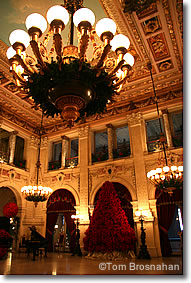
Both the 'cottages' we toured epitomize this excess and both are adorned with gild. Gild is actual melted gold painted over plaster. It can be 18 carat, 20 carat or 24 carat gold, but only the best for the Vanderbilt house - all 24 carat gold. Everything that looks 'gold' in the picture is gild - or actual gold painted onto plaster. It really annoyed me that they refused to allow indoor pictures. At one point we went out onto a huge marble patio overlooking the sea. The wall of French doors that opened onto the patio were from this central receiving room, and they actually had a person with a walkie/talkie stationed on the patio in front of the doors to keep us peasants from snapping a picture of the interior room. I suppose if someone had the audacity to take a picture, burly security personnel would have gotten an emergency call via that walkie/talkie.
Of course there was a library. Those walls were covered in leather decorated with gold leaf or washed with gold.

 The sitting room was painted gray with virtually no gild at all. The curators couldn't figure out for the longest time why silver insets in the corners of the room containing portraits of mythical beings never seemed to tarnish. Once the technology was available, a small sample of the silver was analyzed, and it was discovered the material on which the paintings were executed was not silver but platinum which never loses its shine. All the formal rooms were lavishly decorated. The dining room was really over the top. We're back to excessive gild in this room, but notice the chandeliers.
 Every light in this house is electric. Now, in 1895 household electricity even for the wealthy was a somewhat hit and miss affair, so every light was also piped for gas. If the electricity failed, they simply switched to gas lighting. This room is also an example of craftsmanship. The marble columns, the ornate carvings and the decorations carved in plaster and then decorated were done by Europeans craftsmen who were brought over to Newport in droves to work on this house. Some rooms, such as the music room
 were actually built in France, disassembled and reassembled on site at the house. It took only three years to build this mansion which is insanely fast considering not only the size but also the incredible interior finish work as well as the decorations, lighting, furniture and flooring.
The bedrooms were not nearly as lavish as the 'public' rooms, but The Breakers is unique in that each of twenty bedrooms in the house has a bathroom. Interior plumbing wasn't terribly common in the 1890's, and in even in mansions, there might be only one or two bathrooms. At The Breakers there was a 'stopcock' chart of seventy places within the house to turn water on and off devised by the property manager in the 1890's and still used today. It took forty servants in residence to run this household. Mrs. Vanderbilt managed all of them as well as the entertainment and food service. That job was as demanding as a CEO of a small company. And she did it all while changing clothes seven times a day.
We also went to see The Marble House. This was another Vanderbilt house built on Bellevue Avenue by a Vanderbilt daughter-in-law who actually divorced her Vanderbilt husband not too long after The Marbles was built. The mansion was in HER name, so she retained it after the divorce. Within three years of its completion, she moved out of it into her new husband's summer cottage - also just down the block, and she used The Marble House for its laundry facilities (which were better than in her second husband's house) and for storage. It costs $10 million 1890 dollars to build. Here's the receiving room at The Marbles It's pretty easy to understand how Drake's outrage grew as we looked at this excess. The servant quarters in these houses were airless cubicles in the attics, and they often worked in excess of sixteen hours a day.
The Breakers was used as a private residence well into the 1960's. For instance, there was a 1962 dinner party given for President and Mrs. Kennedy. It was finally donated to the National Historic Trust when the family, who basically squandered the Vanderbilt fortune in three generations, could no longer afford to keep it up. The Vanderbilt family as a whole were not terribly philanthropic. Only Vanderbilt University is left as an example of their somewhat miserly generosity Commodore Vanderbilt, the patron of the fortune worth over 100 million dollars of 19th century money, only donated 10 million dollars to found the University - and he did that on a whim. Fortunately, one of his grandsons, Harold, left the bulk of his inheritance to the university.
Newport is the perfect example of a resort town where I would hate to be a resident. It has small narrow streets with houses crammed together, other than on 'mansion row' of course. The traffic was horrendous, and the parking even worse. Living here even temporarily would get on my every nerve within three days. I'm sure Cape Cod and Nantucket are probably identical during June, July, August and even into September. This was a wonderful place for a day trip, and even I could see that if you were a sailor, this would be heaven since the harbor and coves were dotted with yachts and sailboats.
We also went to see The Marble House. This was another Vanderbilt house built on Bellevue Avenue by a Vanderbilt daughter-in-law who actually divorced her Vanderbilt husband not too long after The Marbles was built. The mansion was in HER name, so she retained it after the divorce. Within three years of its completion, she moved out of it into her new husband's summer cottage - also just down the block, and she used The Marble House for its laundry facilities (which were better than in her second husband's house) and for storage. It costs $10 million 1890 dollars to build. Here's the receiving room at The Marbles
It's pretty easy to understand how Drake's outrage grew as we looked at this excess. The servant quarters in these houses were airless cubicles in the attics, and they often worked in excess of sixteen hours a day. The Breakers was used as a private residence well into the 1960's. For instance, there was a 1962 dinner party given for President and Mrs. Kennedy. It was finally donated to the National Historic Trust when the family, who basically squandered the Vanderbilt fortune in three generations, could no longer afford to keep it up. The Vanderbilt family as a whole were not terribly philanthropic. Only Vanderbilt University is left as an example of their somewhat miserly generosity Commodore Vanderbilt, the patron of the fortune worth over 100 million dollars of 19th century money, only donated 10 million dollars to found the University - and he did that on a whim. Fortunately, one of his grandsons, Harold, left the bulk of his inheritance to the university.
Newport is the perfect example of a resort town where I would hate to be a resident. It has small narrow streets with houses crammed together, other than on 'mansion row' of course. The traffic was horrendous, and the parking even worse. Living here even temporarily would get on my every nerve within three days. I'm sure Cape Cod and Nantucket are probably identical during June, July, August and even into September. This was a wonderful place for a day trip, and even I could see that if you were a sailor, this would be heaven since the harbor and coves were dotted with yachts and sailboats.
Subscribe to:
Posts (Atom)