Tuesday, July 30, 2013

Out of Connecticut


We went from the fourth smallest state to the smallest state in one of our adventures this week.  We hit the road to Newport, Rhode Island.  We joked that if the Connecticut road map was 1 inch equals 30 feet, well the Rhode Island map must be 1 inch equals 5 feet.  It didn't take long to drive half the length of Connecticut and then half the length of Rhode island - just about the amount of time it takes to drive from Hurst to Gainesville or Sun City to Flagstaff.  I wanted to see the summer cottage homes of the rich and famous of the Gilded Age.  Drake spent a lot of time on this outing being outraged and disgusted by the sheer waste of money.


We started with The Breakers, a National Historic Landmark, built by Cornelius Vanderbilt II in 1895.  It took three years to build.  In the 19th century Newport, Rhode Island became the summer escape from New York City of the rich and famous.  They built 'cottages' on Bellevue Avenue, a promenade extending the length of a peninsula into the Atlantic Ocean which afforded each side of the street an ocean view.  They used these elaborate mansions for only a few weeks of the year.  The Vanderbilt cottage shown above has 70 rooms and 20 guest bedrooms.  The building and its contents symbolize The Gilded Age, a term coined by Mark Twain to satirize a skin deep golden reality enjoyed by less than one percent of the population in contrast to a much dingier, darker, and poorer reality for the other 99%.
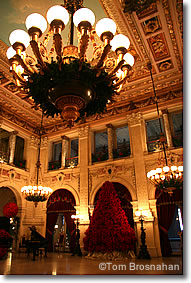
Both the 'cottages' we toured epitomize this excess and both are adorned with gild.  Gild is actual melted gold painted over plaster.  It can be 18 carat, 20 carat or 24 carat gold, but only the best for the Vanderbilt house - all 24 carat gold.  Everything that looks 'gold' in the picture is gild - or actual gold painted onto plaster.  It really annoyed me that they refused to allow indoor pictures.  At one point we went out onto a huge marble patio overlooking the sea.  The wall of French doors that opened onto the patio were from this central receiving room, and they actually had a person with a walkie/talkie stationed on the patio in front of the doors to keep us peasants from snapping a picture of the interior room. I suppose if someone had the audacity to take a picture, burly security personnel would have gotten an emergency call via that walkie/talkie.


Of course there was a library.  Those walls were covered in leather decorated with gold leaf or washed with gold.   


The sitting room was painted gray with virtually no gild at all.  The curators couldn't figure out for the longest time why silver insets in the corners of the room containing portraits of mythical beings never seemed to tarnish.  Once the technology was available, a small sample of the silver was analyzed, and it was discovered the material on which the paintings were executed was not silver but platinum which never loses its shine.  All the formal rooms were lavishly decorated.  The dining room was really over the top.  We're back to excessive gild in this room, but notice the chandeliers.Every light in this house is electric.  Now, in 1895 household electricity even for the wealthy was a somewhat hit and miss affair, so every light was also piped for gas.  If the electricity failed, they simply switched to gas lighting.  This room is also an example of craftsmanship.  The marble columns, the ornate carvings and the decorations carved in plaster and then decorated were done by Europeans craftsmen who were brought over to Newport in droves to work on this house.  Some rooms, such as the music roomwere actually built in France, disassembled and reassembled on site at the house.  It took only three years to build this mansion which is insanely fast considering not only the size but also the incredible interior finish work as well as the decorations, lighting, furniture and flooring.
The bedrooms were not nearly as lavish as the 'public' rooms, but The Breakers is unique in that each of twenty bedrooms in the house has a bathroom.  Interior plumbing wasn't terribly common in the 1890's, and in even in mansions, there might be only one or two bathrooms.  At The Breakers there was a 'stopcock' chart of seventy places within the house to turn water on and off devised by the property manager in the 1890's and still used today.  It took forty servants in residence to run this household.  Mrs. Vanderbilt managed all of them as well as the entertainment and food service.  That job was as demanding as a CEO of a small company.  And she did it all while changing clothes seven times a day.  

We also went to see The Marble House.  This was another Vanderbilt house built on Bellevue Avenue by a Vanderbilt daughter-in-law who actually divorced her Vanderbilt husband not too long after The Marbles was built.  The mansion was in HER name, so she retained it after the divorce.  Within three years of its completion, she moved out of it into her new husband's summer cottage - also just down the block, and she used The Marble House for its laundry facilities (which were better than in her second husband's house) and for storage.  It costs $10 million 1890 dollars to build. Here's the receiving room at The MarblesIt's pretty easy to understand how Drake's outrage grew as we looked at this excess.  The servant quarters in these houses were airless cubicles in the attics, and they often worked in excess of sixteen hours a day.  


The Breakers was used as a private residence well into the 1960's.  For instance, there was a 1962 dinner party given for President and Mrs. Kennedy.  It was finally donated to the National Historic Trust when the family, who basically squandered the Vanderbilt fortune in three generations, could no longer afford to keep it up.  The Vanderbilt family as a whole were not terribly philanthropic.  Only Vanderbilt University is left as an example of their somewhat miserly generosity   Commodore Vanderbilt, the patron of the fortune worth over 100 million dollars of 19th century money, only donated 10 million dollars to found the University - and he did that on a whim. Fortunately, one of his grandsons, Harold, left the bulk of his inheritance to the university.  


Newport is the perfect example of a resort town where I would hate to be a resident.  It has small narrow streets with houses crammed together, other than on 'mansion row' of course.  The traffic was horrendous, and the parking even worse.  Living here even temporarily would get on my every nerve within three days.  I'm sure Cape Cod and Nantucket are probably identical during June, July, August and even into September.  This was a wonderful place for a day trip, and even I could see that if you were a sailor, this would be heaven since the harbor and coves were dotted with yachts and sailboats.           


Tuesday, July 23, 2013

Essex and Old Lyme

Essex and Old Lyme sounds like a new line of men's aftershave, doesn't it?  Actually they are two very old colonial towns at the mouth of the Connecticut River, one on the west shore (Essex) and the other on the east shore (Old Lyme).  There were two special places that we wanted to see.  When we were in New England two years ago, while we were driving around New Hampshire and Vermont, we realized how important the Connecticut River was to the region.  Thus, I jumped at the chance to see the Connecticut River Museum at Essex.  

I learned this area was settled around 1660.  To establish a new colony within New England at the time, you had to have thirty families willing to move together into the new area.  The Essex thirty families broke off from Old Saybrook, a town a few miles to the west along the Connecticut shore of the Long Island Sound and founded Essex at the mouth of the Connecticut River after deposing a half dozen Indian tribes from the area.  All of Connecticut was heavily settled in the 1600's with about 7000 American Natives representing more than 100 tribes.  The clashes intensified between the colonists and Indians egged on by the French, and are mainly remembered in one incident:  the Deerfield Raid of 1704 - a guerrilla army of the French and a half dozen Indian Tribes, including the tribe who used to live on the land Deerfield was built on, overran the town/fort.  They killed more than 50 colonists and took over 100 colonists captive.  Well, we all know that the English triumphed over the French mainly due to the English colonists of the 18th century whose resolve to hold onto the land was fueled by increasingly violent and bloody 'incidents'.  


Two things surprised me:  First, this river museum was all about steamships which went up and down the river from 1815 until 1933 moving goods and people between New England and New York City.  It was a major economic artery that only dwindled with the building of roads and the coming of the railroad.  Second, guess what the best cash crop of Connecticut was from 1830 to 1880?  Broadleaf tobacco.  It was the best tobacco to make and wrap cigars in all of the colonies.  Essex was also the heart of major ship building industry in New England.   Fifty-one ship builders built more than 4000 ships of all sizes for 200 years. They left wonderful colonial houses behind. 


Crossing one of the many bridges that now span the Connecticut, we drove into Old Lyme which is the home of the Florence Griswold Museum.  This museum houses a mint collection of American Impressionism.  Florence Griswold's family were descendants of one of the original thirty families that settled Essex.  Her father was a Captain of a packet ship.  It's function was to carry goods and people up and down the river.  Unfortunately, he was a better captain than investor, and he lost all of the family money and promptly died.  Florence, his unmarried daughter, was on the verge of losing the house and the 11 acres surrounding it on the Lieutenant River when she decided it was time to take in boarders.  One of her first boarders was an American Tonalist artist by the name of Henry Ward Ranger.  (Tonalists preceded Impressionism, and were less interested in realism and actual scenery than creating a mood with their canvasses.)  Ranger was so delighted with the area and the light that he promised Miss Griswold he would return and fill her house with artists.  That's exactly what happened for the next thirty years, and Old Lyme became an artistic community.  What would become some of the most famous American Impressionists would board season after season with Miss Griswold.  They painted and painted, and she collected many paintings as did other people and businesses throughout the area.  After her death, the house languished until being restored as a museum and teaching center.  It has been restored to its 1910 glory on the first floor, and the second floor is room after room staged as galleries of the finest American Impressionist paintings.  This was a beautiful place both inside and out.  

My photographs are combined - the first part being the Connecticut River Museum and town of Essex.  The second part of the Impressionist pictures and Florence Griswold's home and grounds in Old Lyme.


https://plus.google.com/u/0/photos/115478608971584948192/albums/5903978068426822817?authkey=CO37sLW_m_yZ6AE


(Note:  If you watch the pictures as 'slideshow', the captions appear under the pictures.)


Sunday, July 21, 2013

Road Trip to the Heartland of Connecticut

Since we are still sweltering here, what better time for a road trip?  After all, the car has air conditioning.  Connecticut is so tiny.  A forty mile drive took us to New Britain, Connecticut.  This city of 75,000 was first settled in 1687.  It's called the "Hardware City" because it was here in the 1840's that the Stanley brothers began manufacturing door bolts, rules, levels, planes and various other items usually found in hardware stores or used by craftsmen.  The Stanley Tool Company as well as Black and Decker still have their corporate headquarters in this town.  Oh, and just for your trivia knowledge:  the wire coat hanger was invented here as well as basketball dribbling (at the YMCA in 1895).  The other 'first' we came to see is the New Britain Museum of American Art - the first museum in the world to show only American Art.  

This was a gem. A small museum with a specific focus, an outstanding curator, and an amazing collection.  The pictures speak louder than my words, so, for my art fan readers, here's the link 

https://plus.google.com/u/0/photos/115478608971584948192/albums/5903090782419452529?authkey=COuM2Y-tzJq7bg 
My favorite memory of this museum is two fold:  One, Drake asking the security guard a question, and two, seeing the work of Graydon Parrish for the first time. Check it out.

After the museum, we headed for an 1801 house in Bristol, Connecticut that holds the American Clock and Watch Museum.  Did you know Bristol, Connecticut was the place where the manufacture of clocks and watches began in the United States?  All thanks to a young man by the name of Eli Terry who had the bright idea of making clock works out of pre-cut wooden pieces instead of brass, thus reducing the price and making clocks affordable for everyone, not just the upper classes.  He also invented the 'shelf clock'.  As opposed to standing clocks (grandfather clocks, for example), shelf clocks could be loaded stacked into boxes into a wagon and sold by a traveling salesman all over the countryside.  This was a very quirky place filled with amazing time pieces.  I saw my first atomic clock here, and got a tutorial in clock making and how the United States revolutionized the entire industry worldwide.  We were the only people in this museum on Saturday afternoon.  The pictures tell the story:


https://plus.google.com/u/0/photos/115478608971584948192/albums/5903223830678622673?authkey=CMSC873s9IKfGw


All in all, a great road trip, but I still haven't seen the New England Carousel Museum - Drake picked the clocks.  Still time.  Carousels are my favorite ride at the Fair, and I'll just have to keep lobbying to see this place.  


Best news of all:  The heat wave has broken.  Highs are going to be in the low 80's instead of the mid 90's with 100+ heat indexes.  Jackson (or Al, as I call him) is really the most grateful of the three of us.  Drake says I can't change the name of the cat, but, I'm not paying any attention, and Al doesn't seem to mind. He even comes when I call him now.  My daughter with the limited sense of humor will NOT be amused.      

Saturday, July 20, 2013

Dinosaur Tiime

Unless you're addicted to PBS documentaries, the name O.C. Marsh and Hiram Bingham probably won't mean much to you.  We 'did' another Yale Museum
yesterday - The Peabody.  This is their museum of natural history and it's sort of a miniature of the New York City Natural History Museum.  As I'm discovering, if they are willing to put in on display in Bulldog Land, then it's of the first order.  My favorite portion of the museum was the Connecticut Bird exhibition.  That said, I will be SO glad when someone figures out it's just a little creepy to show dead stuffed birds.  They remind me of 'hair art'.  This was a Victorian invention.  Pictures, or even worse, jewelry was made out of the hair of a dead loved one to commemorate the loss.  Morbid, morbid, morbid.  Hundreds of perched, pecking, flying, preening stuffed birds evokes the same shudder.

I love birds, and I'm starting to be able to identify more and more of them when I see them.  Understand, I'm in first grade in the birder world, but I do get a thrill whenever I'm able to identify one. All of I'm saying is that I'd rather see a twenty second video of a live bird than a mounted, stuffed one.  They did have one bird you wouldn't be able to get a video of.  They had a dodo.  

Dodos have gotten the rap of being stupid, and their name has come to mean a stupid person.  Actually, they evolved on Mauritius Island where they didn't have any natural predators and had access to an unlimited food supply.  The result was the more ground plants and seeds they ate, the less they used their wings which began to atrophy and become out of proportion to the size of their ever increasing bodies until they could neither fly nor could they run fast. Along come humans, and nicely fill the niche of 'predator'.  The dodo is the first recorded species whose extinction was a direct result of human beings.  The passenger pigeon also comes to mind as one of these early casualties.

The showy part of the natural history collection are their dinosaurs.  O. C. Marsh, a Yale professor, was one of the first successful dinosaur bone hunters.  He has a bit of a tragic finale, but you can look him up.  In his heyday, he brought back to New Haven thousands of pounds of bones.  Many have been assembled into skeletons resulting in this hall.  This is one of those big plant eaters.
The museum was more interesting than I anticipated.  There is a wonderful section of dioramas showing natural habitats of various climates in the United States.  The 'desert' section looked real familiar.  There was also a very interesting history of hominids (that's us) with bronze casts of skulls of our 'cousins' mounted next to bronze casts of a skull of a homo sapien.  It was a great visual of what is usually presented 2D.  

Finally, who was Hiram Bingham III?  He was a Yale professor who went looking in Peru for the lost city of the Incas, and he found it:  Macchu Pichu. He single handedly invented Incan archaeology  and as a result brought home thousands of artifacts from the sites he excavated.  In 2011, Yale returned all those artifacts to the grateful government of Peru.  That action impressed me more than all the collections put together.     

As always, if you want to look at the rest of the pix - here they are:


Tuesday, July 16, 2013

A Load of Bricks

 Art Museum at Yale about four hot walkable blocks from the apartment. I don't lug my computer with me, and thus, I'm finding that my window to actually write is pretty small. 

We walk a lot here.  Yale is on the edge of downtown New Haven, and New Haven was founded in 1638.  They didn't exactly plan for cars.  Even if we wanted to driveI'm starting to get rumblings again from the bushes.  It's definitely time to 'get on the stick' and write a blog.  Interestingly, I looked that up - get on the stick - and discovered the origin goes back to the beginning of the 18th century when, in preparation for getting off your keester and leaving, you selected a stick and transformed it into a walking aid.  If it were only so easy to 'get going' writing.  Actually, it's not the writing that's the problem...it's the weather.  


NEWSFLASH!  It's very hot in Connecticut.  This week the temps are going to be in the mid 90's and the humidity is hovering about 80% most of the time.  At last count, we are up to five fans in 546 square feet.  The only way to handle this is to be GONE.  We have gotten adept at finding air conditioned spaces.  So far the best 'free' seats are at the British somewhere, it's usually not feasible when we are in the center of town.  One of the smooth spots of these walks is we get to admire the

architecture of the campus.  It's pretty sprawled out after 300+ years, but there are a core of buildings which are constructed to evoke the "look at me, I'm important" feeling.  The structural details of many remind me of elaborate sand castles since they are covered with swirls, squiggles, points, arches, curves, cupolas, statues, and gargoyles, and are often constructed of limestone, or limestone is used as embellishment since it's so carveable.


The oldest building on campus is a red brick building with not a bit of limestone.  There's not too much brick construction anywhere in this area. The residences are mostly clapboard, and most of the big old buildings are stone and the big new buildings are glass.  Anyway, this is Connecticut House - it was the first building of that new college Yale.  It was built about 1700.  It's been tweaked over the centuries including adding an entire third floor.  It was the dormitory of this guy,

Nathan Hale.  You might have heard of him.  Nathan rates a statue around here.  He stands right at the edge of the this building. Until I read his birth and death dates, I didn't realize Hale was only 21 years old when the British shot him for spying during the American Revolutionary War.

Here, we are in the 'green' area of the Old Campus.  These are the oldest buildings at Yale.  In the green area there are statues of past presidents of Yale including one with a shiny shoe.  This is Dwight Woolsey, a 19th century president, and legend says that touching his shoe will bring the student luck.  His statue is all brown bronze, except for the toe of his shoe which is shiny gold.  Just goes to show you, even the smart ones can be superstitious.

The first president, Rector Pierson (1701-1707) started Yale in his house because he couldn't get out of his preaching contract.  The monument to Bart Giamatti, the Yale president of the 1980's is a very uncomfortable looking bench with a great sentiment:  
And that's only the first half...
You can see why this bench warms my heart, but it's still awfully hard on the butt.

"Colleges" (dorms) ring the old campus.  To enter each, you must go through elaborate gates.   Here's a great example of that style.

Below is a close up of the fantastic stone carving that is a hallmark of this campus.  These are just snapshots.  Everywhere you walk, there are more examples of interesting architecture.  The most ornate buildings were built during the "Gilded Age" and feature all the excesses that time period brings to mind.  There are some buildings that are simply tortured with decorations.  

The Sterling Library (main Yale Library) looks 'old', but actually it was built in 1937, and the details over the door were what I found the most interesting.  The represent different cultures who contributed to human knowledge.

Then, if you turn around from this view, suddenly there's a very bauhaus modern type building.  This is the Rare Book Library which is all closed stacks with just a few of it's treasures displayed including a Gutenberg Bible.
There are also many monuments scattered around the Yale campus.  Here's an example of a coordinated building and monument.  The ornate carving of this building frames the 'words' which are a list of the battles of World War I.  In front of this building sits something that looks like a tomb, and commemorates the Yale men who died in World War I.
Finally, the Yale Law School is so over architected, it's almost comical.
It looks like a gothic cathederal complete with stained glass windows.  The music school has a ground level rotunda.  There are buildings with gargoyles carved in the likeness of favorite Yale professors of the 19th century.  It just goes on and on.  These are only the outsides.  Inside is where you find the real treasures...but that's another blog.


Wednesday, June 12, 2013

Visit the Mystic Seaport and Stonington Village in Connecticut

Today we took one of our all day sightseeing tours.  The Mystic Seaport is a completely reconstructed 19th century village devoted to shipbuilding - just as Mystic was in the 1840's.  This is one location where whaling ships as well as many other types of boats and ships were built.  The economy of the entire town revolved around the several ship builders who had their companies located here - on the Mystic River where it flows into the Long Island Sound.

A few miles from Mystic is the village of Stonington - this sits on a peninsula that juts out into the ocean, and is the only port in Connecticut that opens out onto the Atlantic.  It has a unique lighthouse and is filled with beautiful 19th century architecture.  We had a terrific meal here at the Dogwatch Cafe.  (The dogwatch is a short 2 hour watch from either 4pm - 6pm or 6pm - 8pm).


The surprise was the tiny ferry we found on the scenic drive back to New Haven.   


This is better told with pictures.  Here they are with commentary in the captions:

https://picasaweb.google.com/jalyss1/2013ConnecticutTourTwoMysticSeaportStoneingtonVillage?authkey=Gv1sRgCIeMqZzawIHD9gE  

Sunday, June 9, 2013

What is the Life Well Lived?

On a time continuum, our lives are ending.  Sarah and Jay's lives are beginning.  I've discovered that getting ready for a wedding and the attendant parties and events is a marathon, or at best a really involved project requiring management skills, organizational genius, and the ability to draw upon life experiences to maintain focus and perspective.  What doesn't happen is a lot of time for reflection. 

I just read an essay quoting Annie Dillard, a successful, famous American writer, who was musing on the idea that "How we spend our days is how we spend our life."  She suggests that we set ourselves into schedules imposed from within and without, and the days blur together.   When we look back, what we perceive is "a blurred and powerful pattern".  That idea of pattern really struck me.  We divide our lives into pre and post events.  We define and redefine our schedules at those points.  


Snugly entrenched into our current schedule, we occasionally look up and back. What we see is the pattern - of junior high, of high school, of college, of graduate school, of law school, of medical school, of CPA school, of welding school, of trade school, of cosmetology school.  Of the single life, the married life, the pre death and post death life.  


Out of the blur we only have a few spikes of time sticking up; times of intense emotion which have evolved into static snapshots of feelings often the basis of told and retold family stories to codify and classify.  We adjust our schedules and cement our snapshots as we move in and out of one another's lives. 


Would you want to vividly remember each day in each phase of your life?  I can remember being grateful I was old when Sarah was born and, thus, had a better appreciation of how fast time flows.   I vowed the day she was born to not take my time with her as something to be gotten through or rushed along. I still only have snapshots as hard as I tried to savor the time.  The other end of the birth and growth experience spectrum is so painful I'm grateful for selective amnesia.  Are we genetically wired as a species to blur our lives?  

Do some people deliberately set out to live a life of meaning?  Can you deliberately choose to do that?  Who are these people?  Are they plugged into one of the many faces of God accepting direction and instruction?  I have Christian friends who would certainly say so.  Meaningful is a loaded word, isn't it?  Children make my life meaningful.   Altruism is meaningful.  Productivity is meaningful.  Creativity is meaningful.  Contemplation, serenity, action, decision making, can all become frameworks for a meaningful life.

I'm charged and upbeat about being in a new place since it gives us the opportunity to redefine the daily schedule.  What gives this current phase of my life joyful meaning is getting up each morning knowing today can be a wild card. If I choose, it can be totally different from yesterday.  It's freeing; it's scary; it's as much of a responsibility as committing to the monotonous schedule of younger years. Is it meaningful?  I don't know. 

I do know "the family" is looking at pictures, and developing our stories of this momentous wedding.  And, yes, momentous is relative depending on what circle you are orbiting.  I've tried to tell Sarah that her life is now forever changed by formally committing to marriage.  The wedding is the spike; now comes the blur.  Her life is in her hands.