Wednesday, July 21, 2010

Mount St. Helens and Tacoma Washington

I have to start this posting with a few commments about the family wedding. First, we pushed ourselves really hard to get from Mississippi to Washington State in time to rent an apartment and move in prior to the wedding. It taught us that we don't want to ever do that again. There were too many things we passed by simply because we didn't have time to stop. When you think that we left Mississippi on June 27th and arrived in Washington on July 6th with 3 days out of that time spent in Rowlett, Hurst and Tulsa, you can see what I mean. We had an apartment rented by the 9th and we moved in on July 10th. On the 15th we left for Portland, Oregon to pick up Sarah and Jay and then on to Black Butte Ranch outside of Sisters, Oregon for the wedding of the cousin closest to Sarah's age.
Fortunately, the wedding was terrific. This resort had everything - multiple pools, golf courses, bike rental, surrey rental (wierd combo of a wagon and pedals for 2 bikes), tennis courts, and a bunch of other stuff. The entire Perez/Smith families had condominiums rented for us courtesy of Drake's sister and brother-in-law. We were able to share early breakfast (our condo), late breakfast (in-laws condo) and after hours food and drinks (Drake's sister/brother-in-law condo). We went to lunches and dinners together and shopping. We biked. [This was very good news for me - rode about 15 miles in 2 days and didn't have any physical repercussions! That means I will be biking here in Washington.] The wedding itself was lovely and the reception afterwards involved salmon and steak perfectly prepared and lots of dancing. The highpoint of the reception for the Perez/Smith family was when Sarah caught the bridal bouquet! Oh, we had a lot of fun with that. We teased Jay, Sarah's boyfriend, that the Perez brothers would be calling on him SOON to inquire about his intentions. Vincent, the other unmarried cousin in Sarah's generation, declared repeatedly that he was now 'off the hook'. Sarah took all the ribbing good naturedly, and she gave the bouquet to the 7 year old flower girl who was a niece of the bride. That little girl was so happy, she never put the bouquet down the rest of the party. Sarah and I both remember the weddings she attended as a little girl, and the highpoint was always hoping against hope she would be able to catch the bouquet.

After the wedding weekend, we went back to Portland and sent Sarah and Jay on their way to a 10 day vacation up here. They headed for the Oregon seashore. I hope their experience was better than ours. We headed to Long Beach which is a peninsula off the west coast of Washington. It's a 28 mile beach, and it was terrible. First, it's gray sand. Second, there's NOTHING to pick up. There are no shells, no rocks, nothing interesting to collect unless you are into brown seaweed. The only remotely interesting thing was that this is birder heaven. Scores of birds winter and summer here. I guess the best part of the Long Beach trip was this cheesy place called Marsh's Free Museum. It's filled with every bad souvenir you can imagine. The ceiling is covered in the owner's collections. He has a stuffed everything from polar bear, lion, bear, every type of deer, elk, moose, as well as sheep, 2 headed cow, and "Jake" the alligator man. It was so funny to look up and see collections (think washboards, unusual tools, stuffed birds and animals, china, crystal, etc. etc. etc, while the shelves are filled with stuff children (and me) can't live without. He also had the biggest collection of machines you shove a quarter into and receive knowledge of your future or how strong your kiss is or your grip. It was a hoot, and it saved Long Beach. I didn't get over to see the lighthouse on the tip of the peninsula or the Lewis/Clark interpretive center - both of which would have probably been worth going to. There's only so much time in this life.

We actually went to Mount St. Helens on the way down to Portland just before the wedding. Now, that is a very interesting place. For you younger readers, this is a volcano, and it exploded in 1980 flattening a large portion of the area around it. Actually, it was a several part event: First the blast that collapsed an entire side of the mountain, The blast along with the tons and tons of rocks and mud knocked down countlesss acres of trees. The lava flow which changed the courses of several waterways and created new lakes. Finally, there was the ash plume that covered the cities to the east of the mountain in 2 feet of ash blotting out the sun for days. This was an amazing event of nature, and due to the monitoring of the mountain prior to the eruption, scientists can now predict when an volcano is going to erupt. The science generated by the Mount St. Helen's eruption has saved countless lifes around the world. Even 30 years after the eruption, you can still see the marks on the land, but surprisingly, nature is recovering at a much faster rate than predicted. It was definitely worth the 100 mile detour over mountain roads to reach it. The Johnson Ridge Visitor's center has some wonderful scale models that showed 'what happened' in each event - the picture at the top is the lava flow. The tree picture is an example of what happened to trees in the blast path of a mountain exploding. The water picture is a new lake created by the eruption, and the picture to the right of the broken tree is a shot of the mountain today and the landscape leading up to it. There were actually people accidentally trapped on the mountain at the time of the eruption in 1980, and one fascinating wall recounts their experiences in trying to get off an exploding mountain. There were very few people actually killed. There's also a great movie of the actual explosion, lava flow and ash plume because it was being monitored carefully as it started to belch prior to the eruption.

After we left Long Beach (I'm back to after the wedding now), the drive to Tacoma was visually very interesting. The coastline here is nothing like anything else I've seen. The closest comparison is to some parts of the Louisiana coastline prior to Katrina and prior to the oil spill. Lots of it is marshy with this tufted grass that seems almost like a peat bog. There were new wildflowers, and the scenery was excellent. Our Texas license plates seem to generate interested conversation with locals every time we stop for gas. We went to Tacoma because I persuaded Drake that what we wanted to see was the Glass Museum in Tacoma.

We were quite impressed with the lovely downtown area of Tacoma, and had a great lunch at Woody's - outdoors overlooking the glass museum and the marina which is in the middle of downtown Tacoma. Glass art became this city's signature thanks to a glass artist - Dale Chilhuly - a Northwest native. His pieces are world renowned and he has inspired glass artists from all over the world to come to this town. He has almost single handedly started the Glass Museum which includes a Hot Shop - a place to create glass art pieces. The City has gotten on board and constructed an elevated bridge connecting two main downtown streets. The bridge is filled with Chilhuly pieces as is the renovated Union Station which is now the home of the United States Courthouse for the northwest. You can see the blue ballon like sculptures (glass) which mark the bridge. To the left and right as you start across the bridge are walls of glass creations by Chilhuly. I first heard about this artist from my friend Margie who loved to collect pieces of glass. The last portion of the bridge is glass art overhead. This left picture is representative of about 50 feet. It was like being under a sea filled with magnificent creatures.

We saw three amazing exhibits inside the actual musuem - each a wonder in its own right. The one I only went to because it was there was the exhibit in which children designed pieces (made pictures) and glass artists in the area created a glass piece based on each child's inventive picture. It's a pity they wouldn't allow us to take pictures - some of them defy description. Imagine a banana riding on a hotdog bun with flames shooting out of the back of the bun. A glass artist created this design in glass, and that was one of the tame ones. I think the artists had as much fun as the children. It was apparently a state wide contest, and the winners got to see their creations come to life in the Hot Shop at the museum. This exhibit just won me over with its whimsy and creativity. There were children at this exhibit and you could feel their excitement as they looked at the 50 pieces. This is just the type of exhibit that needs to travel around the country. It would be a wonderful introduction to musuems and art for the elementary age group. The other two exhibits were more traditional in that they appealed to adult patrons. Both were outstanding. I felt like I'd seen pieces of art that will be with me forever.

The museum supports glass artists in that it has this Hot Shop in which they can work. Large pieces need large fire boxes to keep the glass malleable, and lots of special tools. In return for getting to work in the Hot Shop, each artist agrees to be watched by an audience. There are theater seats above the shop floor, and a commentator telling the museum patrons what they are seeing. This place also had a killer gift shop. I actually got three small pieces of glass art. They are flat disks about the size of 50 cent pieces with flotsam and jetsam embedded in them - including Mount St. Helen's ash - a nice tie in for us.

Overall, this was a wonderful trip combining family and fun with touring new sights. What could be better?

Friday, July 9, 2010

Tour: Ferndale, Birch Bay, Blaine, Lynden, Washington

Even though we are moving tomorrow, we decided not to waste today. After outwitting the cable company - surprisingly easy for Drake, we took off for the area just north of Bellingham. There are a series of small towns between Bellingham and the Canadian border, and this area is the truck gardening, dairy farming, grass fed beef, organic farming area just north of Bellingham. It's a large valley (Nooksack Valley) at the base of the short mountains that lead up to Mount Baker which is a jewel in the Cascades Chain. We didn't get that far today - that will be another tour.

First, we stopped at Pioneer Village in Ferndale which was a bit of a let down after just being in Mississippi where American history goes back to the late 18th/early 19th century. "History" up here (not counting the Native Americans) only goes back to the late 19th century/early 20th century. However, you have to applaud the Ferndale businessman who moved a large number of early pioneer buildings to create this village in a park like atmosphere. Drake actually talked to a guy who confided that one of the buildings was his grandmother's house. I thought the flower balls which line Main Street in Ferndale were much more interesting than Pioneer Village.

Ferndale also had another attraction - Hovender Fragrance Garden. This is a small park outside of town which was at one point a working farm. It's now a labor of love by a small group of gardeners who are growing amazing, amazing flowers. They claim that this area is the most conducive to flower gardening in the entire country. Well, I don't know about that, but the flowers were spectacular. Here's one picture, but I'll be sharing an entire album of flower pictures I took at this garden with selected friends who will be interested. I did discover what makes this place 'fragrant' is that there are extensive herbs grown. I'd never seen horseradish growing before - and the large lettuce like leaves smell intensely like the freshest horseradish imaginable. I thought of the cooking afficianados I know when I was wandering this portion of the garden.

Moving on - we decided to wander around the back country roads as we wound our way to Birch Bay. Boy, am I glad we did. We stumbled on the Pleasant Valley Dairy which was selling cheese! That was a first for me. I thought you could only get it at the grocery store. We met Jenny who, with her husband and two small daughters, own a family farm of registered dairy cattle. Her grandmother-in-law first started selling cheese she made in the 1970's, and she passed down her recipes. The cheese is outstanding. Jenny makes several different kinds (including feta - one of Sarah's favorites), gouda, farmstead, and mutschli. She flavors the gouda and we bought two flavors - Herbe (onion, parsley, celery and garlic), and wait for it.......jalapeno! The plain gouda is also so good we bought a bit of that too. She confided that she even has some cheese that has aged for 3 years. She called it "stinky cheese" and admits it's a better cooking cheese. I took her word for it. She does 'ship', and if you want to try it email her at cheese98248@yahoo.com. The web site is coming on line soon. The cheese was a welcome addition to our lunch, and we are planning a dinner tonight of cheese/crackers and fresh strawberries we bought at a roadside stand. The berries (Barb's Berries) came right out of the fields.

Our next stop, Birch Bay, was the first time I've ever seen 'mud flats' in person. It is created by low tide in a protected bay like this one. What really, really excited me was that the beach is PEBBLES. Wow. Is that right up my alley, or what? And, yes, I did get a few rocks. They are so cool. Some are two types of rock fused together. Oh, I'll quit - you all know how I am about rocks. Drake says he's going to start calling me "Lucy" because of my habit of picking up rocks just like Lucy did in the movie The Long, Long Trailer that she made with Desi in the early 1950's. This movie was the impetus for the I Love Lucy series on TV. If you haven't seen it, it's a quaint hoot. I do want to stress that I'm collecting pebbles, not big ROCKS. There's a difference.

No tour day would be complete for me without a museum, and we found a great lunch spot at Semiahmoo Park. This park included the Alaskan Pacific Association Musuem which is really all about early Washington State salmon fishermen and canners. (They moved up to Alaska from Washington after the salmon fishing methods changed. It was really a very interesting place. There was an actual salmon fishing boat - like an extended rowboat, really. The fisherman would lower gill nets, haul in salmon, load the fish into open compartments in his small boat, and when full then off load the fish onto pickup boats, and start all over again. They would stay out on the ocean for a week or more at a time during the 'season' in these small boats. I can't imagine the smell. Another interesting feature of this museum was that it sported a Semiahmoo totem pole called Salmon Woman out front. Now, this museum is about serious fishing and they have bronzed a 57 pound salmon (largest caught in this area), and it won a prize at the Pacific Exposition of 1915. I've included a picture just for you fisherfolk.

The prettiest town we saw today was Lynden. This town was settled by the Dutch and as we enjoyed ice cream, I noticed that all the natives seemed blond haired and round faced - facial and hair characteristics of most of the Dutch people I saw in Holland. They also have maintained that sense of precise order and cleanliness that seems a hallmark of the Dutch. I didn't see a single piece of trash much less a dead flower or unpruned tree, or peeling sign or even anything that wasn't at a 90 degree angle. This town also has a wonderful shaded street that goes on forever with overarching 40 foot trees lining both sides of the road. I include the picture of the windmill because another characteristic of the Dutch is that they have a wacko sense of humor which always seems at odds with their devotion to order and beauty.We'll be coming back here in August to enjoy the 100th anniversary of their county fair.
We meandered back to Bellingham, and if this day is any indication, we are going to have a splendid time up here. There is an amazing amount of stuff to do. I can hardly wait to get out on some of the hiking trails. There will be a blog hiatus as we get moved (tomorrow) to the new apartment, recover a bit, and then we leave for Oregon on Friday the 15th to attend a much anticipated family wedding.

Thursday, July 8, 2010

We have a land address!

We rented an apartment today, and we finally have a land address after being without one for the past month. For those of you who care, our new address is: 128 Heritage Place #117, Burlington WA 98233. When we arrived, we drove into Bellingham to discover it full of people! Can you imagine? This is actually a city of 200,000 people. I'm afraid that Bastrop spoiled us to the small town life. Burlington is 25 miles south of Bellingham and is in a cluster of small towns. It's between Sedro Woolley (yes, that's really the name of a town), and Anacortes (where there's a ferry). Ferry access is rather important in this part of the country. Plus, we wanted to have relatively quick access to the Olympic Penninsula. Burlington has about 10,000 people, with another 10,000 scattered throughout the county.

We haven't let any grass grow under our feet. I already have a library card; they have a brand new 20,000 square foot library. Next, we found the Senior Center because Drake wants to get his bridge game set up. (They play every Friday.) Plus, we discovered they have a hot lunch every day for $3. I found a thrift store - remember, I said I wasn't eating on a card table anymore - well, I'm not. I bought a wooden table and two chairs ($60 - not quite St. Paul garage sale prices, but close). It will be so much better for sewing, and I can set up a computer permanently on the card table. I'll Craiglist the table and chairs when we get ready to leave. We even went to play blackjack for an hour today at the Indian casino 5 miles north of Burlington.

The new apartment is ground floor, 2/2 with covered parking, pool, hot tub, exercise room - pretty standard stuff, but Drake was happy to match the Bastrop apartment price. We arrived here on Monday evening and we will move into the apartment on Saturday. It took us 2 days to find a place that met most of our criteria, and 20 minutes for them to 'approve' us. Wasn't that a big surprise. I'm waiting an extra day to move in because they are cleaning the carpet today, and I want it to be thoroughly dry. Oddly, the fridge doesn't have an ice maker. I thought that was weird. However, they do have recycling at the apartment - recycling is mandatory in Washington.

Even stranger for us is that NOTHING up here is air conditioned. We didn't see a single place to live that had air conditioning. A lot of the small individually owned stores don't have AC either. There's been a lot of bitching up here today since it was 91. Everyone is very, very unhappy. The weather is going to moderate beginning tomorrow (83 for a high), and then for the next 10 days, the temperature is going to be 72/55 - and no rain at all. I know everyone in Texas is moaning or cursing. I'm going to enjoy every minute of it. I'm sure my autumn will also be a new experience weatherwise.

We'll be here until November 30th. This silly apartment complex won't prorate the rent on the month you move out. We originally wanted to leave the first or second week of December, but we would have had to pay the entire month's rent for December. I don't think we'll be doing that, so after we eat turkey, we'll pack up and leave. This will give us a leisurely trip down the west coast and we'll turn left at Death Valley to get to Arizona in time for Christmas.

Stay tuned for a play by play description of Washington State and Canada. It's going to be a ball.

Sunday, July 4, 2010

Up the Center of the USA and turning left at South Dakota

If cotton is King in the South, then corn is the Emperor of the Heartland. We drove through 500 miles of corn. Almost as soon as we crossed the Kansas border going up I-35, all we could see was corn. I felt like I finally understood the Omnivore's Dilemma, a book Sarah gave Drake for Christmas which is about the industrial food chain in the United States. One of the sections is how our entire food chain is based on corn - we are more dependent on corn than the Native Americans were. Think about it: Corn syrup is in EVERYTHING. We feed every animal we eat corn. And, it's not only food that we use corn for - but when the food bits are extracted from corn, then there are non-food uses for the byproducts. Plus, can anyone say ethanol? Well, anyone who raises food in this country from the corporate level to the family farm level knows a cash crop when they see it. It was truly awe inspiring to see the corn waving in the wind. One funny thing is that when the corn started in Kansas, it was 4 feet tall. The last small field we saw in Montana was virtually unrecognizable as corn because it was only 6 inches tall. One last thought: You think driving across West Texas is boring? Try driving across the corn fields of Kansas, Nebraska and South Dakota.

When we "turned left" on I-90, the corn fields pretty much disappeared. The central belly of South Dakota is cattle country, and it is also very boring to drive thru since it's mostly flat and monotonous. Scenery wise things picked up when we arrived at the Missouri Valley. This is Lewis and Clark country - they canoed up the Missouri in a northwesterly direction for a great part of the journey. The valley is lush and green and looks pretty much like every other big river valley that I've seen. However, once you passed this area, then a new type of landscape appeared: Soft rolling hills - Drake compared it to green ski moguls undulating across the land.

Then the first really interesting scenery popped up: The BADLANDS. This whole area reminded me of the Palo Duro Canyon. First, it's unexpected. There are these gently rolling green hills, and then next thing you know - up pops up these sand stone hills that are eroded like Bryce Canyon and colored like the Painted Dessert. It's rather like suddenly stumbling onto a moonscape in the middle of an oasis.

We couldn't leave South Dakota without a visit to its most famous attraction - yes, we went to Mount Rushmore. I actually expected to be diasappointed after watching North by Northwest. (For you movie challenged: this is a Cary Grant movie partially set at Mount Rushmore. In fact, he and Eva Marie Saint climb over the carved faces trying to escape the villain. FYI - the National Park people wouldn't let them actually climb on the mountain - so they built mock-ups of the carvings. You see the carvings as gigantic in this movie.) Therefore, I expected the real thing to be sort of small and insignificant. Wrong. It was impressive, and some smart person designed the lead up to the view of the carving very cleverly. They have a Walkway of States with each state flag flying and granite pillars with the date of each state's admission to the Union. I liked Mount Rushmore. I ate ice cream, took pix, and looked for Cary Grant.

Before we left South Dakota, we stayed overnight in Deadwood (the infamous town where Wild Bill Hickok was killed). We ate dinner at Saloon 10 where he was killed (actually we were upstairs in a wonderful restaurant). Drake was very, very happy to gamble for $2 stakes at Blackjack. Deadwood was really very quaint, and it also has a great bike trail - the George Mickelson - which is a 109 mile gravel/asphalt road laid down over over railroad tracks. It looks like excellent daytime fun. Overall though, South Dakota is a total drag until you get to the southwestern corner.

We skirted the edge of Wyoming, and we actually were only 75 miles north of Yellowstone National Park, but we just couldn't see much fun in being in one of the most popular national parks over the 4th of July weekend. We really have raced up here because of the necessity of being in Oregon on July 15th for the big family wedding. As Drake put it: "We can only skim the cream" which means that I didn't get to go to any tacky souvenir shops or other whacko places that appealed to me - like the REPTILE GARDEN!!!!!

We drove completely across Montana. It has interesting scenery from one end to the other. We did get to go to the Little Big Horn Battle Field. Now, when I was in school it was called a Massacre - exactly as it was portrayed in 1876 in every newspaper across the United States. The National Park Service has really done an excellent job in telling the REAL history which was a battle won by the Sioux and the Cheyenne in a last gasp effort to continue living the nomadic life. While it's called "Custer's Last Stand", in reality it was the Last Stand of the Native Americans. The reaction to the battle by the whites was so ferocious thanks to the inflammatory journalism and the self promotion of George Custer, that the Indians had no chance of preserving their nomadic way of life after the battle with Custer's 7th Calvary. After Little Big Horn, Indians were hunted down mercilessly and forced onto reservations or killed - didn't matter whether they were men, women or children, and it didn't really matter to the soliders which choice they made. It was really fascinating to hear about how the Little Big Horn (or Greasy Grass Battle as the Indians called it) came about, the strategy employed by both the Calvary and the Indians while looking at the actual field of battle.

The battlefield is marked with white markers showing where each soldier was killed, and red granite markers mark the places where the Indians were killed. I think the most interesting thing I learned was that as a result of a forest fire in 1993, archeologists were able to recover over 5000 artifacts from the battle that had been hidden by the grasses and reconstruct a much more precise picture of the battle. There's a large monolith at the top of "Last Stand Hill" which lists the names of all the soldiers and civilians killed in the battle. Under it are buried the common soliders who died. (There's a marker for Custer, but he's actually buried at West Point). The Sioux and the Cheyenne have a monument which is a stone wall circle with a wire sculpture on one side.

During the Ranger talk, they called Little Big Horn one of the most important battles in American history, and after hearing the actual facts, I have to agree. It solidified the white opinion of what to do about "the Indian problem". After Little Big Horn, there was no more pretense of treaties with the Indians. The Indians were overwhelmed and forced onto land which they didn't have much if any say in choosing. History shows again and again that unfortunately when one culture is so overwhelming in numbers and weapons, the opposing culture loses everytime.
Montana was rolling hills covered with cattle. The 19th century cattlemen must have dropped to their knees thinking they had died and gone to heaven the first time they saw Eastern Montana. They did learn the hard way over the winters of 1886 and 1887 that you really can't raise cattle on open range in Montana. That's when Montana was finally fenced. The cattle look like raisins dotted on green muffins. There is so much water in Montana that the roadmap looks like the wrinkled skin of a really, really old person with the tracings of all the creeks and rivers on the map.

As you drive farther west, the landscape changes and the Rocky Mountains appear in various ranges. It was thrilling to go over Bozeman Pass - a famous immigrant pass over which wagon trains traveled. We joked that Drake was so concerned about the V-8 engine pulling the trailer over mountains when 150 years ago, oxen were pulling wagons over these passes. 20 mph then would have seemed miraculous - much less 50 mph. The evergreen trees were magnificent growing right up to the edge of the roadway towering over everything, and we started seeing our first aspen trees. I can't imagine ever getting tired of this scenery. Oh, and did I mention that the temperature has been hovering between 60 - 75 degrees? It's really tough to stand this weather - especially after Mississippi.

Tomorrow we roll into Bellingham. We've driven over 4000 miles since June 5th. I've never driven in this part of the country before. Not only is this country huge; it is magnificent. The resources are amazing. It is so obvious that people across this country work hard everywhere. We overheard a table of men in work clothes and boots casually say they were amazed at the number of people taking pictures of the landscape. One then said, "When I look out over this land, all I see is work." One person's playground is another person's work place.
We are both very excited about getting to see the place we've chosen to live for the next 5 months. We'll let you know how the great apartment/house/duplex/townhouse/condo search goes!


Friday, June 25, 2010

My Favorite Tour Day in Mississippi

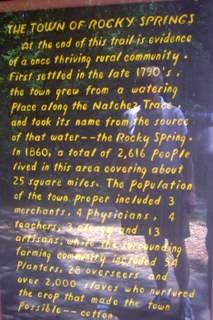
Today was an American history day. Jackson is right on the 400 mile Natchez Trace which is now a National Parkway. The Trace goes back to prehistoric times. It was originally a game trail of the Eastern Bison and mastadons. These animals were hunted by the prehistoric people who evolved into the Choctaw and Chickasaw Indians. The Trace became the 'highway' between Indidan villages. When whites entered the region, flat boats were poled down the Mississippi River, and the Kaintucks (the whites who were taking their goods to market via the river) then walked back home up the Natchez Trace. In the late 18th and early 19th century, this was the main farm to market road between Nashville and Natchez. It was common to drive pigs or turkeys up and down the Trace to market. As Drake commented, this was the interstate highway of the early 19th century. It died overnight with the advent of steamboats which went down the Mississippi River and also UP. Who wouldn't rather take a boat than walk? (Of course it was a crap shoot to take a boat since their boilers exploded with depressing regularity - especially in the early days.)

Early in the 19th century, there were homesteads settled that catered to travelers offering food and shelter - such as Dean's Stand. Towns were founded along the Trace - especially where there was potable water such as Rocky Springs. Drake is standing in the middle of the Sunken Trace which is actually park of the original Trace. You can see that it's just a pathway.
Then, there was Port Gibson - a port on the Mississippi Riveer where plantations could ship their cotton down to New Orleans eventually winding up as raw material in the new English textile factories. Port Gibson has the remnants of the kind of money and power that King Cotton can produce. There are beautiful churches and homes down the main drag.

We drove out into the countryside to see the columns of Windsor. These are all that is left of a 23 room mansion. They are the most photographed scene in Mississipp. The plantation mansion these were a part of was completed in 1860 - talk about timing, huh? It gets worse. The owner DIED 2 weeks after he finished building the mansion. By the looks of the place, you'd think the house was destroyed during the Civil War, but no, it survived the war - a cigarette on a pile of trash in 1890 destroyed it. These things are huge - see Drake for perspective. They are made out of brick with a stucco covering with an intricately carved top out of limestone. These pillars are the middle of the country, and the drive to get to them from Port Gibson was beautiful in that kudzu covered rural South way.

Port Gibson is a small town with a huge number of pre Civil War buildings. The Civil War legend is that Grant declared Port Gibson "too beautiful to burn". That's now the town's motto. The main street is called "Church Street" because of the large number of churches (and the oldest synagogue in Mississippi). The synagogue (see left) actually looks like a mosque! The Catholic Church is really special. (see right) It has blue windows which gives the interior a really eerie lighting effect. It had a very holy feeling. This church had wonderful paintings and sculptures which were exquisitely rendered.


Another place we saw today was Alcorn State University which has a chapel built in 1836. Alcorn State was formed in 1871 with the reconstruction state government buying an existing college and re-incorporating it as a black teacher's college. It is also the first black land grant college in the United States. The unusual thing is Alcorn State just pops up in the middle of rural Mississippi - it was amazing how big it was. I'm talking the middle of nowhere. There's an actual dairy on the campus as well as research facilities for food and plants. Anyway, the chapel is from the first college, and the stairs in the front are actually wrought iron with designs and flowers under the treads. It's one of the best examples of Greek Revival architecture in the United States.


We finished our day today with a trip to the double AA Mississippi Braves ballpark which just happens to be within 2 miles from our hotel. It's a really nice park except for the fact it was a sauna. UGH! How do people stand this climate? However, we toughed it out because it was also FIREWORKS NIGHT! Oh, Boy! You can see why I called this my favorite Mississippi day.


Today, though, was mostly about driving the Trace which I would recommend. It's a narrow ribbon of perfectly smooth highway with tall trees coming right up to the edge of the road. There are no trucks allowed on the Trace, and it possesses the utter beauty that only the deep South can produce in the heighth of summer - so tranquil, so verdant, so compelling. This was a walk back in time.

Thursday, June 24, 2010

Amazing!

Yesterday had to be a poster child for why Drake and I have turned our lives upside down and are pursuing a different existence. We actually had dinner with a pair of professional ballet dancers! YES! It was amazing. Mark Biocca and Victoria Lane Green are principals (that's the best in a company) with the Alberta Ballet in Canada. They are a couple who have been together for five years, and at some point, hope to have children and pursue teaching/coaching careers when their dancing days are over. My unquenchable curiousity and unstoppable friendliness got us acquainted with them. I saw them in the audience the day after they competed, and I went over to congratulate them on their performance. Gradually over the next week, we spoke to them more and more culminating in a dinner invitation before the performance last night. (Unfortunately, they didn't move up in the competition, but this was our gain - otherwise they wouldn't be free to mingle.)

We got to have the once in a lifetime experience of getting a small snapshot glance of what it is like to be a professional ballet dancer which in our humble opinion is a career that is the perfect marriage of art and athleticism. Here's a little background: Ms. Green (Lane), who just turned 27 and is in the peak of her career, left home at the age of 12 to train full time to dance professionally. She went to work as a professional dancer at the age of 15 after winning a 1st place in ballet in an important national student competition. Today, she feels like her family was really sold a bill of goods, and that if her own daughter wanted dance as a career that it would not be necessary for her to completely give up a major portion of her growing up years to it exclusively. (Ten years ago, the prevailing wisdom was that you couldn't really have a dance career unless you trained to the exclusion of everything else beginning at an impossibly young age - think Olympic gymnastics) Lane projects a demeanor and personality of someone far older than her years. She is contained, mature, and is obviously used to holding her own in the temperamental world of dance. She's a star in this world, and as with all genius this comes with a price.

I asked her how long she plans to dance, and her answer surprised me. She told me that she had PLANNED to stop dancing when she was 25, but she continues because not only is it what she knows, but there is a drive to dance - to create that you find in artists. That's what sets an artist apart from a hobbyist - you have to create. It's as if there's an innate drive inside you. She has been with four major companies - breaking in with the Boston Ballet, moving on to BalletMet which is an Ohio ballet company, and then traveling to England to work with the Leeds Ballet. She was invited 'back home' (she's a native Alberta, Canadian) by the Alberta Ballet's Artistic Director three years ago to dance principal roles.

One part of the price in the ballet dance biz is lack of roots - you can be dismissed or you can change companies and often, it's totally beyond your control. For instance, they own a house in Leeds, England, which they are currently renting. Another part of the price of this career choice is body damage. Lane has been fairly fortunate. She's only had one major surgery to correct a condition she described as 1000 times worse than shin splints. (It has something to do with the fascia pulling away from the bone in her legs.) She danced for several years without feeling below her knees - well, except for the pain. Then, there's her feet: she casually referred to her bunions and some other aches and pains. She admits there are some days when it is difficult to roll out of bed because of the aches and pains. However, none of this matters whenever you can create a role and perform it.

I asked her what is the most difficult thing for a ballerina to do. Her answer was: It depends on the dancer. Some dancers have incredible balance, while others have natural hyper flexibility, while still others have marvelous leaping ability. The trick is to make your weakest element indetectable from your strongest. Finally, there's this 'something' that all superior artists have. I've seen ballet for over 30 years. I've seen principal dancers that do everything completely correctly, and the performance no matter how difficult to perform, is just ho-hum. I've seen dancers come out of the corps (think chorus), and give a performance so electric that it crackles out to the audience who is swept away. Lane agreed that the best dances for her are the ones where she can marry her creativity and acting ability to her meticulously trained body. She's become very vocal about roles that she feels are not 'right' for her - either technically, or because she can't get into character. "Getting into character" is part of that indefinable something that happens on stage.

We have felt so privileged to spend time with Lane and Mark. It is inspiring to be in the presence of art, and to be in its presence when it's a person is just wonderful. Lane's maturity shows when she laughingly described herself as temperamental. What she really means is that she doesn't allow anyone to push her around. I asked for an example of when she is temperamental. She said that she really loses it when some choreographer comes in unprepared, to work with dancers who have spent several hours in classes, so their bodies are ready to work and then expects them to meekly sit around while the choreographer dithers. She feels this is not only disrespectful to her, but dangerous to her body. She and Mark both agreed that the irrationally temperamental artiste' is alive and well in the ballet world, but that behavior is only really tolerated in those dancers who can back up their antics with those electric performances that audiences crave.

That brings us to Mark. His story is totally different from Lane's. He is an Italian who speaks virtually perfect English with a Canadian accent. He didn't start dancing until he was a young teen, and then he stayed home commuting to a small studio 3 or 4 times a week that was a little over an hour from his home in Italy. He is magazine model handsome with jet black hair that curls slightly, and he's about 6 feet tall with an impossibly narrow waist and broad shoulders. He has muscles as only a male ballet dancer can have. He could even pick my fat ass up. When he started dancing, he actually hid that he was dancing from everyone - especially his schoolmates.

This is a time when male ballet dancer meant - hey, he's a homosexual; let's ridicule him, and if we feel like it, beat him up. Mark admits that he endured some of that taunting and ignorance when he was young. His eyes flared, and his voice got passionate saying how much he hated that attitude. Gradually, he let his closest friends in on his secret, and slowly they accepted his choice to dance. Again, we are talking about a drive to do something - a drive that you really can't control. I don't think Mark could have stopped dancing if he had wanted to. He still loves to dance with the passion of a child. While Lane seems serious and thoughtful, Mark seems quixotic and mercurial. He is so happy to be who he is and doing what he does. This is a man who is at peace with himself and his career. It's not a chore for him to go to work everyday. However, he has also paid a price for his dancing. He has had surgeries on both his ankles to remove bone spurs. Mark has had an advantage in his career - he's a large, talented male dancer. These are rather like left handed baseball pitchers who can throw heat with accuracy - there will always be an inquenchable demand for their talents. Men choosing dancing is slowly becoming somewhat more acceptable to the general public, thus more boys are going into the field and the natural advantage that Mark has experienced is slowing waning in the dance field.

The dance world has many pitfalls. The most glaring being injury. We saw something horrible while we've been here. A dancer stopped dancing abruptly during a performance and actually crawled off the stage. He partially tore his achilles tendon during the performance. That's a terrible injury for a dancer - waiting for healing, rehabbing, and still perhaps having to have devastating surgery. I also discussed with Lane the pitfall of eating disorders that the young girls are especially prone to. I'm convinced that one of the Chinese competitors is anorexic. I asked Lane who takes responsibility to approach a dancer who had fallen into an eating disorder. She told us that it was the company dance director's responsibility, but mostly no one wanted the responsibility though they are quick to dismiss you if you are 'too fat'. And, believe me, 'too fat' is very, very subjective. A surprising number of dancers, especially women, smoke to control weight. Lane feels fortunate that her directors likes the 'athletic look' which is something of a protection for her. She did say that the eating disorder problem really came to a head recently when a ballerina died of anorexia and her family sued the company and recovered millions in damages. It will probably take that kind of financial penalty for the dance world to start cleaning up the eating disorder mess that is rampant.

As a couple, they are contemplating their future - which after 5 years - is obviously going to be a joint one. Mark (being the competitor in the USA-IBC while Lane was his non-competing partner - she was one month too old) admitted to being really upset when they didn't move on in the competition especially when they got such positive feedback from all sides after the performance. I think they were both calculating that a strong showing at the IBC would give them some negotiating power when contract renewal time came around. However, Mark's attitude is what it takes to make it in a subjective world: Disappointments just make you stronger. Perservere and all will be well. Don't stand still licking your wounds, but move forward - who knows what will be around the corner. I think that "you can't get me down" approach is another element that makes any artist successful. These two people are stars. They have achieved the top 1% in their chosen field. Think of all the child dancers who take ballet, and then the ones who are 'good', and then the ones of those who are willing to work and sacrifice, and the fewer still who continue to work and sacrifice when it is swimming against the tide of 'what everybody else does with his/her life'. You begin to get a glimpse of where Lane and Mark are sitting. It's a pretty lofty place. Perhaps put in that perspective, you can understand why we were so thrilled and felt so honored that they would chose to spend some time with us giving us an insider's look at a world that we have marveled at for so long.

Spending time with these two dancers has made this competition all the more special. It's one of the many reasons why we have not been 'let down' by our hotly anticipated attendance for 16 days in Jackson, Mississippi to see world class ballet dance. Every time we have one of these experiences, we feel validated by our choices to change our lives. I have to go now. I have to pick the medal winners, so far, there's still one more group to dance tonight. Perhaps the judges might need a little input, who knows?

Tuesday, June 22, 2010

A Visit to 1863

Yesterday, we visited Vicksburg. Vicksburg, Mississippi has the distinction of being the site of the battle that most historians attribute to being the beginning of the end for the South during the Civil War. After Vicksburg was taken by U.S. Grant, Commander of the Tennessee Army, the South had no tactical chance to win the war. The reason, of course, was that Vicksburg, sitting on high bluffs, controlled what moved up and down the Mississippi River. It was the supply artery of the Southern Army.

This battle was fought from mid May until July 4th 1863 when General Pemberton, Confederate Commander at Vicksburg, surrendered to Grant. He was not defeated, so much as starved out. As it was, 20,000 soldiers died at Vicksburg - mostly Union troops. There are 17,000 of them buried in the cemetery that is part of the national park commemorating and explaining the battle. (13,000 of those buried are in nameless graves - I guess the result of having to get bodies underground ASAP in the wicked heat.)

Our visit coincides with the 147th anniversary of the battle, and we watched a troop of re-enactors load and fire a small artillery piece. I'm sure this must have looked like a great summer job in November, but in the June heat, this guy was sweating profusely in his authentic butternut uniform. They actually primed and fired this piece of artillery, and it was LOUD. As you do the driving tour of the park, there are hundreds of artillery implacements. It wasn't hard to imagine the soldiers eating, sleeping and firing their artillery pieces day and night. The Union Army rained cannon balls not only on the soldiers, but also right into Vicksburg driving the remaining civilian population to dig underground caves and live in them most of the time except when venturing out to forage for food and water. The Confederates, from the high ground, rained cannon balls down on the Union troops forcing them into trenches. Union soldiers (after the first disasterous charges) fought with shovels as much as with guns as they dug trenches, build gun implacements, and tried tunneling under the Confederate lines.

There are intricate lines of trenches in zig-zag patterns (for less damage from the pesky cannon balls) that are still visible today 147 years later. You can see the earthen hills built with the soil dug out of the trenches that gun implacements sat on. And there are monuments everywhere. It's hard to imagine how close the front lines were in this battle until you see the map and drive down the Union lines, turn about 200 yards and drive up the Confederate lines. The small lighted area in the map shows the site of the battle. In some places the battle lines were 15 feet apart. Not only were cannon balls raining down, there were sharp shooters from both sides picking off unlucky soldiers who showed their heads at just the wrong moment. And, of course, the great killer on both sides - sickness including maleria and dysentery. The Confederates also had to contend with hunger. Grant realized after two disasterous 'charges' (read slaughter) that he wasn't simply going to be able to overrun the Vicksburg fortifications. He settled down into a siege, and that ultimately won the day.


As you drive the battle lines, there are approximately 1300 monuments from at least 20 states that were represented in this battle. Some of the prominent are Illinois, Indiana, Wisconsin, Minnesota, Mississippi, Louisiana, Alabama and Texas. The monuments are plaques, busts, bronze statues, obelisks, and even temples to the dead. Vicksburg has other distinctions - this is the first battle the Union used African American troops who fought so fiercely they gained the respect of the Southerners fighting against them. Vicksburg also became the model for re-construction - freeing the slaves, creating a freed black police force to patrol the city, curtailing the rights of white southerners, and sending freed slaves back to the fields earning a wage - thus foretelling the share crop system of Southern agriculture that persisted until well into the 1950's.
This battle now seems not so much awe inspiring as tragic. It's a sad place still. So many graves. The battle plan is easily understandable, so the focus, thanks to all the monuments with so many names, centers on the soldiers (both sides) who died here. Many died because commanders used 18th century battle tactics against vastly improved artillery. Beginning with the Civil War, thanks to the growing industrialization, cannons were in all sizes, made of superior material that could fire longer and more rapidly and much more accurately. Lines of infantry charging/marching toward a fortified position were cannon fodder.
This is a place that makes the reality of the Civil War come alive. It reminded me of the cost of war, no matter the glorious cause - and both sides in any war always fight on the intellectual plane for a glorious cause - and the immense sacrifice. As I passed by the thousands of names, I could picture the parents, the sweethearts, the siblings who just knew their boy was dead - and buried 'somewhere'. Vicksburg is also a living picture that the cost of war is not only in lives, but there is a terrible cost to the land. This tree was the most striking example of the damage that cannon balls do to the landscape. This is definitely a 'must visit' place. It's rich in history, beauty, tragedy, heroism, sacrifice, and provokes thoughtful reflection on what being 'at war' really means not only to the soldiers who fight it, but to a society.