Friday, June 25, 2010

My Favorite Tour Day in Mississippi

Today was an American history day. Jackson is right on the 400 mile Natchez Trace which is now a National Parkway. The Trace goes back to prehistoric times. It was originally a game trail of the Eastern Bison and mastadons. These animals were hunted by the prehistoric people who evolved into the Choctaw and Chickasaw Indians. The Trace became the 'highway' between Indidan villages. When whites entered the region, flat boats were poled down the Mississippi River, and the Kaintucks (the whites who were taking their goods to market via the river) then walked back home up the Natchez Trace. In the late 18th and early 19th century, this was the main farm to market road between Nashville and Natchez. It was common to drive pigs or turkeys up and down the Trace to market. As Drake commented, this was the interstate highway of the early 19th century. It died overnight with the advent of steamboats which went down the Mississippi River and also UP. Who wouldn't rather take a boat than walk? (Of course it was a crap shoot to take a boat since their boilers exploded with depressing regularity - especially in the early days.)

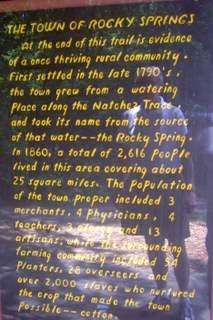
Early in the 19th century, there were homesteads settled that catered to travelers offering food and shelter - such as Dean's Stand. Towns were founded along the Trace - especially where there was potable water such as Rocky Springs. Drake is standing in the middle of the Sunken Trace which is actually park of the original Trace. You can see that it's just a pathway.
Then, there was Port Gibson - a port on the Mississippi Riveer where plantations could ship their cotton down to New Orleans eventually winding up as raw material in the new English textile factories. Port Gibson has the remnants of the kind of money and power that King Cotton can produce. There are beautiful churches and homes down the main drag.

We drove out into the countryside to see the columns of Windsor. These are all that is left of a 23 room mansion. They are the most photographed scene in Mississipp. The plantation mansion these were a part of was completed in 1860 - talk about timing, huh? It gets worse. The owner DIED 2 weeks after he finished building the mansion. By the looks of the place, you'd think the house was destroyed during the Civil War, but no, it survived the war - a cigarette on a pile of trash in 1890 destroyed it. These things are huge - see Drake for perspective. They are made out of brick with a stucco covering with an intricately carved top out of limestone. These pillars are the middle of the country, and the drive to get to them from Port Gibson was beautiful in that kudzu covered rural South way.

Port Gibson is a small town with a huge number of pre Civil War buildings. The Civil War legend is that Grant declared Port Gibson "too beautiful to burn". That's now the town's motto. The main street is called "Church Street" because of the large number of churches (and the oldest synagogue in Mississippi). The synagogue (see left) actually looks like a mosque! The Catholic Church is really special. (see right) It has blue windows which gives the interior a really eerie lighting effect. It had a very holy feeling. This church had wonderful paintings and sculptures which were exquisitely rendered.


Another place we saw today was Alcorn State University which has a chapel built in 1836. Alcorn State was formed in 1871 with the reconstruction state government buying an existing college and re-incorporating it as a black teacher's college. It is also the first black land grant college in the United States. The unusual thing is Alcorn State just pops up in the middle of rural Mississippi - it was amazing how big it was. I'm talking the middle of nowhere. There's an actual dairy on the campus as well as research facilities for food and plants. Anyway, the chapel is from the first college, and the stairs in the front are actually wrought iron with designs and flowers under the treads. It's one of the best examples of Greek Revival architecture in the United States.


We finished our day today with a trip to the double AA Mississippi Braves ballpark which just happens to be within 2 miles from our hotel. It's a really nice park except for the fact it was a sauna. UGH! How do people stand this climate? However, we toughed it out because it was also FIREWORKS NIGHT! Oh, Boy! You can see why I called this my favorite Mississippi day.


Today, though, was mostly about driving the Trace which I would recommend. It's a narrow ribbon of perfectly smooth highway with tall trees coming right up to the edge of the road. There are no trucks allowed on the Trace, and it possesses the utter beauty that only the deep South can produce in the heighth of summer - so tranquil, so verdant, so compelling. This was a walk back in time.

Thursday, June 24, 2010

Amazing!

Yesterday had to be a poster child for why Drake and I have turned our lives upside down and are pursuing a different existence. We actually had dinner with a pair of professional ballet dancers! YES! It was amazing. Mark Biocca and Victoria Lane Green are principals (that's the best in a company) with the Alberta Ballet in Canada. They are a couple who have been together for five years, and at some point, hope to have children and pursue teaching/coaching careers when their dancing days are over. My unquenchable curiousity and unstoppable friendliness got us acquainted with them. I saw them in the audience the day after they competed, and I went over to congratulate them on their performance. Gradually over the next week, we spoke to them more and more culminating in a dinner invitation before the performance last night. (Unfortunately, they didn't move up in the competition, but this was our gain - otherwise they wouldn't be free to mingle.)

We got to have the once in a lifetime experience of getting a small snapshot glance of what it is like to be a professional ballet dancer which in our humble opinion is a career that is the perfect marriage of art and athleticism. Here's a little background: Ms. Green (Lane), who just turned 27 and is in the peak of her career, left home at the age of 12 to train full time to dance professionally. She went to work as a professional dancer at the age of 15 after winning a 1st place in ballet in an important national student competition. Today, she feels like her family was really sold a bill of goods, and that if her own daughter wanted dance as a career that it would not be necessary for her to completely give up a major portion of her growing up years to it exclusively. (Ten years ago, the prevailing wisdom was that you couldn't really have a dance career unless you trained to the exclusion of everything else beginning at an impossibly young age - think Olympic gymnastics) Lane projects a demeanor and personality of someone far older than her years. She is contained, mature, and is obviously used to holding her own in the temperamental world of dance. She's a star in this world, and as with all genius this comes with a price.

I asked her how long she plans to dance, and her answer surprised me. She told me that she had PLANNED to stop dancing when she was 25, but she continues because not only is it what she knows, but there is a drive to dance - to create that you find in artists. That's what sets an artist apart from a hobbyist - you have to create. It's as if there's an innate drive inside you. She has been with four major companies - breaking in with the Boston Ballet, moving on to BalletMet which is an Ohio ballet company, and then traveling to England to work with the Leeds Ballet. She was invited 'back home' (she's a native Alberta, Canadian) by the Alberta Ballet's Artistic Director three years ago to dance principal roles.

One part of the price in the ballet dance biz is lack of roots - you can be dismissed or you can change companies and often, it's totally beyond your control. For instance, they own a house in Leeds, England, which they are currently renting. Another part of the price of this career choice is body damage. Lane has been fairly fortunate. She's only had one major surgery to correct a condition she described as 1000 times worse than shin splints. (It has something to do with the fascia pulling away from the bone in her legs.) She danced for several years without feeling below her knees - well, except for the pain. Then, there's her feet: she casually referred to her bunions and some other aches and pains. She admits there are some days when it is difficult to roll out of bed because of the aches and pains. However, none of this matters whenever you can create a role and perform it.

I asked her what is the most difficult thing for a ballerina to do. Her answer was: It depends on the dancer. Some dancers have incredible balance, while others have natural hyper flexibility, while still others have marvelous leaping ability. The trick is to make your weakest element indetectable from your strongest. Finally, there's this 'something' that all superior artists have. I've seen ballet for over 30 years. I've seen principal dancers that do everything completely correctly, and the performance no matter how difficult to perform, is just ho-hum. I've seen dancers come out of the corps (think chorus), and give a performance so electric that it crackles out to the audience who is swept away. Lane agreed that the best dances for her are the ones where she can marry her creativity and acting ability to her meticulously trained body. She's become very vocal about roles that she feels are not 'right' for her - either technically, or because she can't get into character. "Getting into character" is part of that indefinable something that happens on stage.

We have felt so privileged to spend time with Lane and Mark. It is inspiring to be in the presence of art, and to be in its presence when it's a person is just wonderful. Lane's maturity shows when she laughingly described herself as temperamental. What she really means is that she doesn't allow anyone to push her around. I asked for an example of when she is temperamental. She said that she really loses it when some choreographer comes in unprepared, to work with dancers who have spent several hours in classes, so their bodies are ready to work and then expects them to meekly sit around while the choreographer dithers. She feels this is not only disrespectful to her, but dangerous to her body. She and Mark both agreed that the irrationally temperamental artiste' is alive and well in the ballet world, but that behavior is only really tolerated in those dancers who can back up their antics with those electric performances that audiences crave.

That brings us to Mark. His story is totally different from Lane's. He is an Italian who speaks virtually perfect English with a Canadian accent. He didn't start dancing until he was a young teen, and then he stayed home commuting to a small studio 3 or 4 times a week that was a little over an hour from his home in Italy. He is magazine model handsome with jet black hair that curls slightly, and he's about 6 feet tall with an impossibly narrow waist and broad shoulders. He has muscles as only a male ballet dancer can have. He could even pick my fat ass up. When he started dancing, he actually hid that he was dancing from everyone - especially his schoolmates.

This is a time when male ballet dancer meant - hey, he's a homosexual; let's ridicule him, and if we feel like it, beat him up. Mark admits that he endured some of that taunting and ignorance when he was young. His eyes flared, and his voice got passionate saying how much he hated that attitude. Gradually, he let his closest friends in on his secret, and slowly they accepted his choice to dance. Again, we are talking about a drive to do something - a drive that you really can't control. I don't think Mark could have stopped dancing if he had wanted to. He still loves to dance with the passion of a child. While Lane seems serious and thoughtful, Mark seems quixotic and mercurial. He is so happy to be who he is and doing what he does. This is a man who is at peace with himself and his career. It's not a chore for him to go to work everyday. However, he has also paid a price for his dancing. He has had surgeries on both his ankles to remove bone spurs. Mark has had an advantage in his career - he's a large, talented male dancer. These are rather like left handed baseball pitchers who can throw heat with accuracy - there will always be an inquenchable demand for their talents. Men choosing dancing is slowly becoming somewhat more acceptable to the general public, thus more boys are going into the field and the natural advantage that Mark has experienced is slowing waning in the dance field.

The dance world has many pitfalls. The most glaring being injury. We saw something horrible while we've been here. A dancer stopped dancing abruptly during a performance and actually crawled off the stage. He partially tore his achilles tendon during the performance. That's a terrible injury for a dancer - waiting for healing, rehabbing, and still perhaps having to have devastating surgery. I also discussed with Lane the pitfall of eating disorders that the young girls are especially prone to. I'm convinced that one of the Chinese competitors is anorexic. I asked Lane who takes responsibility to approach a dancer who had fallen into an eating disorder. She told us that it was the company dance director's responsibility, but mostly no one wanted the responsibility though they are quick to dismiss you if you are 'too fat'. And, believe me, 'too fat' is very, very subjective. A surprising number of dancers, especially women, smoke to control weight. Lane feels fortunate that her directors likes the 'athletic look' which is something of a protection for her. She did say that the eating disorder problem really came to a head recently when a ballerina died of anorexia and her family sued the company and recovered millions in damages. It will probably take that kind of financial penalty for the dance world to start cleaning up the eating disorder mess that is rampant.

As a couple, they are contemplating their future - which after 5 years - is obviously going to be a joint one. Mark (being the competitor in the USA-IBC while Lane was his non-competing partner - she was one month too old) admitted to being really upset when they didn't move on in the competition especially when they got such positive feedback from all sides after the performance. I think they were both calculating that a strong showing at the IBC would give them some negotiating power when contract renewal time came around. However, Mark's attitude is what it takes to make it in a subjective world: Disappointments just make you stronger. Perservere and all will be well. Don't stand still licking your wounds, but move forward - who knows what will be around the corner. I think that "you can't get me down" approach is another element that makes any artist successful. These two people are stars. They have achieved the top 1% in their chosen field. Think of all the child dancers who take ballet, and then the ones who are 'good', and then the ones of those who are willing to work and sacrifice, and the fewer still who continue to work and sacrifice when it is swimming against the tide of 'what everybody else does with his/her life'. You begin to get a glimpse of where Lane and Mark are sitting. It's a pretty lofty place. Perhaps put in that perspective, you can understand why we were so thrilled and felt so honored that they would chose to spend some time with us giving us an insider's look at a world that we have marveled at for so long.

Spending time with these two dancers has made this competition all the more special. It's one of the many reasons why we have not been 'let down' by our hotly anticipated attendance for 16 days in Jackson, Mississippi to see world class ballet dance. Every time we have one of these experiences, we feel validated by our choices to change our lives. I have to go now. I have to pick the medal winners, so far, there's still one more group to dance tonight. Perhaps the judges might need a little input, who knows?

Tuesday, June 22, 2010

A Visit to 1863

Yesterday, we visited Vicksburg. Vicksburg, Mississippi has the distinction of being the site of the battle that most historians attribute to being the beginning of the end for the South during the Civil War. After Vicksburg was taken by U.S. Grant, Commander of the Tennessee Army, the South had no tactical chance to win the war. The reason, of course, was that Vicksburg, sitting on high bluffs, controlled what moved up and down the Mississippi River. It was the supply artery of the Southern Army.

This battle was fought from mid May until July 4th 1863 when General Pemberton, Confederate Commander at Vicksburg, surrendered to Grant. He was not defeated, so much as starved out. As it was, 20,000 soldiers died at Vicksburg - mostly Union troops. There are 17,000 of them buried in the cemetery that is part of the national park commemorating and explaining the battle. (13,000 of those buried are in nameless graves - I guess the result of having to get bodies underground ASAP in the wicked heat.)

Our visit coincides with the 147th anniversary of the battle, and we watched a troop of re-enactors load and fire a small artillery piece. I'm sure this must have looked like a great summer job in November, but in the June heat, this guy was sweating profusely in his authentic butternut uniform. They actually primed and fired this piece of artillery, and it was LOUD. As you do the driving tour of the park, there are hundreds of artillery implacements. It wasn't hard to imagine the soldiers eating, sleeping and firing their artillery pieces day and night. The Union Army rained cannon balls not only on the soldiers, but also right into Vicksburg driving the remaining civilian population to dig underground caves and live in them most of the time except when venturing out to forage for food and water. The Confederates, from the high ground, rained cannon balls down on the Union troops forcing them into trenches. Union soldiers (after the first disasterous charges) fought with shovels as much as with guns as they dug trenches, build gun implacements, and tried tunneling under the Confederate lines.

There are intricate lines of trenches in zig-zag patterns (for less damage from the pesky cannon balls) that are still visible today 147 years later. You can see the earthen hills built with the soil dug out of the trenches that gun implacements sat on. And there are monuments everywhere. It's hard to imagine how close the front lines were in this battle until you see the map and drive down the Union lines, turn about 200 yards and drive up the Confederate lines. The small lighted area in the map shows the site of the battle. In some places the battle lines were 15 feet apart. Not only were cannon balls raining down, there were sharp shooters from both sides picking off unlucky soldiers who showed their heads at just the wrong moment. And, of course, the great killer on both sides - sickness including maleria and dysentery. The Confederates also had to contend with hunger. Grant realized after two disasterous 'charges' (read slaughter) that he wasn't simply going to be able to overrun the Vicksburg fortifications. He settled down into a siege, and that ultimately won the day.


As you drive the battle lines, there are approximately 1300 monuments from at least 20 states that were represented in this battle. Some of the prominent are Illinois, Indiana, Wisconsin, Minnesota, Mississippi, Louisiana, Alabama and Texas. The monuments are plaques, busts, bronze statues, obelisks, and even temples to the dead. Vicksburg has other distinctions - this is the first battle the Union used African American troops who fought so fiercely they gained the respect of the Southerners fighting against them. Vicksburg also became the model for re-construction - freeing the slaves, creating a freed black police force to patrol the city, curtailing the rights of white southerners, and sending freed slaves back to the fields earning a wage - thus foretelling the share crop system of Southern agriculture that persisted until well into the 1950's.
This battle now seems not so much awe inspiring as tragic. It's a sad place still. So many graves. The battle plan is easily understandable, so the focus, thanks to all the monuments with so many names, centers on the soldiers (both sides) who died here. Many died because commanders used 18th century battle tactics against vastly improved artillery. Beginning with the Civil War, thanks to the growing industrialization, cannons were in all sizes, made of superior material that could fire longer and more rapidly and much more accurately. Lines of infantry charging/marching toward a fortified position were cannon fodder.
This is a place that makes the reality of the Civil War come alive. It reminded me of the cost of war, no matter the glorious cause - and both sides in any war always fight on the intellectual plane for a glorious cause - and the immense sacrifice. As I passed by the thousands of names, I could picture the parents, the sweethearts, the siblings who just knew their boy was dead - and buried 'somewhere'. Vicksburg is also a living picture that the cost of war is not only in lives, but there is a terrible cost to the land. This tree was the most striking example of the damage that cannon balls do to the landscape. This is definitely a 'must visit' place. It's rich in history, beauty, tragedy, heroism, sacrifice, and provokes thoughtful reflection on what being 'at war' really means not only to the soldiers who fight it, but to a society.


Saturday, June 19, 2010

Artists, Artists Everywhere!

Today I went to the most fascinating place: The Mississippi Crafts Center. It's a wonderful building filled with art by all types of Mississippi craftspeople. The outside lawn has many whimsical outdoor sculptures. The interior has a shop filled with incredibly beautiful handmade items. Think pottery, wood, furniture, jewelry, weaving, quilts, baskets, and decorative items. I'm a sucker for handmade, hand crafted and imaginative items. For instance, how about using all those empty wine and whiskey bottles?

One of the highlights of the day was getting to meet several of the artists who were doing demonstrations of their art. First, was Max Goodman of Ogre Forge who makes the most amazing handforged knifes. He takes a raw piece of metal and turns it into a large hunting knife with an exotic wood handle and a handwoven leather scabbard. He was in the outdoor area - like a big garage, but three of the walls were windows. He had a small forge there and all sorts of blacksmithing tools. He gave us an interesting talk about the chemistry of forging steel. It's quite complicated and the chemistry is very precise. Forging is not trial and error anymore. Mr. Goodman is a retired geologist.

Then, there was the German Baptist basket maker. At first, because of her clothing, I thought she was Amish, so I just asked and found out she was German Baptist - obviously, not a Southern Baptist. This community migrated to Mississippi sometime in the 19th century, and the traditions are still alive - witness her dress and the cap covering her hair. She's a basketmaker, and she actually finished this basket in the time that we were here. You can see the stainless steel staircase and glass walls of the Center behind her. This is a place to work and to teach. The Center, which is on the Natchez Trace just north of Jackson, runs summer programs and is a galley offering the works of 0ver 400 members of its Craftsmen Guild.

Without a doubt, the most cutting edge art we saw was an artist making clocks using material and ideas from the past four centuries. First, personal clocks date back from the 18th century. This is when it really became possible for ordinary people to own a clock as a decorative item in their home. Larry L. Smith, the artist, makes clocks using a compilation of materials. He begins with 19th century weathered wood in blocks or cut into 18" long pieces of 2x4. He mounts computer mother boards and disc drives as well as 20th century vacuum tubes from radios and televisions onto the wood. The 21st century computer detritus is what he mounts the clock works and hands on. He actually buys antique wood to use. He's branching out from weathered fence posts and barn wood and has just bought the wood interior of an old elevator from New York City. He has friends that are really happy to give him their old computers which he salvages for parts. In the gift shop, there is a killer grandfather clock he has created. He confided it was the grandfather clock that got him into the Craftsmen's Guild. I can see why; it's spectacular. He calls what he does PC Art. Imagine 18th century personal clock, 19th century wood, 20th century vacuum tubes, and 21st century computer disc drives and motherboards. I'm so sorry the picture didn't come out; technology, what can you say?

Another demonstator was making chainmail. Martha Scarborough has learned the medieval technique of making chainmail - the shirts knights wore to repel knives, swords, and pikes. (That's why the longbow was such an awesome weapon - fired from afar, it could pierce chain mail.) Nowadays, there's not too much call for chainmail armor, so she is using chainmail techniques with silver, copper and gold wire to create jewlry. There are formal patterns (turkish, celtic, etc.) that she uses to make her jewlry. I asked her how she got started, and she confided that she went to a craft school with some girlfriends, and the silver working class was full but the wire class was open! An artist was born.

I think overall each of the artists that I spoke with came to art late in life. They don't have fine arts degrees. They all have 'day jobs' - actually careers, and they pursue their art in their spare time as a passion they can not deny. I can identify with that drive to create which drives my embroidery work.
The drive to create can be all consuming, but most artists don't have the luxury to create on a full time basis. That's the real beauty of the Mississippi Crafts Center - it's a showcase for art that sometimes only finds a home at local craft fairs or church bazaars. The Center legitimizes this type of artwork. The venue is really great - spacious, full of cases, shelves, hanging space, and light. You wander from one beautiful item to another. Some are lyrical, some are whimsical, some are functional. All have that creative spark of artwork. Drake has faithfully promised that when we come back for the next ballet competition (yes, we are having that great of a time - you should have seen the contemporary stuff last night) that I can shop the Craft Center for decorative items to furnish our house when we re-settle. Now, because of our tight space and weight requirements, I only got a handmade ceramic magnolia magnet (my Mississsippi magnet), and SOMEONE who reads this blog got a gift from this wonderful place.

Wednesday, June 16, 2010

Coming to the end of Round I (or the 'two a days' as I like to call them), we will have seen 103 dancers perform. It's still a mystery how many competitors will get to move on to the second round - that number is a closely guarded secret, or more likely, a fixed number is not desirable because it hems in the judges. Without a fixed number moving onto Round II, they can be more flexible in including competitors they want to reward.


This next section of this blog will make much more sense and be much more fun if you read everything in quotations marks with a soft, dripping, southern accent. Be sure to end each quotation as if you've asked a question. Southern people's voices always go up in octave at the end of each conversational pod. It's a conversational technique that keeps things flowing.


I've heard so much artful small talk this week that it's a lesson in itself. Almost every encounter overheard includes a reference to the weather, to family, to the competition, all tinged with a bit of gossip - not malicious - more like, "Did you hear that Mary Lou may have to have her fingernails removed? Lord, I hope she will be Ok." Then there are formal goodbyes - along the line, of "It's been so good to see you all." (You all is singular or plural, remember). "We have to get together soon." with the alternative closing of: "You tell your sweet _________ hello for me." The blank is usually a family member in the same generation as the person who initiated the goodbye ritual. Younger people use Yes, Ma'm and "No Sir" routinely during these encounters. Little old ladies are particularly good at this exchange, but men also excell at it. I saw a group of three ladies stand directly in front of the interior door into the Ladies Room and carry on like this for at least 2 minutes. It never occurred to them they were blocking the door. No wonder people from elsewhere pull out their hair. These people have all the time in the world to practice the art of civility. Watching all of this makes me realize how isolationistic we heathens have become.


Much more interesting are the people we have been directly meeting. By far the most surprising are the country couple from Cleveland, Mississippi - "You, know, we live on the Delta" was how the woman introduced herself in the kind of an accent you could spoon over ice cream. She cooks lunch everyday (still) for six people including her husband, her children and some grandchildren. "They just like my cookin', and this way they don't eat that fast food." You would not pick this couple out of a line-up as people coming to every performance. I do find it amusing that they eat at the same restaurant between the performances every day. When I inquired why they didn't try new places, her reply was: "I just like it; it's the food I make, but with a twist." The restaurant they like is in the museum, and she confided that they are slowly making their way around the place, a little bit at a time.


They are also rating the dancers (as we are), and we have been having some lively discussions about what we like/don't like about what we see. I think we've been too lenien't in awarding our *'s - which indicates we think they will move forward. All our favorites are not going to make it to Round II. We have been having fun doing this, though. The group of us Mezzaniners who all visit among one another quip that we are going to be sending down our recommendations to the judges.


Our evening seatmates are a couple of native Jacksonians who have been generous with their restaurant recommendations as well as suggesting things we can do in the area. Alec in particular is very interesting. He's an English professor at the local junior college. He volunteers as a docent at the Eudora Welty house (yes, this is her home town), and from what he has let drop has his finger in many cultural activities in Jackson. His wife, Kay, is very friendly. I do get the feeling she still works full time, and this competition (coming every night to performances) is wearing her out. She left early last time pleading tiredness.


Many other people are now recognizing us and speaking to us when they see us. It's fascinating how people will form themselves into a group simply based on propinquity. You can see it happen everywhere - especially when people seat themselves in the same place over and over again. (Think church, classrooms, work cubicles, meetings and auditoriums!) By the time we leave here, I'll bet I will have added another few readers to this blog. I wonder how much more I will know about these individual people before I leave. That's interesting in itself. I'm sure this talent, curse, ability, whatever you can call it, will rear up and folks will start telling me all sorts of things.

Monday, June 14, 2010

Here's Jackson!

We've now seen one-half of the 112 dancers who are the competitors of the USA International Ballet Competition. It is an honor just to be a competitor since the selection is so rigorous. This experience was a 20 year dream, and I was initially worried that we would have built up such high anticipation that the actual competition would be a let-down. Happily, it's been just the opposite. So far this has been more fun than the anticipation. In addition to seeing wonderful dancers, we are developing a little mezzanine community of people who, like us, have the time and desire to come to ALL the performances including the 'two a days' we are doing now.

We go to see dance performance at 2 pm and 7 pm EVERY day. That doesn't leave a lot of time for anything else. We leave at 1 pm and get back to our home away from home (extended stay hotel) about 10 pm. We are eating in some really new interesting restaurants. One surprise is that there was a pretty substantial group of Lebanese who settled here, and you can see their stamp in the restaurants here. We ate at a terrific place (Aladdin's) yesterday. Today we went to the Mayflower Cafe - a downtown landmark for over 75 years. I think it opened in the 1920's.

Everyone (whether black or white) has been extremely friendly and welcoming as only the Deep South is. Good news is that there seems to be a lot less racial tension than there was 20 years ago. These people also have the most amazing accent. It's so thick at times that we have to pay really close attention to understand them! We are sitting right across from a couple form Cleveland, Mississippi - deep in the heart of the Delta - (exactly what they said!) They are taking a pause and going home on Thursday, so the husband can "check in on his recliner" - no lie, that's what she (the wife) said. The four of us are rating the dancers, and we keep joking that we'll be glad to send our consensus down to the judges. It will be interesting to see how well we do when the competitors are judged. The couple sitting next to us are native Jacksonians who rattled off 10 restaurants to try when we asked for recommendations.

This is really a lot of fun. We have seen some amazing young dancers from as far away as Mongolia! (The one competitor from Mongolia wore the same costume for both of his solos today. I got the feeling from his response to the audience that he's never performed before so many people before.) Overall, the Japanese competitors are extremely well trained and a joy to watch. There are also a large number of wonderful American dancers of all different ethnicities. Next week starts Round II which Drake estimates will be only 3/8ths of the total competitors. That's about 40 dancers that will move on.

On a sad note. Jackson is filled with wonderful architecture, and should be a delightful place to live. However, we went to the main downtown public library today, and it was really sad. Obviously, they are seriously underfunded. The Bastrop, Texas library was more up to date and better funded per capita than this library. For instance, their audio book collection is ALL beat up cassettes - almost no CD books, and no MP3 books. Their "new book" section was just pathetic. Apparently, race is still dictating. There's 'white flight' going on - moving out to the suburbs, leaving Jackson economically strapped - then along comes the recession. I've talked to several people, and everywhere else in the country people are moving back to their city - here, whites are still fleeing a wonderfully livable city because they might have to live by black people. On the positive note, there is some racial mixing that I never saw 20 years ago. So even Mississippi is changing.

The weather is dreadful. Just as hot, humid and miserable as I expected. Washington is going to feel great after this climate. Stay tuned for more dancing updates - I'm sure you'all just can't wait.

Saturday, June 12, 2010

Now, for some Ballet - READ THIS YOU PHILISTINE!

We made it to Jackson. Today was the Opening Gala Performance of the USA International Ballet Competition. This was a half/half deal. The first half was a lot of speeches thanking everyone in Jackson who makes this possible. This competition comes to Jackson every 4 years. The moving force that made this happen was Thalia Mara - a famous ballet professional and teacher who was lured to Jackson from New York. She was the determined person who made this competition a United States presence in the ballet competition world. She made this competition happen in Jackson beginning in 1979 - and it's happened every 4 years since then. Most dancers consider the Jackson venue to be the premier dance competition in the world - similar to what Cliburn is for piano. Tonight was spent doing atta boys, and kowtowing to the sponsors who give bucks, plus they had a nice little quasi olympic type opening complete with flag procession of dancers and a torch being lit.

For anyone reading who doesn't know. Drake and I were in Jackson 20 years ago. Drake came up on a Saturday night to pick me up after I had spent a week with my brother at his first rehabilitation attempt. Looking for something to do, we discovered this 'ballet thing'. We just walked over to the theater, and scored a pair of 'will call' tickets that hadn't been picked up. We were blown away by the quality of the dance, and we promised ourselves that when we retired, we would return for the entire competition. I was beginning to have some doubts that we had done the right thing, until after the intermission tonight.........

The second half of tonight's "Gala" was actual dancing by an invited dance company called "The Bad Boys of Dance". They were an amazing company of 6 men and one woman. The artistic director (lead dancer) and his wife (the one woman), who is the choreographer/assistant artistic director both won gold medals in Jackson. (FYI - She's doing all this while also having had a baby - she brought out their 3 year old daughter during the final curtain call.)

The electrifing performance and innovative choreography was set to rock and roll/early hip hop music (think Queen). The men danced with power, grace, and athleticism, and the entire performance was an overwhelming assault to the eyes and the ears. Let's just say, I would pay really good money to see the "Bad Boys" perform again. I kept thinking that this is the performance I would choose to take someone to see who "doesn't like ballet".

After tonight, we get SERIOUS. Young dancers have sent audition tapes to a committee of selectors. The selectors cull the field down to 100 dancers from all over the world - well, 31 countries, and the 100 compete through 3 elimination rounds. Tomorrow, Round 1 begins. At 2 pm there will be 10 performances, an intermission, and 10 more performances. Same deal repeats at 7:30 pm tomorrow night. WOW. It's going to be amazing. Any kind of a medal here makes a dancer's career. Just being a competitor gets you exposure to artistic directors from ballet companies all over the world. They arrive in Jackson with blank dance contracts, and most of the competitors leave with their names on those contracts. That means for a young dancer that they get to make a living at what they love to do, and what they've trained many hours for from about age 5 on.

Other fun today - Martha Priska met us in McComb, Mississippi and we had lunch (really dinner) at The Dinner Bell - a boarding house style restaurant, complete with the giant table seating 15 people (as if this was a boarding house) with a turntable that revolves around the center area of the table. On the turntable is: fried chicken, ribs, sausage, fried eggplant, dumplings, corn, lima beans, green beans, mashed potatoes, squash casserole.......and MORE. Fun and FILLING. The food was excellent like good southern home cooking can be. We talked non-stop with Martha for 3 hours. We ended up at McDonald's - less crowded and more conducive to visiting where we tried McDonald's version of the Starbucks Frappucino - and FYI - they taste exactly the same for 1/2 the price. Thanks, Martha, for doing the heavy driving. She came almost 2 times farther than we had to drive.

We are settled in. The extended stay hotel is new. Beds are great, towels and shower are good. We've even made the run to the grocery store.

Stay tuned. We're still having fun. AND WE ARE PUMPED ABOUT THE BALLET!!